
Livraison le jour même ou le lendemain

Qualité garantie

Débloquez vos offres de bienvenue: Livraison GRATUITE | Jusqu'à -80 % | 30 jours d'essai gratuits à JoyPlus
Téléchargez l'application
Choosing the right cat tree is often a real challenge. Caught between promises of absolute comfort and appealing designs, it's easy to end up with a disappointing product, or even one that's dangerous for your four-legged companion. Too many cat trees that look perfect in photos reveal their weaknesses after just a few weeks: chronic instability, crumbling materials, and unsuitable dimensions.
To avoid buyer's remorse, it's essential to know the most common pitfalls. The goal: to invest in a model that will truly satisfy your feline and earn a lasting place in your home.
To avoid these setbacks, rely on technical and objective criteria. These are the true guarantees of the quality and longevity of your future cat tree.
The golden rule for a stable cat tree is simple: its base must be wide and heavy enough to counterbalance the structure's height and your cat's energy. For a model over 1.50?m tall, aim for a base of at least 50?x?50?cm and a total weight exceeding 15?kg. Models with a solid wood cat tree structure or dense fibreboard (like MDF) offer a much better guarantee of stability than those made of simple particleboard.
The scratching post function is at the heart of the cat tree. Examine the thickness of the sisal rope wrapped around the posts. A sisal of 6?mm in diameter or more will withstand your cat's repeated assaults for much longer. The structure itself should be made of wood panels (MDF, high-density particleboard) or, for the ultimate in durability, solid wood. Also, remember to check the quality of the hardware and the density of the fabric.
The size of the tree should match your pet's size and your living space.
Here is a selection of models that cater to different user profiles, taking into account the criteria of stability, materials, and configuration.
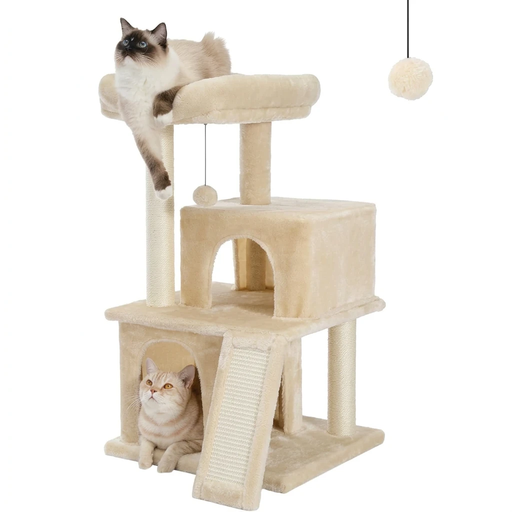
Why we recommend it: Perfect for apartments or as a first cat tree, its 90 cm height and compact base (49 x 44 cm) optimise vertical space without cluttering the floor. It offers several areas for rest and play, ideal for one or two medium-sized cats.
Its base is well-proportioned to its height, ensuring good stability for cats up to 5 kg. This effectively manages the risk of tipping over.
Versatility in a compact design: it combines a den, a lounger, and a top-level perch. Bonus: the bed's cover is removable and washable, a real plus for hygiene.
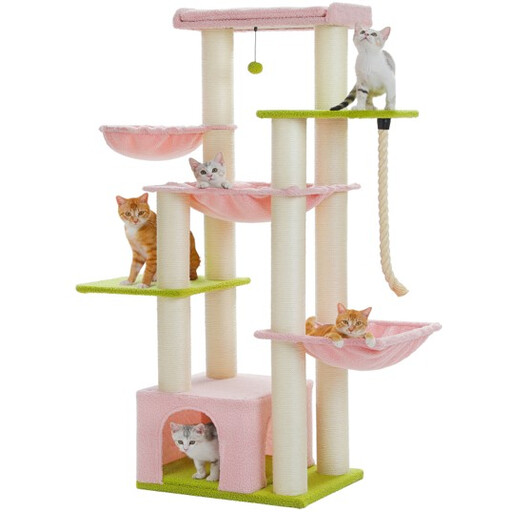
Why we recommend it: Designed for households with multiple cats or large breeds, this 170 cm tree is a true 7-level amusement park. It features multiple hammocks, platforms, and a large den.
Its 24 kg weight and 13 posts, each 11 cm in diameter, guarantee rock-solid sturdiness and stability, even against the most energetic assaults from an entire tribe.
An XXL structure designed for heavy use, with ultra-thick sisal posts and spacious rest areas featuring washable cushions.
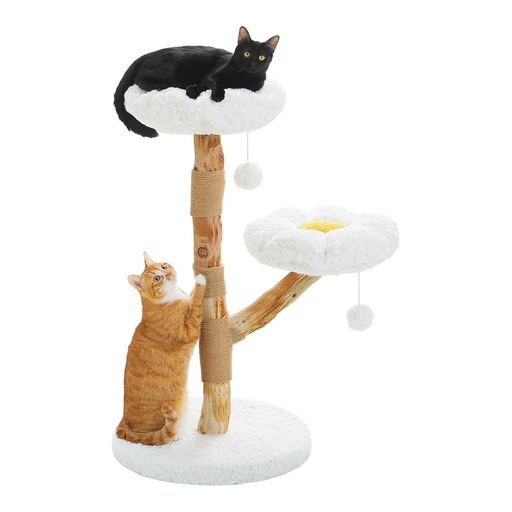
Why we recommend it: For those who refuse to choose between aesthetics and animal welfare, this tree combines a natural wood structure with a beautiful floral design. It integrates like a true piece of decorative furniture while remaining perfectly functional, even for large cats.
Its solid wood base is double-reinforced for maximum stability. This counters the risk of tipping, a common flaw in designer models that are often too lightweight.
The perfect blend of a robust natural solid wood structure and a meticulous design, with its soft, flower-shaped velvet perches.
Discover our complete selection of products that meet our strictest quality and safety standards.
Once the tree is assembled, place it on a flat, stable surface. Apply firm pressure to the top to simulate a cat jumping on it; it should not wobble dangerously. For the tallest models, manufacturers often provide a wall anchor strap. This is an additional safety measure that should not be overlooked for complete peace of mind.
It all depends on the quality of the materials and how your cats use it. A budget model with thin sisal will hardly last more than a year. Conversely, a quality tree with solid wood posts and thick sisal can last over five years. Good to know: on some models, the scratching posts are replaceable, which significantly extends the life of the structure.
The answer is an unequivocal yes. A solid wood cat tree offers a heavier structure that is more resistant to wear and moisture than standard particleboard. The wood does not crumble and maintains its rigidity over the years. The initial investment is higher, but it often pays for itself in the long run, especially if you have very active or large cats.