
Livraison le jour même ou le lendemain

Qualité garantie

Débloquez vos offres de bienvenue: Livraison GRATUITE | Jusqu'à -80 % | 30 jours d'essai gratuits à JoyPlus
Téléchargez l'application
Is your sofa bearing the brunt of your cat's claws? Are they bored and treating your shelves like a personal climbing frame? A cat tree is not just an accessory; it's an essential territory for their well-being. It serves as their vertical playground, their dedicated scratching post for claw maintenance, and a high-up observation deck where they feel safe and secure.
Navigating the jungle of available models can be overwhelming. Our mission is to help you see things more clearly. This guide breaks down the essential criteria and presents a curated selection of products to help you make the right choice, cutting through the marketing noise.
Before we dive into our top picks, let's review the key factors in finding the perfect cat furniture that will delight your companion and complement your home.
The first question is simple: how big is your cat? A small cat tree might be sufficient for a kitten or a small-breed cat, but a Maine Coon will need a cat tree for large cats, or even an XXL model.
Stability is a critical factor—it's a matter of safety. A stable cat tree relies on a wide, heavy base, which is essential to prevent it from tipping over when your cat leaps or climbs with enthusiasm. For the tallest models, a wall-mounting kit is often included. Using it is highly recommended for maximum safety, especially if you have several cats in a multi-cat household.
A good cat tree is multifunctional. Natural sisal posts are a must-have: they serve as a scratching tower and will (finally!) spare your furniture.
Observe your companion's habits:
The quality of the materials (wood, fabric, sisal) is also a guarantee of durability and safety for your pet.
The era of bulky and frankly ugly cat trees is over. Today, many models with a sleek design blend seamlessly into your decor. Neutral colours (beige, charcoal grey) and clean lines allow the tree to become a piece of furniture in its own right, whether in the living room or the bedroom.
To help you choose, here are three models that stand out for their design, features, and suitability for different needs.
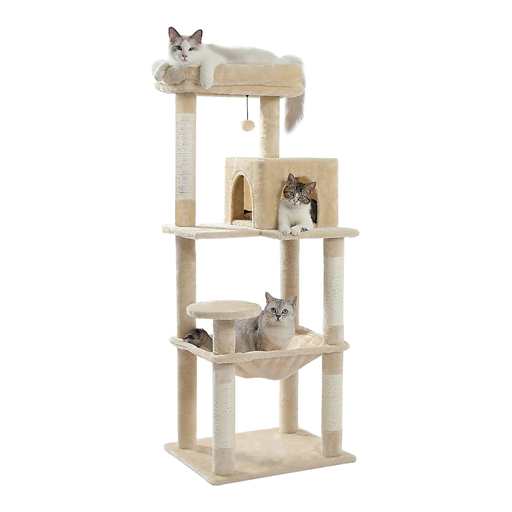
Why it stands out: An excellent balance between a compact footprint and a wealth of activities, this mid-sized model has it all. Its six-level structure provides multiple spaces for play and rest. We love its unique hammock, mounted on a metal frame for extra stability and comfort. The dual-entry condo is perfect for feeling secure while keeping an eye on the surroundings.
Key features:
Who is it for? A versatile option, ideal for households with one or more small to medium-sized cats. It's a complete activity centre that maintains a small footprint.

Why it stands out: At 206 cm tall, this cat tower is a climber's paradise. This large-format model meets the needs of the most active cats and multi-cat households. It features no fewer than 13 scratching posts, two condos, a basket, a hammock, and multiple platforms, offering a myriad of zones for play and napping. Its sturdiness is confirmed by a static load capacity of 75 kg.
Key features:
Who is it for? Designed for very active cats, natural-born climbers, and families with multiple felines, including large breeds. It requires some space but offers an unparalleled playground and resting area in return.
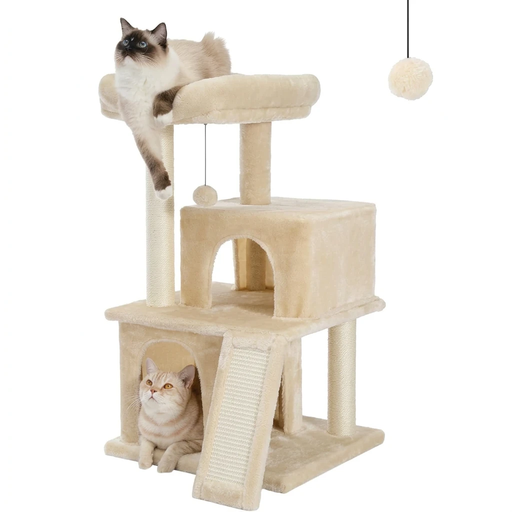
Why it stands out: This small cat tree proves you can offer a fantastic playground even in a limited space. At 90 cm tall with a compact base, it fits in anywhere, making it ideal for an apartment. It's no less complete, featuring multiple scratching surfaces, a top perch, a condo, and a hammock.
Key features:
Who is it for? Perfect for kittens or small cats living in an apartment. It's an excellent first purchase or the ideal solution for those looking to optimise their space without sacrificing their companion's well-being.
Every cat is unique, and so is every home. If these three models don't check all your boxes (size, style, budget), don't worry—other solutions are available.
To explore a wider range of models, feel free to browse our complete collection.
Discover our selection of affordable cat scratching trees
The ideal height depends on your cat's age, size, and temperament. A kitten or a less mobile senior cat will be happy with a model under 100 cm. Conversely, an active adult cat who loves to climb will adore a tall cat tree (over 150 cm) to survey their territory. The key is that the tree should offer at least one perch that is higher than the furniture in your living room.
The introduction should be gradual. Place the tree in a living area where your cat spends a lot of time. To entice them, place their favourite toys on it, leave a few treats on the platforms, or rub some catnip on the posts. Praise and reward them as soon as they start exploring it. Most importantly, never force them: let them claim this new territory at their own pace.
Absolutely. In fact, it's essential. For an indoor cat, a cat tree recreates a stimulating vertical environment. It allows them to satisfy their instinctual needs: climbing, scratching, hiding, and observing. It is a pillar of their physical and mental well-being, crucial for preventing boredom, stress, and destructive behaviours (goodbye, shredded sofa!).