
Livraison le jour même ou le lendemain

Qualité garantie

Débloquez vos offres de bienvenue: Livraison GRATUITE | Jusqu'à -80 % | 30 jours d'essai gratuits à JoyPlus
Téléchargez l'application
A cat tree can combine several functions in one space: climbing, watching, sleeping, hiding, playing and scratching. But a poorly chosen model risks cluttering the room without being used, or even wobbling at the slightest jump onto a platform.
Before comparing models, it's best to look beyond the marketing claims and examine some very concrete points: dimensions, materials, maintenance and suitability for the number of cats that will use it.
A very tall climbing tower may appeal to an active cat, but it also puts more strain on its base. If the structure is too narrow or poorly balanced, it may move when your cat leaps from one level to another.
Make sure to check:
In a flat, a vertical cat tree saves floor space. However, it must be placed on a flat, clear surface, far enough away from furniture that could serve as a landing point.
Plush fabrics easily trap fur, dust and small marks. With several cats, a non-removable cushion quickly becomes a chore to clean.
Choose a removable, washable cushion, along with surfaces that are easy to reach with a vacuum cleaner or lint roller. Maintenance should stay simple: regular cleaning directly helps preserve the hygiene and appeal of the structure.
A scratching post located on only one part of the tree may be ignored if your cat prefers to scratch near its resting spot or along its usual route. Several sisal posts, spread across different levels, give your cat more options.
The sisal should be properly wound and thick enough to withstand repeated scratching. That doesn't guarantee an unlimited lifespan, though: regularly check for frayed areas and inspect the fixings.
For a large cat, a narrow platform can restrict movement and discourage them from settling there. A surface of 50 × 30 cm or 60 × 40 cm, depending on the model, will give them more room to stretch out comfortably.
For a cat tree for multiple cats, look for a layout with separate zones:
The number of sleeping spots alone doesn't guarantee peaceful cohabitation. Each cat must be able to reach a resting area without being constantly disturbed.
Kittens and adult cats generally enjoy vertical routes. An older cat, however, will often need closer, easier-to-reach levels. Platforms should be arranged to allow a gradual climb, without requiring overly large jumps.
An XXL cat tree over two metres tall is best suited to rooms with sufficient ceiling height. Also measure the space around the structure to keep a safe walkway.
A stable structure relies on a sufficiently wide base and properly tightened joints. Models with several sisal posts offer more scratching options, but the screws still need checking after assembly and over time.
Before buying, also check:
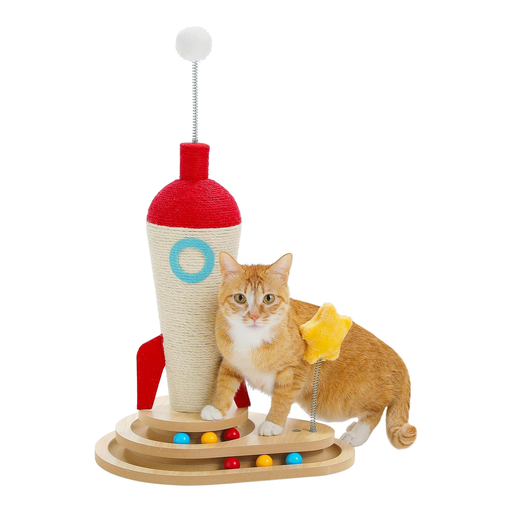
Why this choice suits this profile: At 63 cm high, this model is ideal for a first setup or a small home, where the main aim is to offer a scratching post and some extra activity.
No need for great height to vary activities: a sisal post, ball track and feather wand are combined in a compact structure.
Stated dimensions: 40 × 30 × 63 cm, wooden base and battery-free play elements.
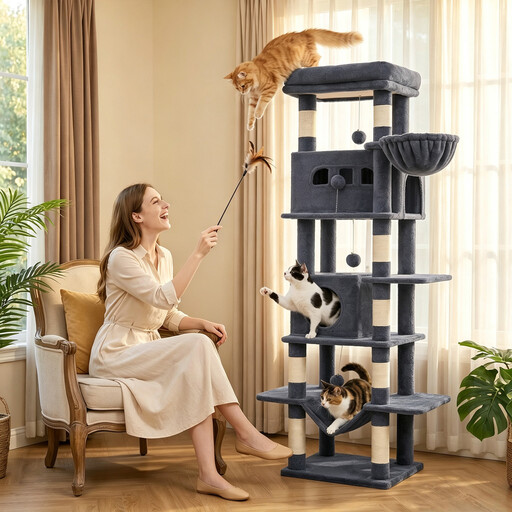
Why this choice suits this profile: This vertical structure is aimed at homes with a room that has good ceiling height and who want to multiply the resting and scratching spaces.
The reinforced base and anti-tip device stated on the product page limit the risk of movement, provided assembly is done correctly.
Height of 212.5 cm, 8 sisal posts, two cubby holes, a hammock and a basket; platform stated at 60 × 40 cm.
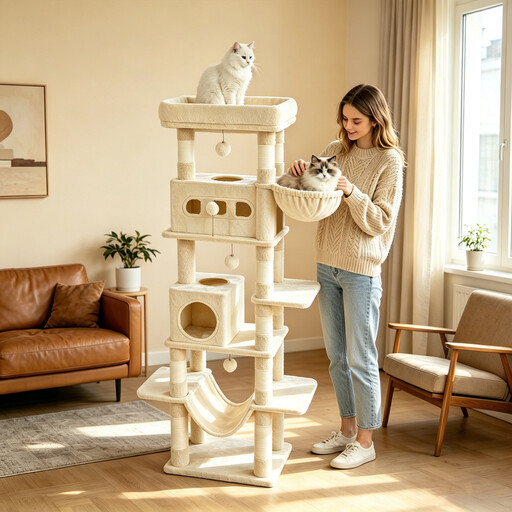
Why this choice suits this profile: Its six levels and various spaces suit homes with several cats or animals that use their climbing tower very regularly.
The spaces are spread across two cubby holes, a hammock, a basket and a large platform, rather than being concentrated around a single sleeping spot.
Six levels, 8 sisal posts and a 50 × 30 cm platform with a removable, washable cushion.
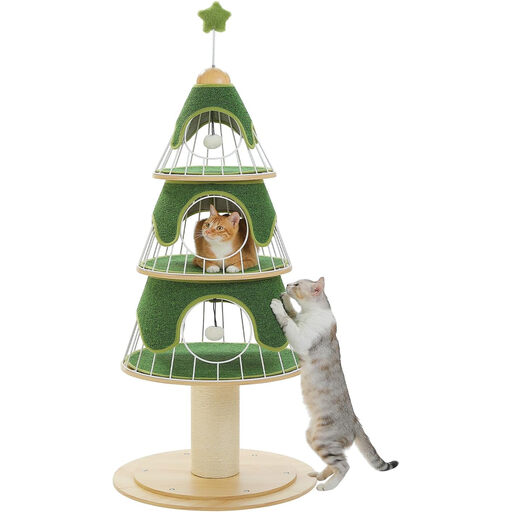
Why this choice suits this profile: Its Christmas tree silhouette fits into seasonal décor while still offering real resting and scratching spaces.
Its stated base of 60 × 60 cm is wider than that of many decorative models. Assembly and checking the fixings are still essential, though.
Height of 130 cm, three levels, three cubby holes and central posts stated at 12.5 cm in diameter.
We've put together a complete, up-to-date selection of products that meet these demanding criteria and the applicable European safety regulations.
Place the cat tree in a spot where your pet already tends to move around, for example near a window or in a living area, without blocking walkways. Avoid slippery floors and make sure no platform risks hitting a fragile object.
After assembly:
An interactive cat toy can complement the tree, but hanging elements should be inspected frequently. It's better to remove a damaged piece immediately than to leave it within your pet's reach.
A spot near a window, in a room where the family spends time, often works better than an isolated corner. However, leave enough distance from radiators, cables and fragile objects.
It depends on how often it's used, the weight of your cats, the quality of the joints and the maintenance. Sisal and fabrics are wear items. Regular checks help you spot parts that need replacing and fixings that need tightening.
Not necessarily. Instead, compare the available surface area, the number of platforms, the width of the base and your cats' habits. Two calm animals can easily share a compact model, while active or large cats will be more comfortable on a taller, better-compartmentalised structure.