
Livraison le jour même ou le lendemain

Qualité garantie

Débloquez vos offres de bienvenue: Livraison GRATUITE | Jusqu'à -80 % | 30 jours d'essai gratuits à JoyPlus
Téléchargez l'application
A cat tree can combine several functions in one piece of furniture: climbing, observing, sleeping and scratching. But just because a model is imposing doesn't mean it will necessarily suit your home or your cats. A base that's too narrow, shallow platforms or posts that wear out quickly can turn an appealing purchase into a cumbersome piece of furniture.
Here are the key criteria to consider before choosing an XXL cat tree, a compact tower or a model designed for multiple pets.
A great height naturally attracts attention, but it also increases the strain on the base when your cat jumps or comes down quickly. For a large cat tree, check the floor dimensions, the weight of the structure and whether it has an anti-tip device.
Any model over 190 cm should generally be placed on a flat surface and, when the manufacturer recommends it, fixed to the wall with the kit provided. This precaution is particularly important in flats, where the lack of space can increase the risk of tipping.
A multi-level cat tree may boast five or six tiers, but that doesn't mean every platform is actually comfortable or easily accessible. Be sure to check:
A large perch measuring 50 × 30 cm or 60 × 40 cm will be more practical for a cat that likes to stretch out than a series of small platforms.
Sisal posts encourage natural scratching behaviour, but they won't necessarily make your cat abandon the sofa overnight. The distribution of surfaces plays a key role: for multiple cats, or for a pet that likes to scratch at different heights, a single scratching post at the base may not be enough.
To cover the different levels, choose several sisal posts, ideally placed in the most-used areas. You can also browse our selection of scratching posts to complete your home setup.
Measure the floor area, the ceiling height and the distance to windows, radiators and nearby furniture. In a small home, a vertical structure can free up floor space, but it must remain far enough away from fragile objects.
In a household with several cats, also compare the usable surface area: a double cubby, a hammock and an open platform don't exactly meet the same needs.
A wide, reinforced base helps limit movement of the structure. The total weight gives a useful indication, but doesn't replace a wall fixing when one is required. Once assembly is complete, check every joint and tighten the screws if necessary.
Models intended for multiple cats must be used within the weight limit stated by the manufacturer. The Feandrea model at 206 cm, for example, is rated for six cats weighing up to 7 kg each. Its anti-tip device must be installed before first use. This indication is a usage limit, not a guarantee of stability in every configuration.
Sisal covers the posts to give cats a suitable scratching surface. Check its thickness, the number of posts and their placement. A removable textile cover, or one that's easy to vacuum, will simplify maintenance, especially during shedding seasons.
Washable cushions are a real advantage day to day, while a dense fabric can improve the comfort of resting areas. However, regularly inspect the ropes, seams, hanging toys and fixings. Any loose or heavily worn parts must be removed.
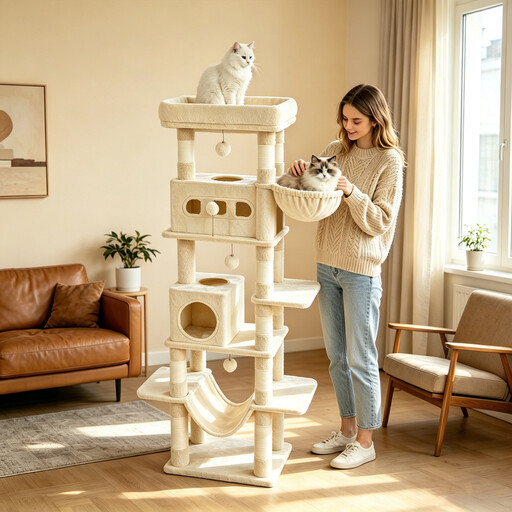
Why this model suits this profile: Its six-level design combines two cubbies, a hammock, a basket and a large 50 × 30 cm platform. Plenty of space to spread the resting areas between several cats.
Eight sisal posts spread across the different levels offer several scratching zones, rather than a single point of use.
Six levels, eight posts and assembly accessories identified in the instructions.
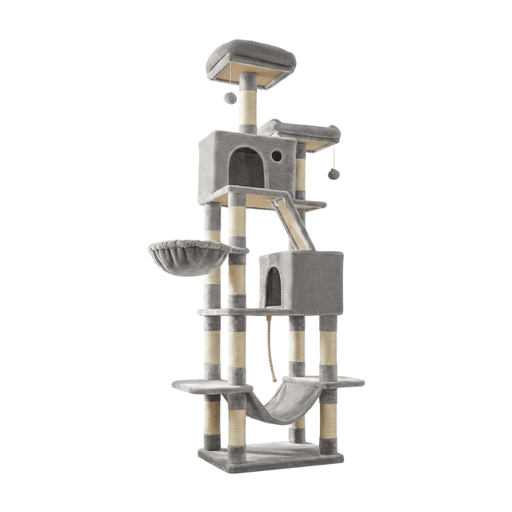
Why this model suits this profile: This structure includes five levels, two cubbies, two platforms, a basket, a hammock and thirteen dedicated scratching posts.
Its reinforced base and anti-tip kit address the risk associated with a 206 cm tower, provided the installation instructions are followed.
Dimensions of 60 × 50 × 206 cm, weight of 23.5 kg and a stated capacity of six cats weighing up to 7 kg each.
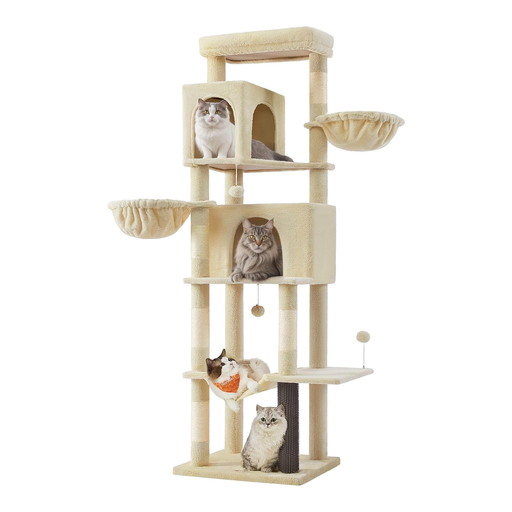
Why this model suits this profile: Two cubbies, two resting platforms, a hammock and a large platform are ideal for cats that alternate between play sessions and naps.
The five sisal posts are spread across several levels, while the wall fixing helps limit tipping.
Height of 190.7 cm, plush fabric stated at 500 g/m² and a brush integrated into the base.
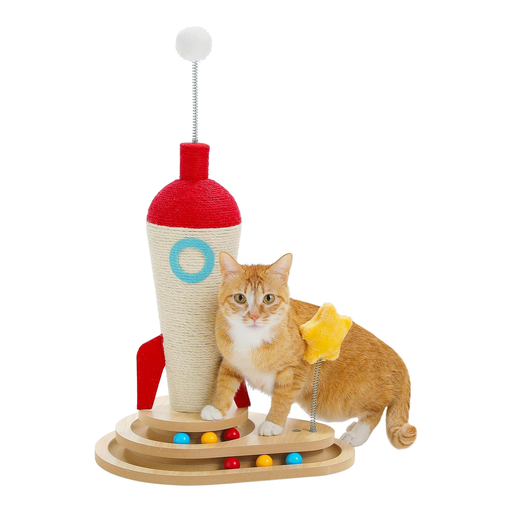
Why this model suits this profile: With its wooden base, sisal post, ball track and feather wand, it combines scratching and play without taking up the space of a large tower.
Its 40 × 30 × 63 cm format means it can easily be placed next to a sofa or in a small room.
Structure weighing 3.35 kg, sisal post and play elements that work without batteries.
Discover an updated selection of products that meet these criteria to set up your cat's space.
To help your cat accept it, place the structure near a spot they already enjoy. A treat or a toy can encourage them to explore it, without ever forcing them to climb.
A structure of 120 to 175 cm can work when ceiling height or floor space is limited. Models from 190 to 212 cm offer more vertical space, but need a suitable base and often a wall fixing. Always measure the available space before buying.
Yes, provided you plan for several separate areas. Look for a cat tree for multiple cats with separate cubbies, baskets or platforms, as well as several sisal posts. Also respect the maximum weight stated by the manufacturer.
The lifespan depends on the weight and activity level of your cats, the quality of assembly and maintenance. The sisal posts and joints are the parts to check first. Replace or remove any frayed, unstable or damaged parts, even if the structure still seems to be in good condition.