
Livraison le jour même ou le lendemain

Qualité garantie

Débloquez vos offres de bienvenue: Livraison GRATUITE | Jusqu'à -80 % | 30 jours d'essai gratuits à JoyPlus
Téléchargez l'application
A treat can reward your cat, add to a play session or simply give you a chance to share a special moment. But not all cat treats meet the same needs. Texture, ingredients, calorie content, your cat’s age and storage requirements are all worth checking before you buy.
A label saying ‘with salmon’ or ‘with chicken’ doesn’t necessarily mean the product contains a substantial amount of meat or fish. Check the ingredients list and the quantitative ingredient declaration, often referred to as QUID. Some products, for example, contain around 4% salmon or chicken. In that case, the ingredient may add a hint of flavour or be present in a small amount, rather than forming the basis of the recipe.
Cat snacks are generally complementary pet foods. They don’t replace a complete diet suited to your cat’s age and lifestyle. Giving your cat several bites without slightly reducing their main food allowance can lead to excess calories, particularly if they’re not very active or have been neutered.
Crunchy cat treats suit cats that enjoy small, dry bites. Liquid cat treats offer a different way to serve a treat or can be given alongside dry food. However, soft, saucy or jelly-like treats don’t keep in the same way as dry products. Some portions need to be used straight away once opened, while others can be kept in the fridge for a limited time.
Start by checking the ingredients list. Ingredients are listed in descending order by weight. A recipe containing cereals isn’t automatically unsuitable. Likewise, the grain-free label alone doesn’t guarantee the overall quality of a product. Every cat has their own needs and sensitivities.
If your cat has a known intolerance, also check for potential allergens. Fish, milk, soya, gluten and different animal proteins can all be included in the recipe. If you know your cat has a dietary issue, ask a vet or another animal health professional for advice before changing their routine.
Cat treats should be given in moderation. Some products contain less than 2 kcal per piece, while others give a daily amount in grams, such as 13 g for an adult cat weighing around 4 kg. These figures are a useful starting point, but you should also consider your cat’s activity level, weight and usual food allowance.
When using cat treat biscuits, remember to count how many you give during training or play sessions. A small bite given several times a day can add up to a significant amount over the course of a week.
Treats for adult cats aren’t necessarily suitable for kittens. Some products are suitable from 2 months of age, while others are intended for adult cats only. Check the size of the bites too, and make sure your cat can chew them comfortably.
Finally, choose a format to suit how you plan to use the treats:
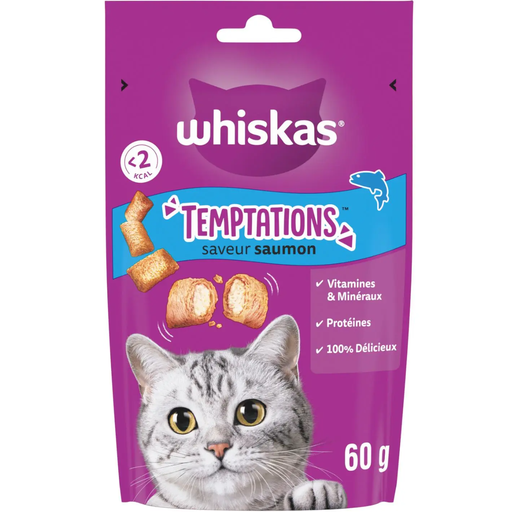
Why it suits this type of cat owner : The 60 g pack and clear serving guidance make it easy to get started with treats as part of your daily routine. The crunchy outside and soft centre may appeal to adult cats who enjoy contrasting textures.
Cereals are listed first in the ingredients, and the product contains 4% salmon. This makes it clear that the featured flavour doesn’t mean the recipe is mainly made from fish.
Up to 12 pieces a day as directed, 28% crude protein and a resealable pouch.
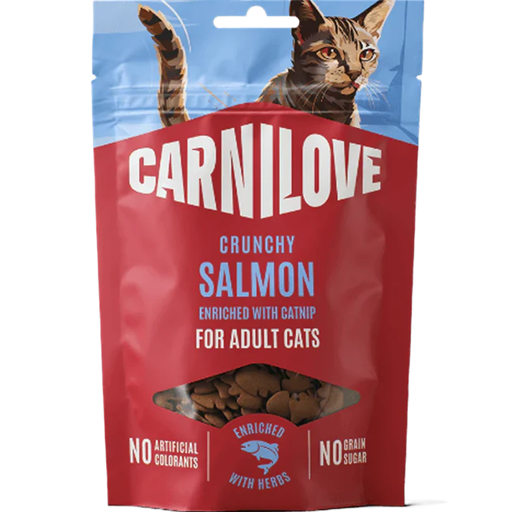
Why it suits this type of cat owner : This product is for owners looking for a recipe without cereals or soya, with a stated 26% salmon protein content.
The salmon content and absence of cereals are clearly stated in the ingredients. This makes it easier to compare with products that simply use fish flavourings.
32% crude protein, a crunchy texture, a recipe without cereals or soya, and serving guidance based on your cat’s weight.
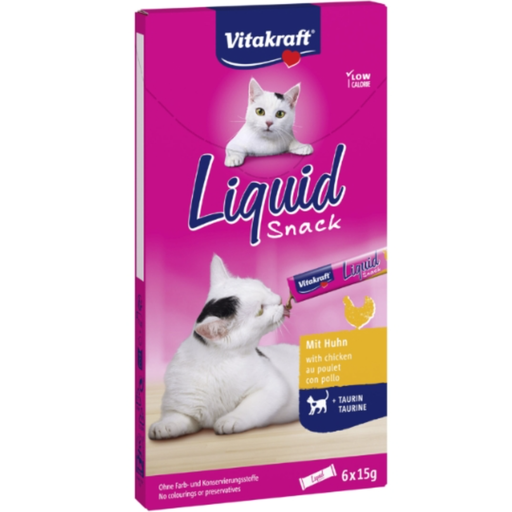
Why it suits this type of cat owner : Individual liquid portions suit cats who prefer a soft texture. They’re also handy if you’d like to vary how you serve treats between meals.
It shouldn’t be treated as a complete meal: the product information classifies it as a complementary pet food and recommends serving it as a treat or with dry food.
Liquid texture, convenient portions, 85% moisture and the option to serve it on its own or with dry food.
We’ve brought together a comprehensive, regularly updated selection of products that meet these exacting criteria and comply with European safety rules.
The amount depends on the product, your cat’s weight and activity level, and their complete daily food allowance. Start by following the guidance on the packaging, then reduce their main food portion if needed. Treats should remain a supplement.
Not necessarily. They may suit an owner’s preference or meet a specific dietary requirement, but the ‘grain-free’ label alone isn’t enough to assess a recipe. Read the full ingredients list and consider what your cat can tolerate.
Yes, but only in the amounts recommended by the manufacturer, and as part of your cat’s daily food allowance. An opened liquid portion should usually be used promptly. It doesn’t replace a complete diet, even if your cat loves it.