
Livraison le jour même ou le lendemain

Qualité garantie

Débloquez vos offres de bienvenue: Livraison GRATUITE | Jusqu'à -80 % | 30 jours d'essai gratuits à JoyPlus
Téléchargez l'application
A treat can be used to reward good behaviour, to accompany a play session, or simply to create a little ritual with your cat. However, not all cat treats meet the same needs. Texture, age, ingredients, moisture content and daily quantity are all factors to consider.
The Joybuy selection is based on an objective reading of the information on the packaging, rather than relying solely on marketing promises.
Most cat bites, sticks and liquid treats are complementary foods. They are therefore not a replacement for the main diet, which must remain suitable for the animal's nutritional needs.
Even a reward presented as high in protein or meat should be given in moderation. As a general rule, treats should not make up more than 10% of the daily food intake, unless otherwise stated by the manufacturer or recommended by a vet.
A mention like "with chicken" or "with salmon" does not necessarily mean that the ingredient in question is the main one in the recipe. Some chicken cat treats, for example, contain only 4% chicken. It is therefore better to check the ingredients list and the quantitative declaration, where available.
Taste obviously matters for your feline's preferences, but it is not enough to assess the quality or balance of the recipe.
Dry treats are generally easier to store after opening, provided you reseal the packet properly. Moist products and hydrating cat treats require more care: after opening, several varieties need to be kept in the fridge and consumed within 24 hours.
For a cat that eats slowly, individual portions can help reduce waste. Conversely, a batch of cat treats in resealable pouches will suit a household that gives out rewards regularly.
A treat intended for a kitten must clearly state the age from which it can be given. Some products are for adult cats only, while others are suitable from 2 months of age. The Catisfactions Salmon Treats for Cats and Kittens, for example, are suitable for adult cats and kittens from 2 months old, with a daily quantity adapted to each age group.
Conversely, the Whiskas Temptations Adult Cat Treats Chicken & Cheese are for adult cats only and are not suitable for kittens under 12 months.
In particular, look at:
Low-calorie treats can help you control portions better, but their energy value should always be considered alongside the feeding recommendations. Temptations state less than 2 kcal per bite, while some Churu products claim around 6 kcal per stick. These figures alone are not enough to determine your cat's total daily ration.
In the Catisfactions and Temptations examples, the dry treats have around 10% moisture. Depending on the product, liquid or gel formats can reach 85 to 93% moisture. They therefore offer a different texture and can be served on their own, mixed with food or used as a topping.
This is a water intake built into a reward, not a replacement for a bowl of fresh water. If your cat is on a special diet or has a health problem, ask your vet for advice.
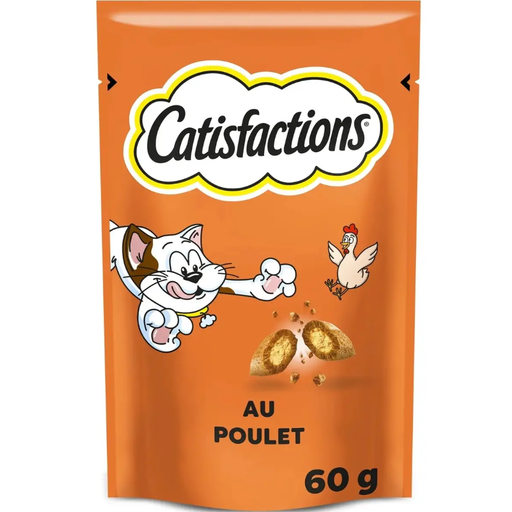
Why this choice suits this profile: At 60g, this size lets you try crunchy bites with a soft centre without investing in a large batch straight away. This product is for adult cats, while the salmon version in the range is suitable from 2 months.
The product page states that it is a complementary food and recommends up to 12 bites per day for an adult cat, to be adjusted according to its profile.
A crunchy and soft texture, 4% chicken stated in the ingredients, a 60g format and no artificial colourings or preservatives, according to the product page.
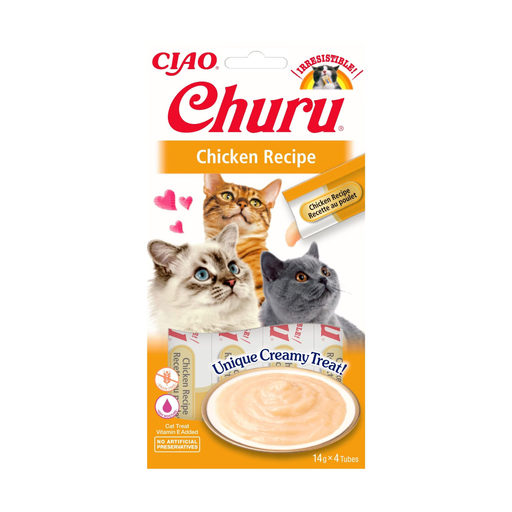
Why this choice suits this profile: This purée stick is for those looking for a chicken reward, grain-free, with a lickable texture and high moisture content.
The product page details the analytical data, including 90.5% moisture and 0.5% fat, rather than relying solely on a texture promise.
The ingredients state 30% chicken. The pack contains 4 sticks of 14g, grain-free, to be served on their own or as a topping.
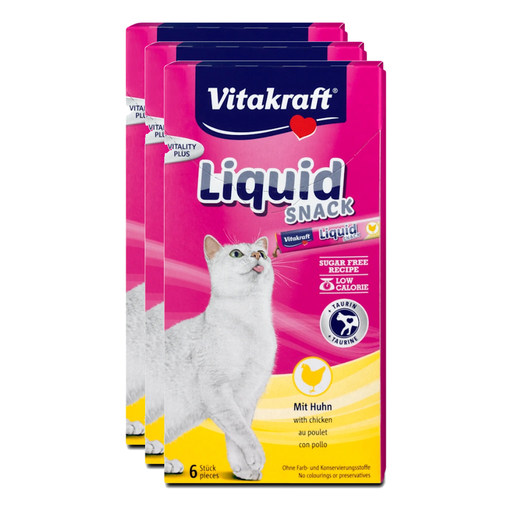
Why this choice suits this profile: At 270g, this size is ideal for households that give treats often or want to mix a liquid treat with dry food.
The total quantity and liquid format make regular dosing easy. After opening, however, the product must be kept in the fridge and used within 24 to 48 hours.
A stated moisture content of 85%, a 270g format, chicken flavour and the option to serve the product on its own or mixed with dry food.
We have compiled a comprehensive list, updated in real time, of products that meet these strict selection criteria and the requirements of European safety regulations.
To give cat rewards without unbalancing the diet:
If your cat is sensitive to certain ingredients, check the full ingredients list: cereals, dairy products, animal proteins and additives included. A "grain-free" recipe is not automatically suitable for all dietary restrictions.
The amount depends on the animal's weight, age, activity level and main diet. Manufacturers often state a daily limit on the packaging. In any case, treats should remain a supplement and make up a limited part of the total diet.
Some products are suitable for all ages, while others are for adult cats only. So always check the recommended age on the product page. For a kitten, choose a product that clearly states it can be used from that age.
Dry bites should be stored in a cool, dry place, in a tightly sealed packet. Hydrating cat treats generally need to be kept in the fridge after opening and consumed quickly, often within 24 hours. The product label remains the reference to follow.