
Livraison le jour même ou le lendemain

Qualité garantie

Débloquez vos offres de bienvenue: Livraison GRATUITE | Jusqu'à -80 % | 30 jours d'essai gratuits à JoyPlus
Téléchargez l'application
Between biscuits advertised as “low calorie”, chicken recipes that ultimately contain only a small proportion of meat, and lickable sticks sold in multipacks, choosing cat treats can quickly become a headache. Whether you want to reward your companion, add variety to their meals or share a special moment together, the right product depends above all on their age, habits and the amount actually given.
Cat snacks, crunchy bites and liquid treats are generally complementary foods. They therefore do not replace complete dry food or wet food formulated as a main meal. Giving too many can unbalance the daily ration and contribute to weight gain.
A description such as “with chicken” or “with salmon” does not necessarily mean that the ingredient makes up the largest part of the recipe. Check the ingredients and the percentage stated. Some Catisfactions products, for example, specify 4% chicken or 4% salmon. This information is far more meaningful than the picture on the packaging or the flavour claim.
A multipack can reduce the price per portion, but it is only worthwhile if your cat regularly eats the product. Dry treats should be kept in a properly resealed pouch. Wet products and lickable cat sticks often need to be consumed quickly after opening, sometimes within 24 to 48 hours. Always check the instructions on the label of the product you receive.
Kitten treats should not be chosen in the same way as those intended for adult cats. Some Catisfactions salmon products are suitable for cats and kittens from 2 months old, with a daily amount adapted for younger animals. Other products, such as certain Sheba fillets, are intended exclusively for adult cats.
For a neutered, inactive or overweight cat, compare the energy value per bite and reduce the main ration if necessary. The claim “low calorie” should be accompanied by verifiable information, such as “less than 2 kcal per treat” where this information appears on the product page.
Texture is primarily about how the product is used, rather than a guarantee that every cat will find it appealing. Some cats will prefer chicken, while others may favour salmon, tuna, liver or a particular texture.
Before ordering, check the following:
Nutritional claims and percentages should be interpreted exactly as they appear on the packaging. On their own, they cannot be used to draw a medical conclusion about the animal’s state of health.
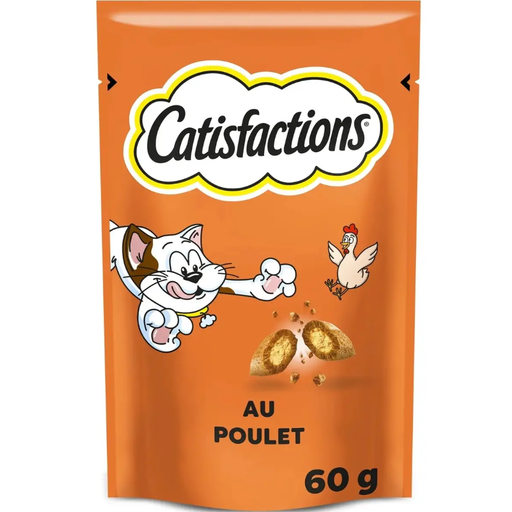
Why this choice suits this profile : Its small size lets you try chicken cat treats without being left with a difficult-to-use stock. The crunchy texture with a soft centre is ideal for occasional treats.
The product page specifies that this is a complementary food and sets a limit of up to 12 bites per day for an adult cat.
60 g pouch, 28% crude protein and no artificial colourings or preservatives, according to the product page.
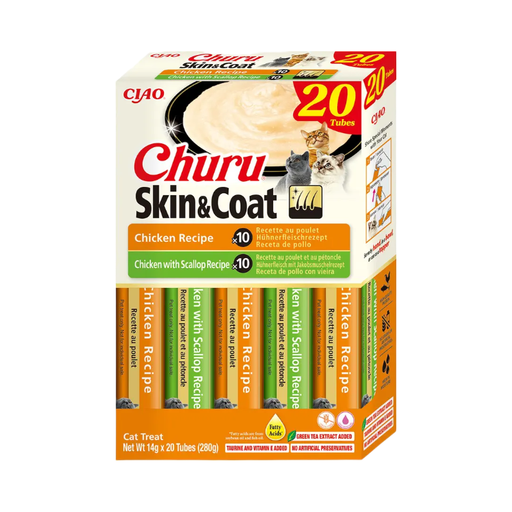
Why this choice suits this profile : Presented in individual sticks, this purée offers a more interactive way to give treats than a traditional biscuit. It can be served on its own or added to dry food.
The 20-portion format helps limit waste. Once opened, each stick should be refrigerated and consumed within 24 hours.
20 sticks of 14 g, 86% moisture, 30% chicken listed in the ingredients and a grain-free recipe.
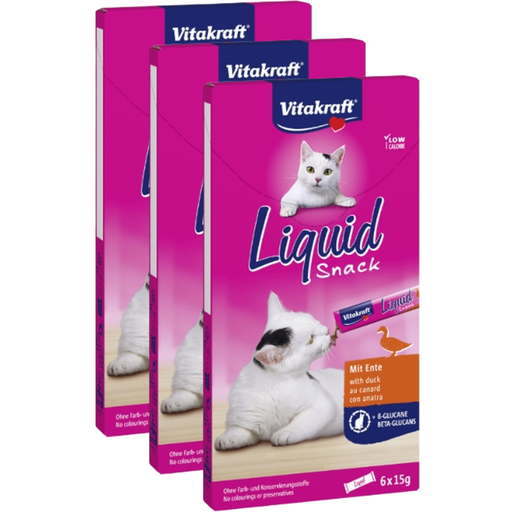
Why this choice suits this profile : Its liquid portions are ideal for cats that prefer licking to chewing, as well as households that regularly give treats that are easy to measure.
The 18 portions of 15 g make it easier to control serving sizes and avoid keeping an opened wet pouch for several days.
Liquid texture, 88.5% moisture and ingredients listing 4% duck. Serve as a complementary food.
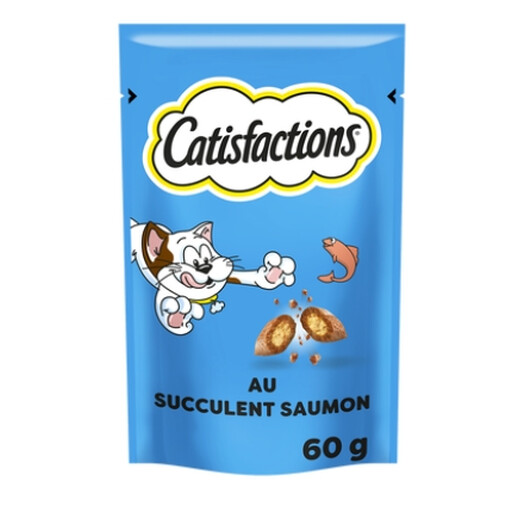
Why this choice suits this profile : The multipack lets you alternate salmon rewards and keep several pouches sealed, making it a practical solution, particularly in households with several cats.
The product page states a limit of 20 bites per day for an adult and 6 for a kitten from 2 months old.
6 pouches for a total of 360 g, less than 2 kcal per treat according to the product page, and 4% salmon listed in the ingredients.
We have put together a complete, real-time updated list of products that meet these demanding selection criteria and European safety regulations.
Start with a small amount to see what your cat prefers. Treats should remain occasional or be counted as part of the day’s food allowance. For training, give a bite immediately after the desired behaviour. During a calm moment, a liquid treat can be given slowly, without allowing your pet to chew on the packaging.
Store dry foods in a cool, dry place, then reseal the pouches carefully. For wet food and liquid snacks, maintain the cold chain after opening and discard any leftovers once the stated time limit has passed. Always make sure fresh water is available.
There is no universal amount. Follow the manufacturer’s recommendation, then adapt it according to your cat’s weight, age, activity level and main ration. If your pet is overweight or receiving particular care, ask a vet for advice.
Not necessarily. Check the minimum age stated on the packaging. Some products are suitable for kittens from 2 months old, while others are reserved for adult cats. In all cases, treats are complementary foods and do not replace a complete food suitable for growth.
Start with the flavour your cat enjoys, then compare the ingredients, texture and recommended ration. Chicken cat treats are often available as crunchy bites, while salmon treats also come in liquid or soft textures. To find out the actual proportion of the highlighted ingredient, the label remains the only reliable reference.