
Livraison le jour même ou le lendemain

Qualité garantie

Débloquez vos offres de bienvenue: Livraison GRATUITE | Jusqu'à -80 % | 30 jours d'essai gratuits à JoyPlus
Téléchargez l'application
Choosing a cat food isn’t about grabbing the brightest bag on the shelf or the most tempting-sounding recipe. Between the “rich in meat” claims, the promises about digestion and the family-size packs, the genuinely useful information can sometimes get lost.
Three mistakes crop up time and again among cat owners in the UK:
Adult cat food doesn’t cover the same needs as kitten food. During their growth phase, a kitten needs a formula suited to its age. An adult cat, on the other hand, will need a ration calculated according to its weight and activity level.
After neutering, appetite and energy requirements can change. Kibble for neutered cats is formulated accordingly, but it must be served in line with the recommended portions. It doesn’t replace weight monitoring.
A cat that lives mainly indoors generally gets less exercise. Indoor cat kibble can therefore include more fibre or have a tailored energy density. For the daily amount, though, the label is still your best guide.
The term “complete food” means the product can form the basis of your cat’s diet, provided you follow the manufacturer’s recommendations. Cat treats, on the other hand, are complementary foods.
Catisfactions chicken treats recommend up to 12 bites per day for an adult cat, depending on its size, activity and metabolism. Catisfactions salmon treats state up to 20 bites daily for an adult and up to 6 for a kitten from 2 months old. These amounts must be factored into the overall ration to avoid overfeeding.
To compare different recipes, look at:
For sensitive cat food, read the full ingredients list and make any transition gradually. If problems persist, you suspect an allergy, or your cat needs a specific diet, it’s best to ask your vet for advice.
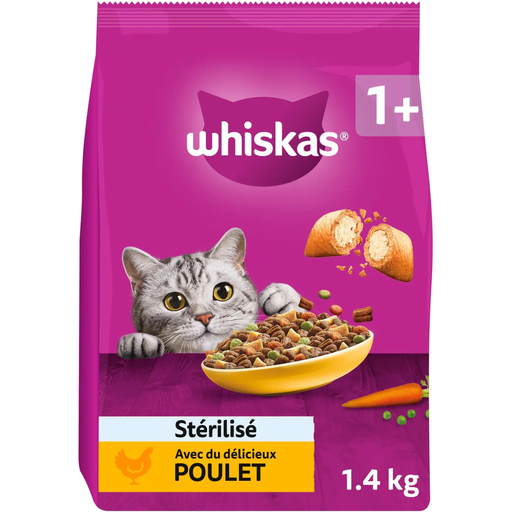
Why this choice suits this profile: At 1.4 kg, this bag lets you try the recipe without committing to a large pack straight away. It is designed for adult neutered cats aged at least 1 year.
The “complete food” label and the weight-based feeding recommendations help you avoid mistaking a simple treat for the daily meal. The advised transition takes place over 7 to 10 days.
The product page states 30% protein, 11.5% fat and 4.1% crude fibre. The recipe contains 4% chicken in the brown kibble.
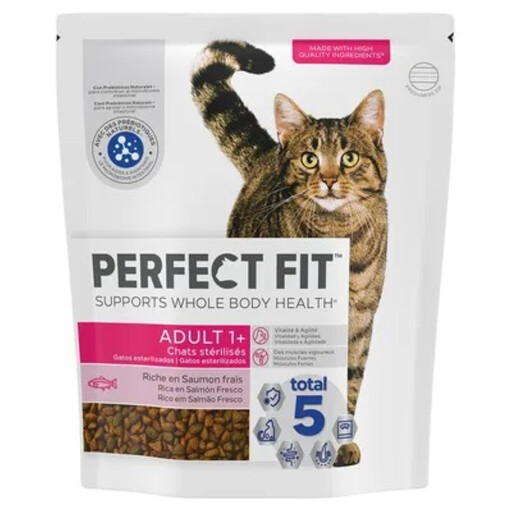
Why this choice suits this profile: This salmon recipe is for owners who want to compare a formula for adult neutered cats using detailed analytical data, all in a medium-sized pack.
The product page states a metabolisable energy of 386 kcal per 100 g and provides indicative rations by weight. That lets you compare the product on more than just the word “salmon”.
The ingredients list mentions 14% salmon, 34% protein and 14.5% fat. The product is presented as a complete food for cats aged 1 year and over.
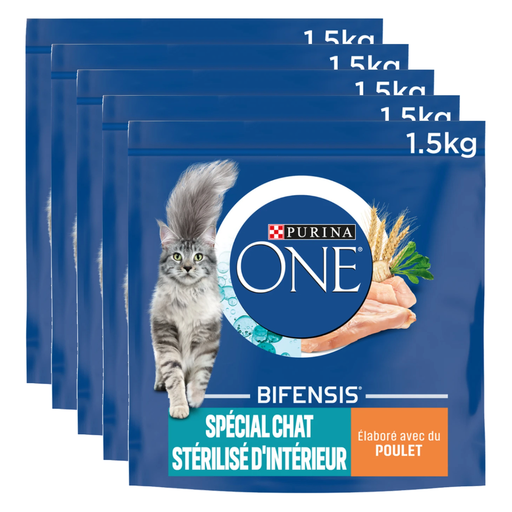
Why this choice suits this profile: This large format works well for households with multiple cats or those who prefer to shop less often. It is designed for adult neutered cats that live mainly indoors.
The pack of five 1.5 kg bags stops the whole stock from being exposed to air after opening, unlike a single 7.5 kg bag.
The product page states 37% protein, 13% fat and 5.5% fibre. The recipe contains 15% chicken and 2% chicory.
We’ve put together a comprehensive, real-time list of products that meet these demanding selection criteria as well as European safety regulations.
Chicken kibble for cats and salmon kibble for cats may suit your pet’s preferences, but the flavour shouldn’t make you forget the essentials: the nutritional value and the product’s status. Always check whether it’s a complete or complementary food.
To reward your companion, chicken cat treats and salmon cat treats are easy to use, as long as you keep the quantities sensible. Catisfactions chicken treats are sold in six sachets, totalling 360 g, and contain fewer than 2 kcal per bite according to the product page. They include 4% chicken. Catisfactions salmon treats also claim fewer than 2 kcal per bite and 4% salmon in their ingredients.
Storage deserves as much attention as choosing the recipe: reseal the sachets properly, stick to the stated consumption period and always leave fresh water available.
The amount depends on weight, age, activity, neutering status and the energy density of the recipe. Use the table printed on the packaging as a starting point, then regularly monitor your cat’s body condition and weight.
It’s best to plan a gradual transition, usually over around 7 days, or 7 to 10 days depending on the manufacturer’s recommendations. Gradually mix the old and new recipes together to avoid too sudden a digestive change.
No. Treats are complementary foods and do not replace a complete diet. If you give rewards frequently, slightly reduce the main ration while staying within the limits stated on the packaging.