
Livraison le jour même ou le lendemain

Qualité garantie

Débloquez vos offres de bienvenue: Livraison GRATUITE | Jusqu'à -80 % | 30 jours d'essai gratuits à JoyPlus
Téléchargez l'application
Choosing a cat food isn’t just about comparing the price per kilo or being won over by an appetising picture on the packaging. Your cat’s age, whether it’s been neutered, its activity level and the type of food all play a part in finding the most suitable option for your pet.
In the UK, cat owners often fall into three common traps:
An adult cat food isn’t automatically suitable for a kitten. During their growth phase, kittens have specific nutritional needs and should be fed a kitten food designed for this stage. Purina One Bifensis Kitten, for example, is suitable from weaning up to 12 months, as well as for pregnant or nursing queens, according to the manufacturer’s information.
For a neutered adult cat, choose a formula that clearly states this. Kibble for neutered cats typically offers an adjusted energy content and specific portion recommendations. However, this doesn’t replace the need to monitor your cat’s weight or to consult a vet if you have any particular concerns.
A cat that mainly lives indoors can also benefit from an indoor cat food, with a ration suited to its activity level. Don’t rely solely on the brand name – always check the target animal type on the label.
In the UK and across the European Union, the distinction between complete and complementary food is essential. A complete cat food is formulated to cover the daily ration when used according to the recommendations. In contrast, a complementary product, such as certain fillets in sauce, should remain a treat or an occasional addition.
Wet cat food generally provides a high water content. Felix pouches, for example, have a moisture content of 82% and are presented as a complete food for adult cats. The Sheba Filets Les Effilés de Poulet product, on the other hand, is labelled as a complementary food – so it should not make up daily meals on its own.
Start by looking at the ingredients list, then the analytical constituents: crude protein, fat, fibre, ash and moisture. These figures alone won’t tell you which food is ideal for your cat, but they do allow you to compare products on a more objective basis.
For chicken kibble for cats, check the actual percentage of chicken stated. Purina One for adult cats with chicken states 17% chicken, while Whiskas Adult Sterilised kibble shows 4% chicken in the brown kibbles. These numbers aren’t directly comparable without looking at the whole recipe, but they stop you from relying solely on the picture on the packet.
The same caution applies to beef kibble for cats. Purina One Bifensis Sterilised Adult with beef states 16% beef offal. So you need to read the full ingredients list, especially if you’re looking for a cat food without artificial colours or a recipe containing certain additives.
Finally, choose the pack size based on actual consumption. Bags of 1.35 kg to 3 kg are handy for trying a recipe or limiting storage time. Larger formats of cat food, such as 7.5 kg, 8 kg or 12 kg, can be good value for multi-cat households, provided you store the kibble in an airtight container away from heat and moisture.
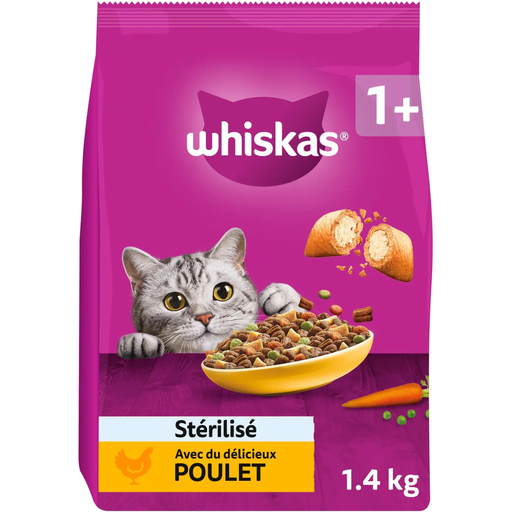
Why this choice suits this profile: Its 1.4 kg size lets you try a chicken kibble recipe without spending a lot or leaving a bag open for weeks.
The product page clearly states it is a complete food for neutered adult cats aged 1 year and over, and gives recommended portions based on weight.
The recipe contains 30% crude protein and 11.5% fat. It is also said to be free from artificial colours and added preservatives.
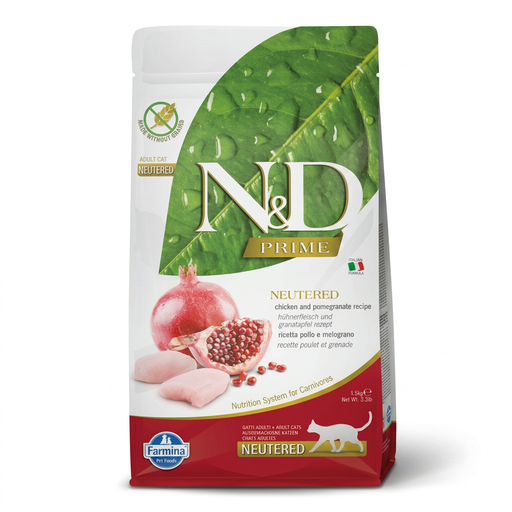
Why this choice suits this profile: Designed for neutered cats, this recipe focuses on a grain-free composition and a 1.5 kg size that lends itself to careful storage.
The product page clearly targets “neutered adult cats” and provides guidance on gradual transition and indicative portions.
The product page states 38% crude protein, 16% fat and a composition based on fresh and dehydrated chicken.
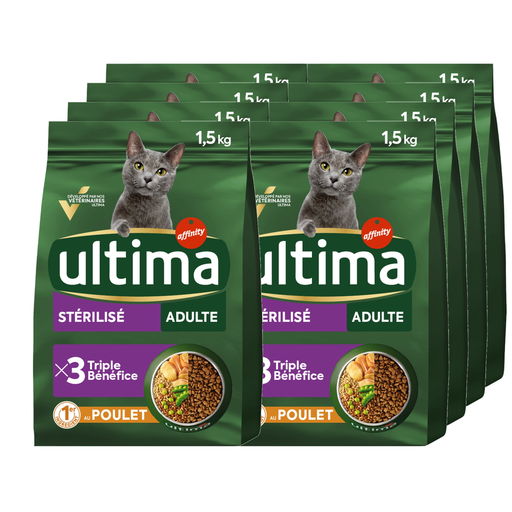
Why this choice suits this profile: The 12 kg bag is ideal for households with several neutered cats or those who go through this kibble regularly, provided it is stored in an airtight container.
The product page provides rations based on weight and states that the product is not suitable for kittens or pregnant or nursing queens.
The recipe states 35% crude protein, 12% fat and 17% chicken in its composition.
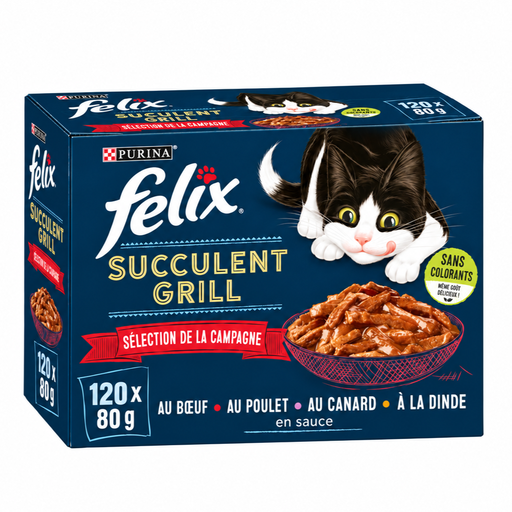
Why this choice suits this profile: The 120 pouches of 85 g make daily portioning easy in households that prefer wet cat food.
It is presented as a complete food for adult cats, unlike complementary wet foods that are only intended as an extra.
The individual 85 g portions have a moisture content of 82% and are said to be free from added artificial colours, flavours and preservatives.
We have put together a comprehensive, real-time selection of products that meet these strict criteria and comply with European safety regulations.
Yes, as long as you adjust the daily amounts. Check that both the wet food and the kibble are complete foods, then reduce the portion of each to avoid overfeeding. A gradual transition over several days also helps to minimise digestive upset.
The shelf life depends on the packaging and the manufacturer’s recommendations. Seal the bag carefully or transfer the kibble to an airtight container stored in a cool, dry place. For a single cat, bags of 1.35 kg to 3 kg are often easier to keep fresh than a 12 kg bag that might stay open for months.
Gradually mix the old and new food over a period of about 7 to 10 days, unless the packaging says otherwise. Start with a small amount of the new food and increase it step by step. Keep an eye on your cat’s appetite, weight and digestion. If your cat has a particular sensitivity or a diagnosed medical condition, ask your vet for advice before changing its diet.