
Livraison le jour même ou le lendemain

Qualité garantie

Débloquez vos offres de bienvenue: Livraison GRATUITE | Jusqu'à -80 % | 30 jours d'essai gratuits à JoyPlus
Téléchargez l'application
Choosing a cat food isn’t about grabbing the first well-known brand or the most tempting recipe. Between wet cat food, kibble for neutered cats, fresh pouches and grain-free cat food, the packaging is full of promises. Yet some essential information often gets overlooked: whether it’s a complete or complementary food, the actual proportion of the highlighted ingredient, an impractical format, or a poorly calculated daily portion.
For an adult cat living in a flat, neutered or not very active, these details can quickly lead to unsuitable purchases and a budget that spirals. Here are the points to check before you finalise your basket.
A complete diet for adult cats is formulated to cover their daily needs when fed according to the manufacturer’s recommendations. Conversely, a soup, a bite in sauce or certain fillets may be classed as complementary food and are designed to accompany meals, not replace them.
The product Sheba Soup Thon et Filet de poulet, 24 × 40 g, for example, is presented as an aid to hydration and as a complementary treat. It should not, therefore, take the place of main meals. This distinction is essential to avoid imbalances from a diet made up solely of supplementary products.
The ingredient highlighted on the front of the pack is not necessarily the main one in the recipe. To get a clearer picture, check the ingredients list and the quantitative declaration: in several wet preparations, chicken, salmon or rabbit account for only 4% of the variety in question.
This doesn’t automatically mean the product is unsuitable. However, this information allows you to compare products on a concrete basis. The ingredients list, analytical constituents and nutritional status generally tell you far more than phrases like “gourmet recipe” or “high palatability”.
A multipack of cat food with 24, 48 or 60 pouches can lower the price per portion. But the saving quickly disappears if your cat turns its nose up at certain recipes. For a first order, it’s better to start with a small pack to test your cat’s interest in the texture, sauce and protein sources.
Once opened, wet cat food should generally be kept in the fridge and used within the time stated on the packaging, often within 24 to 48 hours. Pouches of 50 g or 85 g also help reduce waste if your cat eats only a little at each meal.
Look for an explicit statement such as “complete food for adult cats” or “complete food for neutered adult cats”. A kitten, a pregnant female and an adult cat all have different nutritional needs.
For a neutered cat food, also look at the recommended daily amount in grams. Dry recipes designed for neutered cats often provide guidelines by weight range, for example 2 to 3 kg or 4 to 5 kg. These indications should be adjusted according to your cat’s activity level and body condition, rather than followed to the gram without considering its individual situation.
Wet cat food generally contains a high amount of water and comes in individual portions. It suits households that want to vary textures or serve easily measured amounts. On the downside, wet food keeps less well after opening and needs space in the fridge.
Cat kibble is easy to store and can be weighed with a kitchen scale. For a neutered or less active cat, portion control is especially important: a constantly full bowl can encourage grazing and weight gain.
A mixed diet is perfectly possible, as long as you adjust the total portion. Avoid adding a full portion of kibble to several pouches of wet food without recalculating the quantities.
The term grain-free cat food alone isn’t enough to determine whether a recipe is right for your pet. Instead, compare the protein sources, fats, fibre, minerals and the manufacturer’s recommendations.
Some Farmina N&D references for neutered cats are grain-free, with chicken or lamb as the main protein sources. This feature may suit a particular preference or set of requirements, but it doesn’t on its own guarantee that the recipe will suit every cat.
If your cat has digestive or urinary issues, or if its weight is changing unusually, consult a vet before making any long-term changes to its diet.
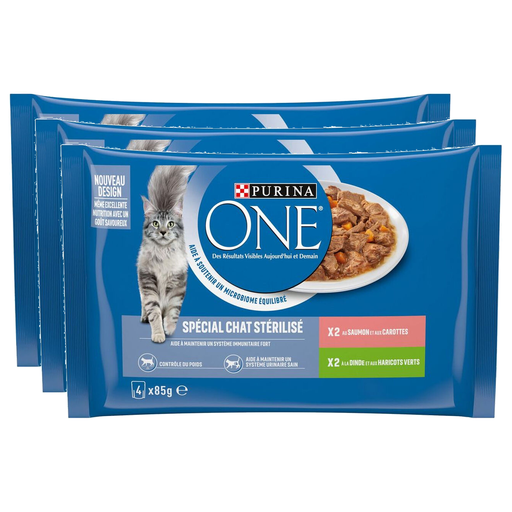
Why this choice suits this profile: This multipack lets you start with a sensible quantity and two main recipes, while targeting neutered adult cats.
The product page presents it as a complete food for neutered adult cats and provides analytical constituents, rather than just a taste promise.
12 pouches of 85 g, with salmon and turkey recipes, containing 13% protein and 3.6% fat according to the product page.
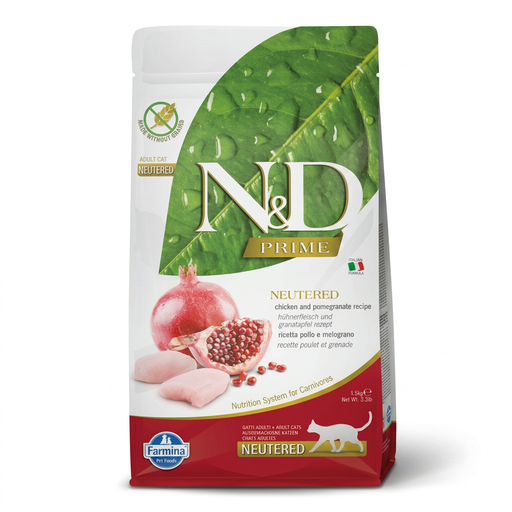
Why this choice suits this profile: This dry recipe is for owners who want to examine a detailed ingredients list and choose a formula specifically designed for neutered cats.
The product page states it is a complete food, recommends a gradual transition and details the analytical values, including 38% protein and 16% fat.
1.5 kg bag, with chicken and dehydrated chicken in the ingredients, grain-free according to the description provided.
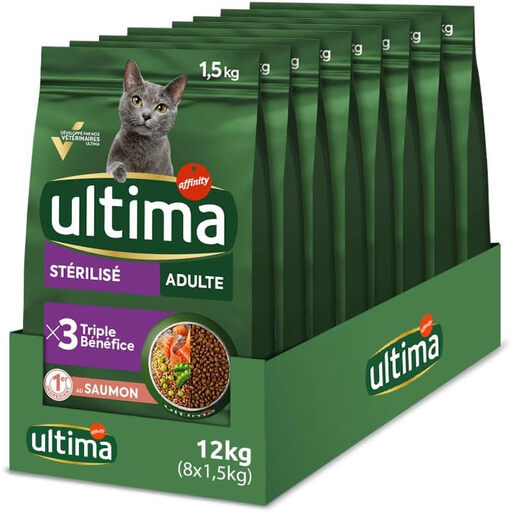
Why this choice suits this profile: This large pack is ideal for households that regularly feed several neutered cats or prefer to space out their orders.
The feeding recommendations are detailed by weight, with a gradual transition over 7 to 10 days and storage instructions for a dry place.
12 kg in total, with 15% salmon stated, 35% protein and 12% fat according to the product page.
We’ve put together a comprehensive, real-time selection of products that meet these exacting criteria as well as European safety regulations.
The amount depends on your cat’s weight, activity level, age and the energy density of the recipe. Use the table on the packaging, weigh the kibble and reduce the amount accordingly if you also give wet food. Regularly check your cat’s body condition rather than relying solely on what’s in its bowl.
Both formats meet different needs. Wet food provides a high amount of water and is easy to serve in measured portions, while kibble is simple to store and portion out. The choice depends on your cat’s preferences, your routine and, if necessary, your vet’s recommendations.
Put the remainder in the fridge and follow the time stated on the packaging. Depending on the product, it generally needs to be used within 24 to 48 hours. Take the portion out a few minutes before serving so it returns to room temperature, and avoid leaving wet food in the bowl for long periods.