
Livraison le jour même ou le lendemain

Qualité garantie

Débloquez vos offres de bienvenue: Livraison GRATUITE | Jusqu'à -80 % | 30 jours d'essai gratuits à JoyPlus
Téléchargez l'application
Choosing a cat food can quickly become a headache, with all the promises of "grain-free", protein-rich recipes and so-called hypoallergenic formulas. Yet a pretty label alone isn't enough to tell you whether a product suits your cat's age, lifestyle or any sensitivities.
Here are the criteria to check before buying wet cat food, dry cat food or a mixed diet.
The mention "with chicken", "with lamb" or "with fish" doesn't guarantee that the recipe contains a large amount of that ingredient. To find out what's really in it, you need to read the full ingredients list and check the percentages when they're stated.
A formula might, for example, highlight turkey while still containing rice, maize, maize gluten or several sources of animal protein. To compare two products properly, look at:
A grain-free wet food or grain-free dry food can be perfectly suitable for some cats, but this claim alone says nothing about the overall balance of the food. Grains are sometimes replaced by potatoes, peas or other sources of starch.
The key point is to check that the product is clearly labelled as a complete cat food, not just a complementary food. A complete food should be able to form the daily ration, following the manufacturer's recommendations.
A high-protein diet isn't automatically right for every cat. Age, weight, neutering, activity level and digestive tolerance all need to be taken into account. A kitten recipe doesn't serve the same purpose as a food for neutered cats or a formula for a less active adult cat.
If your cat has itching, repeated vomiting or ongoing digestive issues, it's best to consult a vet. The term hypoallergenic cat food refers to a recipe direction or a manufacturer's claim – it's not a diagnosis.
Start by checking which profile the product is intended for: kitten, adult or neutered cat. A kitten food must meet the specific needs of growth. For a neutered adult, also keep an eye on the daily portion and energy density – weight gain depends particularly on the amount served and activity level.
The Farmina N&D products on offer include, for example, Kitten, Neutered and recipes for adult cats. This distinction makes it easier to choose, but the recommendations on the packet remain the reference.
Compare all the available information, without stopping at the protein percentage shown on the front. Dry foods contain very little water, while wet cat food contains much more. So protein percentages aren't directly comparable between wet and dry food without accounting for this difference.
Other data to examine include:
A large bag of dry food can be practical in a multi-cat household, provided you seal it properly and store it in a dry place. For wet food, check the quantity in each tin or pouch, as well as the storage time after opening.
The MJAMJAM products state that they should be kept in the fridge after opening and consumed within 24 hours, and recommend serving at room temperature. This is worth bearing in mind if your cat eats small portions spread throughout the day.
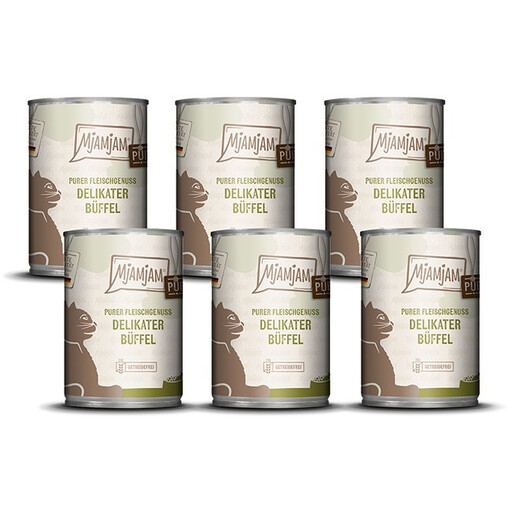
Why this choice suits this profile: This pack of six 400 g tins is ideal for households that want to organise an adult cat's meals economically, with a clearly detailed recipe.
The listing presents a complete food, grain-free and sugar-free, and details its composition, which includes 71.6% buffalo meat, offal and broth.
The listing states a single-protein recipe, with 79% moisture and a suggested daily portion of 200 to 400 g for a cat weighing between 3 and 5 kg.
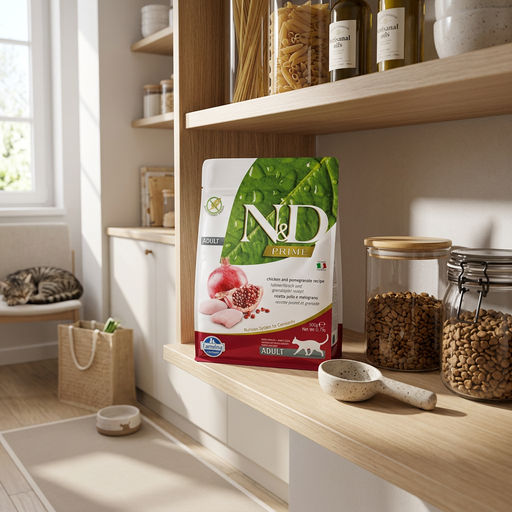
Why this choice suits this profile: This small format lets you try a Farmina N&D recipe before moving on to a 1.5 kg or 5 kg bag if your cat likes it.
The listing details the ingredients and analytical constituents, rather than relying solely on the promise of a high-protein recipe.
The ingredients list mentions 30% boneless chicken and 28% dehydrated chicken protein, for 44% crude protein.
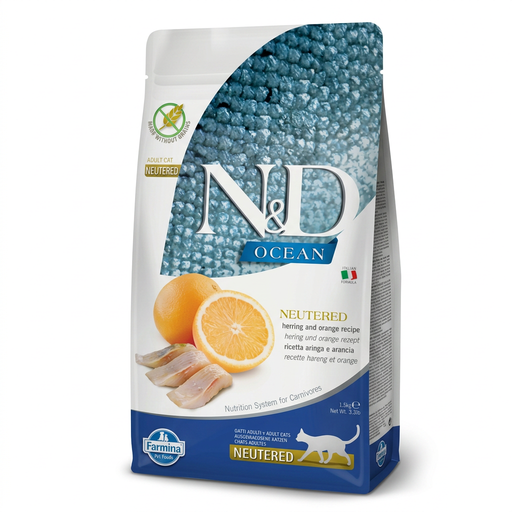
Why this choice suits this profile: This product is clearly intended for neutered cats. Its 1.5 kg format is suitable for regular use without requiring you to store an overly large bag.
The "Neutered" targeting reduces the risk of accidentally choosing a general recipe for a cat whose lifestyle has changed.
This Farmina N&D Ocean recipe, based on herring, comes in a format that's ideal for a gradual transition and precise monitoring of portion sizes.
We've put together a comprehensive, real-time updated list of products that meet these demanding selection criteria and European safety regulations.
A sudden change can lead to your cat refusing its bowl or developing digestive issues. Gradually mix the old and new food over several days, slowly increasing the proportion of the new product. Start by following the quantities stated on the packaging, then adjust them according to your cat's weight, activity level and body condition.
If you're feeding a mixed diet, take into account the calories from both wet and dry food. Always leave fresh water available, especially when the ration includes a significant amount of dry food.
Choose a recipe with a clear ingredients list that, if necessary, limits the number of protein sources. Products marketed as sensitive cat food or for delicate digestion should still be compared against their actual ingredients list. If reactions persist, ask your vet for advice rather than switching foods repeatedly.
Both formats can have a place in your cat's diet, as long as you choose a complete food and stick to the recommended amounts. Wet food provides more water, while dry food is easy to portion and store. The choice may also depend on your cat's preferences, its feeding routine and your daily schedule.
For the MJAMJAM tins and pouches shown here, the listing recommends storing them in the fridge and consuming within 24 hours. Dry food should be kept in a cool, dry place in a carefully sealed bag. Always check the label on the specific product – storage instructions can vary depending on the format.