
Livraison le jour même ou le lendemain

Qualité garantie

Débloquez vos offres de bienvenue: Livraison GRATUITE | Jusqu'à -80 % | 30 jours d'essai gratuits à JoyPlus
Téléchargez l'application
Buying cat accessories can quickly turn into disappointment: a cat tree that wobbles, a toy abandoned after a few days, or a scratching post that doesn't stand up to claws for long. Flattering photos and generic promises aren't enough to tell whether a product will really suit your pet and your home.
Before you check out, focus on three key criteria: stability, durability of materials, and whether the equipment can be adapted to your cat's habits. These points are especially important in flats or when a cat tree for multiple cats needs to withstand jumps and repeated comings and goings.
An imposing cat tree appeals to felines who love to climb high and survey their territory. But a tall size doesn't guarantee safety. A base that's too narrow, lightweight panels, or the absence of an anti-tip system can make the structure wobble with every leap.
For a cat climbing tower, examine the width of the base, the total weight, the wall-mounting kit provided, and the arrangement of the platforms. In a home with wooden flooring, tiles, or a slightly uneven floor, placement also matters: positioned in a corner and against a wall, the tree will generally move less from side to side.
The number of posts isn't everything. Check their arrangement, their height, and whether sisal is present on the areas your cat can actually reach. A scratching post that's too short won't necessarily allow your cat to stretch out to its full length.
Several surfaces placed at different heights better suit the habits of cats who like to scratch when they wake up, during play, or near their sleeping area. This can help divert their attention from sofas and curtains, though it won't promise a complete end to scratching on furniture.
A catnip toy, a silvervine toy, or a ball for cats needs to be inspected regularly. Feathers, strings, bells, elastic bands, and small parts can come loose over time.
Electronic toys add a few extra points to watch: charging cable, built-in battery, durability of the fabric, and use on a dry surface. An interactive cat toy doesn't remove the need for supervision, especially when it contains small parts or moving components.
Measure the available space, taking into account doors, windows, and walkways. For a cat tree, the height must be compatible with your ceiling height, and the width with the room's dimensions. Vertical models free up floor space, but they need a sufficiently deep base to stay stable.
In a household with multiple cats, also consider the number of distinct spaces: platforms, baskets, hammocks, and cubbies. A single resting area can cause competition between animals, even if the tree is large enough.
Sisal is particularly well-suited to scratching surfaces, while removable textiles and cushions make it easier to remove fur. Washable items or those that are easy to vacuum clean are invaluable for accessories intended for indoor cats.
For fabric toys, choose models with clearly stated cleaning instructions. Some toys containing catnip or silvervine should not be submerged. According to the manufacturer's recommendations, spot cleaning with a damp cloth may sometimes be preferable.
Check the maximum static load stated and don't confuse it with the structure's resistance to repeated jumps. For a cat tree intended for several animals, fix it to the wall if the manufacturer provides an anti-tip kit, and follow the assembly order given.
For toys, immediately remove any torn parts, frayed string, or exposed stuffing. Wand toys, such as a cat fishing rod, should be put away after each session to prevent your cat from chewing on them unsupervised.
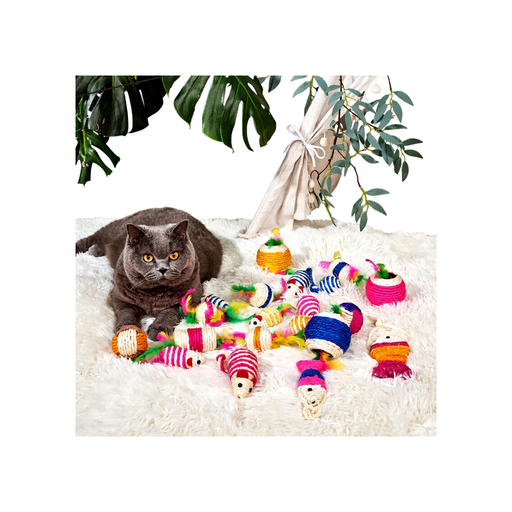
Why this choice suits this profile: With four balls to hand, you can start gradually in a flat without installing a bulky structure.
The materials and detachable parts can be checked before each play session, unlike a toy that's difficult to inspect.
Pack of 4 pieces, combination of feathers and sisal, lightweight format for floor play.
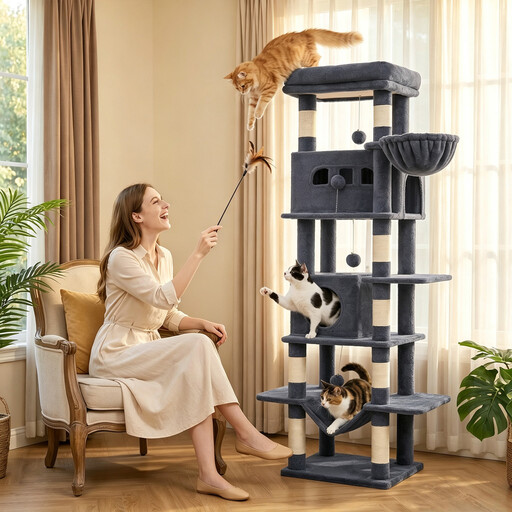
Why this choice suits this profile: Its vertical design is ideal for households that want to multiply climbing and resting spaces without taking up all the floor area.
The eight sisal posts are spread across the different levels, rather than being concentrated in a single scratching area.
Height of 212.5 cm, six levels, 60 × 40 cm platform, two cubbies, hammock and anti-tip system.
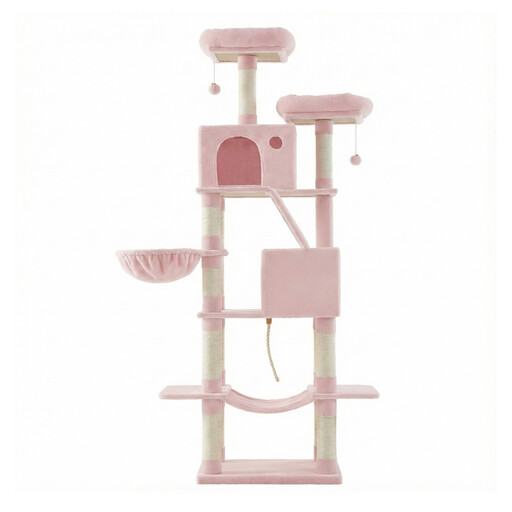
Why this choice suits this profile: With its many spaces, this model is ideal for households where several cats need to move around, climb, and rest without getting in each other's way.
The reinforced base and anti-tip kit minimise the risk of wobbling caused by repeated climbing and descending.
206 cm height, 13 scratching posts, ramp, two cubbies, basket and hammock.

Why this choice suits this profile: This USB-C rechargeable toy is aimed at owners who want to vary their indoor cat's activities.
Recharging avoids having to buy batteries regularly, while the three shapes allow you to vary the toys.
USB-C rechargeable, tumbling movements, three sea creature shapes and multi-layer fabric.
We've put together a comprehensive, real-time updated selection of products that meet these demanding criteria as well as European safety standards.
Plan several distinct areas for resting and scratching, especially if your cats have different temperaments. A cat tree for multiple cats can be supplemented with separate scratching posts and a few individual toys placed around the home.
It depends on the weight of your cats, how often they jump, the quality of the sisal, and how well it's maintained. Check the fixings regularly and replace any textile or hanging parts as soon as they become torn. The lifespan stated by the seller doesn't remove the need for these checks.
They can reduce spending on batteries, but you also need to consider the purchase price, the battery life, and the possible replacement of the product. Only recharge it with a cable in good condition, out of your pet's reach, and stop using it if the casing or fabric is damaged.