You’re preparing a portion for your journey
If you don’t want to eat straight from the bag, check the kcal for the amount you’re taking with you. As a guide for this specific product, Auchan lists 149 kcal per 25 g of its unseasoned cashews.


To take cashews on the train, first decide how much you want to eat, then check the nutritional information on the pack for that portion. An unseasoned option or one with no added salt may suit your taste or ingredient preferences, but that doesn’t make it “low calorie”: Auchan lists 149 kcal per 25 g for its unseasoned cashews.
If you don’t want to eat straight from the bag, check the kcal for the amount you’re taking with you. As a guide for this specific product, Auchan lists 149 kcal per 25 g of its unseasoned cashews.
The ingredients list and the “salt” line can help you distinguish between two recipes. Auchan’s unseasoned cashews contain 0.03 g of salt per 100 g, compared with 0.8 g per 100 g for its roasted and salted option; these figures don’t apply to all cashews.
A resealable pack can be useful if you’ll be snacking over several legs of your journey. ALDI describes its Trader Joe's roasted unsalted cashews as coming in a resealable pack; also check the storage instructions for the product you buy.
Start with the amount you want to take with you. Then compare recipes by their salt content and ingredients, and choose packaging that suits your journey.
| What matters | What to check | Who is this for? |
|---|---|---|
| Amount to take | The kcal for your chosen portion, as well as the pack weight. | If I prepare my snack before boarding the train, I want to know what the amount I’ve set aside represents, rather than relying on the whole pack. Around 50% of consumers put portion size first. |
| Recipe and salt | The ingredients list and salt content per 100 g for the exact product. | If I want a snack with no added salt, I prefer to distinguish an unseasoned recipe from a flavoured one before choosing. This would be the top priority for around 30% of consumers. |
| Transport and storage | Whether the pack can be resealed and its storage instructions after opening. | If I plan to save some cashews for later in the journey, I mainly look for packaging I can reseal. Around 20% of consumers would prioritise this practical feature. |
In France, the EU rules on nutrition claims reserve the term “low energy” for solid foods providing no more than 40 kcal per 100 g. Auchan and Carrefour list 595 kcal per 100 g for unseasoned cashews and 617 kcal per 100 g for Jardin Bio organic raw cashews, respectively.
For your journey, compare the kcal for the amount you plan to take, rather than assuming these descriptions mean the product has a lower energy value.
Two cashew products can differ in their ingredients and salt content. Auchan’s product information shows that its roasted and salted version contains sunflower oil and salt; it has 0.8 g of salt per 100 g, compared with 0.03 g for the unseasoned version.
If added salt matters to you, check the ingredients and nutritional information on the exact pack. Even if you prefer the salted version, it’s still important to decide how much to take.
A pack that’s easy to slip into your bag won’t necessarily contain the amount you want for a snack break. For example, Auchan lists 149 kcal per 25 g for its unseasoned cashews, which are sold in a 200 g bag.
Set aside your chosen amount before you leave, or plan to reseal the pack after serving yourself.
Cashews are an allergen, and warnings about possible traces can vary between products. Storage instructions after opening also apply to the specific product.
Check the allergen and storage information on the pack you buy, especially if you need to avoid other ingredients or save the rest for another journey.
These examples highlight differences between specific products without suggesting that the same features apply across an entire retailer’s range.
Carrefour’s product information for Jardin Bio describes organic raw cashews in a 200 g bag.
The retailer lists products including Tokapi roasted and salted cashews in a 400 g pack.
Auchan’s product information lets you compare a 200 g pack of unseasoned cashews with a 125 g pack of roasted and salted cashews.
Lidl’s Alesto page features unseasoned cashews.
ALDI features Trader Joe's roasted unsalted cashews.
Monoprix’s product information features raw cashews in a 200 g bag.
These cashews include unsalted and seasoned options to suit different preferences for your journey. The pack size doesn’t determine how much you should take with you, so check the nutritional information and allergens for each product before buying.
 Image unavailable
Worth considering if you prefer an unsalted recipe and plan to portion your snack before travelling. The bag contains 130 g; if you also want to avoid added oil, check the ingredients, as well as the allergen warnings on the packaging.
 Image unavailable
This dry-roasted option may appeal if you prefer this preparation method for your snack. The bag contains 165 g; don’t assume that “dry-roasted” means the recipe is unsalted, and check the seasoning on the label.
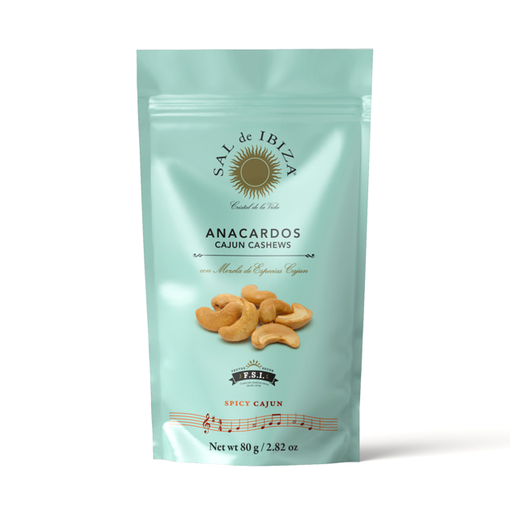 Image unavailable
The 80 g pack could suit you if you want to take a small bag of spiced cashews, but don’t assume the whole pack is your portion. As this recipe is seasoned, check the ingredients, salt content and allergen warnings carefully.
Not the Auchan products covered here. In France, EU rules on nutrition claims set a maximum of 40 kcal per 100 g for a solid food to be described as “low energy”; Auchan lists 595 kcal per 100 g for its unseasoned recipe and 607 kcal per 100 g for its roasted and salted recipe. When choosing your snack, it’s better to focus on the portion of the specific product.
Choose an amount you can set aside before you leave, then check the corresponding kcal on the label. Auchan lists 149 kcal per 25 g of its unseasoned cashews; this figure doesn’t automatically apply to other recipes.
First read the ingredients list on the exact pack, then check its “salt” line. Auchan’s unseasoned cashews list cashews as the ingredient and contain 0.03 g of salt per 100 g, while its roasted and salted version contains sunflower oil and salt and has 0.8 g of salt per 100 g.
Check the ingredients and warnings on the exact pack before taking it with you. Cashews are identified as an allergen in the product information consulted, and warnings about possible traces of other allergens can vary between products.