Anyone looking to keep portions in check
If you add cashews to lunch or snack on them during a break, checking the energy per portion, when provided, can help you decide how much to serve before settling in front of your screen.


Cashews aren’t low in calories in their own right: products listed by Carrefour, Auchan and E.Leclerc contain between 559 and 621 kcal per 100 g. To round off a working-from-home lunch, serve yourself a small portion, then compare the nutritional values and ingredients. ‘No added salt’ doesn’t mean there’s no oil.
If you add cashews to lunch or snack on them during a break, checking the energy per portion, when provided, can help you decide how much to serve before settling in front of your screen.
An unsalted recipe may still contain oil. Check the ingredients list to see how much salt, oil and other additions that matter to you it contains.
If you’re adding a few cashews to a salad or another dish, a single-ingredient recipe makes it easy to see what you’re adding to your meal. Remember to check how much you use, too.
Start by deciding how much you plan to serve, then compare the recipe and pack size to suit the way you’ll use them.
| What to consider | What to check | Who might find this useful? |
|---|---|---|
| Portion and energy | Compare the kcal per 100 g and, if shown on the pack, the energy per portion. Serve the amount you’ve planned before you start eating. | When I’m at my screen, I’d rather put a few cashews in a bowl than eat from the pack; around 46% of consumers prioritise portion control. |
| Salt and other additions | Read the ingredients list to distinguish plain cashews from those containing oil or seasoning; also check the salt per 100 g. | When topping my lunch without choosing a sweet or savoury recipe, I want to know whether oil has also been added; around 36% of consumers prioritise ingredients. |
| Pack size and storage | Check the pack weight, how it closes and the storage instructions after opening. | If I’m spreading a pack over several lunches, I need a size I can store as directed; around 18% of consumers prioritise a practical pack size. |
Auchan’s roasted cashews with no added salt contain sunflower oil and provide 619 kcal per 100 g. So, no added salt tells you nothing about the oil content or energy value.
Compare the kcal per 100 g and the ingredients, and use the per-portion value if one is provided.
E.Leclerc’s listing for TOKAPI honey and salt cashews states that they contain 39.7% sugar, 2% honey and 1% salt. Bear these ingredients in mind if you’re looking for a simple recipe to go with lunch.
Choose a recipe to suit how you plan to use it, rather than assuming it’s light because of its flavour.
It can be harder to keep track of how much you’ve eaten. For a practical guide, Auchan lists 155 kcal per 25 g portion of its roasted cashews with no added salt.
Serve the amount you want in a bowl first, then put the rest of the pack away.
Some listings, including Carrefour’s and Monoprix’s Vico product, warn that the product may contain traces of peanuts or other nuts. Storage instructions also vary from product to product.
If you have an allergy, check the information on each pack. Once opened, follow the storage instructions for that product.
A 200 g pack of cashews with no added salt, useful for comparing an unsalted recipe.
Organic roasted cashews in a 100 g pack, for anyone wanting to check out a recipe with no salt listed.
Roasted cashews with no added salt, available in 125 g and 150 g packs, among other sizes.
ALDI offers roasted cashews with no added salt in a 200 g pack, as well as another dry-roasted option in a 150 g pack.
An unroasted, unsalted option sold by Monoprix, worth considering if you want to add cashews to a salad or another dish.
This selection includes seasoned or salted cashews and an unsalted recipe. To go with a working-from-home lunch, compare the ingredients, then serve a portion that suits your meal. None of these options is low in calories simply because of how it’s made.
 Image unavailable
For a snack or salad topping, serve a measured amount of this seasoned recipe. It provides 586 kcal and 0.92 g of salt per 100 g; the listed ingredients include caramelised sugar and dextrose. Check the pack for warnings about traces of peanuts and other nuts.
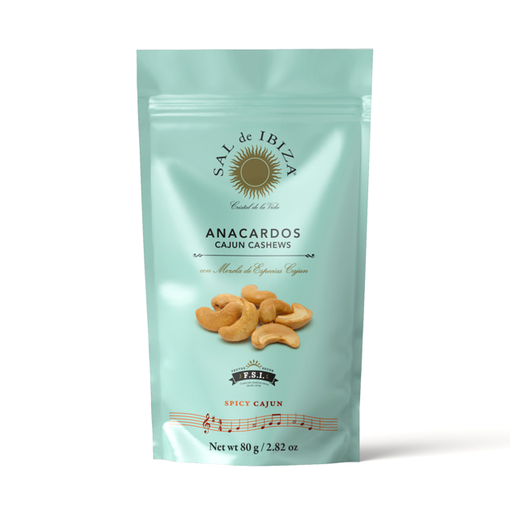 Image unavailable
This spicy recipe can go with a salad if you’re after this type of seasoning rather than an unsalted option. It provides 595 kcal and 1.2 g of salt per 100 g. Check the pack for any allergen warnings that apply to you.
 Image unavailable
For a snack or to serve alongside a meal, bear the salty seasoning in mind before choosing this product. It provides 596 kcal and 0.9 g of salt per 100 g. Serve the amount you want rather than relying on the pack size as a guide.
 Image unavailable
If you prefer a recipe with no added salt, check the oil content and how much you serve, too. This product contains sunflower oil and provides 624 kcal and 0.02 g of salt per 100 g. The pack warns that it may contain traces of peanuts and other nuts.
No, that’s not how to think about the products featured here: listings from Carrefour, Auchan and E.Leclerc state between 559 and 621 kcal per 100 g. To round off a meal, focus instead on how much you serve. Manger Bouger recommends a small handful of unsalted nuts.
No. Auchan’s roasted cashews with no added salt contain sunflower oil and provide 619 kcal per 100 g. Check the ingredients list, salt content and energy value separately.
First compare the nutritional information per 100 g, then work out how it relates to the amount you plan to eat. The DGCCRF notes that nutritional information is given per 100 g or 100 ml; the portion stated on some packs can also be a useful guide.
Read the ingredients and allergen information on the pack for the product you choose: some listings warn that it may contain traces of peanuts and other nuts. To store the rest of the pack, follow the instructions for closing it and consuming the product after opening.