Anyone keeping an eye on calories
You’d like to serve cashews, but want to compare the kcal per 100 g rather than assume a “plain” recipe is lower in calories.


When choosing cashews to share during a games night, start by comparing the energy per 100 g, then check the recipe and pack size. Two Auchan product listings show 559 kcal per 100 g for roasted cashews, compared with 595 kcal per 100 g for unsalted cashews. So “unsalted” doesn’t necessarily mean “lower in calories”. A smaller pack can help you plan how much to serve, but it won’t change the product’s energy value per 100 g.
You’d like to serve cashews, but want to compare the kcal per 100 g rather than assume a “plain” recipe is lower in calories.
You’re looking for an unsalted or no-added-salt option for drinks and nibbles. Check this separately from the energy value.
You’re considering roasted, salted or sweetened cashews for their flavour and want to tell these recipes apart from options with no added sugar or salt.
For a games night, start with your main priority: calories, added ingredients or how much you’ll be sharing. Then check the other details on the pack you choose.
| Criterion | What to check | Who is it for? |
|---|---|---|
| Energy | Compare the kcal per 100 g on the labels of the products you’re considering. | If I’m looking for a lower-calorie snack, I want to compare products on the same basis. Around 50% of consumers are said to make energy their main priority. |
| Recipe | Read the ingredients, then check the “sugars” and “salt” figures per 100 g. | If I want to serve cashews with no added sugar or salt, I need to distinguish a simple recipe from seasoned versions. This is said to be the first priority for around 30% of consumers. |
| Pack size | Check the net weight and choose an amount to suit the number of players. | When I’m preparing a bowl to share, I want to plan how much I need without leaving the whole pack on the table. Pack size is said to come first for around 20% of consumers. |
At Auchan, the unsalted product listed contains 595 kcal per 100 g, compared with 559 kcal per 100 g for the roasted version. These two products show that salt claims alone don’t tell you how their energy values compare.
Check the energy and salt figures per 100 g separately.
The ingredient list for TOKAPI honey & salt cashews published by E.Leclerc includes 39.7% sugar and 2% honey. This recipe isn’t suitable if you’re looking for cashews with no added sugar.
Read the ingredients for the exact variant before relying on the product’s general name or the pack design.
A Monoprix Courses listing for Seeberger cashews warns of a choking risk for young children, particularly those under four. This is worth bearing in mind if a bowl will be within reach during the game.
Keep whole nuts out of their reach and follow the warnings on the packaging.
Two 125 g options make it easy to compare a roasted recipe with an unsalted one.
The retailer offers Carrefour Classic’ roasted cashews with no added salt in a 125 g pack.
The TOKAPI honey & salt option is an example of a sweet-and-savoury recipe, distinct from plain cashews.
ALDI France listings feature Trader Joe’s dry-roasted cashews in a 150 g pack and roasted unsalted cashews in a 200 g pack.
Monoprix Courses lists Seeberger roasted unsalted cashews in a 150 g pack, among other options.
These cashew packs offer different recipes and pack sizes for a games night. Compare their labels if your main aim is to limit calories, salt or sugars.
 Image unavailable
Worth considering if an unsalted recipe is your priority. The pack contains 130 g; the recipe includes sunflower oil and has a listed energy value of 624 kcal per 100 g. Check the allergen information on the packaging if relevant to you.
 Image unavailable
A roasted option in a 165 g pack to share among the players. The listed value is 586 kcal per 100 g; the seasoning contains salt and sugars. So this isn’t the same choice as a recipe with no added sugar or salt.
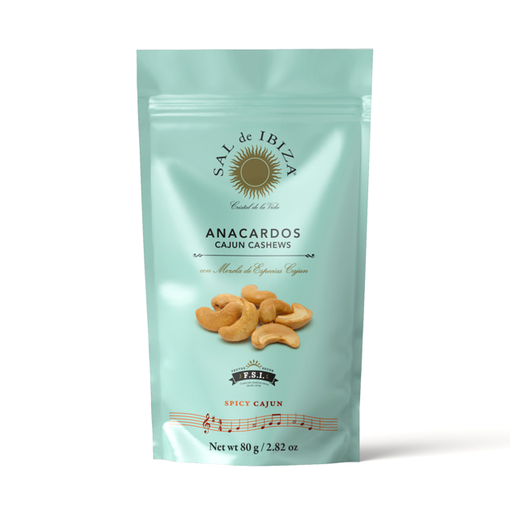 Image unavailable
The 80 g pack is a good fit if you’re looking for a smaller size and a spicy recipe. Its listed energy value is 595 kcal per 100 g; the recipe also contains salt and sugars. Check the label for allergen information.
 Image unavailable
This 120 g pack is suited to anyone who prefers salted cashews ready to serve. Its listed energy value is 596 kcal per 100 g; if you’re looking to limit salt, check the “salt” figure on the label too.
Not necessarily. Auchan listings show 595 kcal per 100 g for an unsalted option and 559 kcal per 100 g for a roasted option. Compare the energy per 100 g for each product, and check the salt separately.
Read the ingredients for the exact product, then check its sugars and salt per 100 g. A recipe with neither added isn’t automatically lower in calories, so check its energy value too.
Compare their nutritional information per 100 g. The Directorate General for Competition, Consumer Affairs and Fraud Control states that nutrition information for solid foods is given on this basis. Then check the net weight to plan how much to serve.
Don’t leave whole cashews within their reach. A Monoprix Courses listing for Seeberger cashews warns of a choking risk for young children, particularly those under four.