What should you check before buying?
Start by deciding how much you plan to eat, then compare recipes based on the snack’s role during your ride and the ingredients you want to avoid.
| What matters |
What to check |
Who is this for? |
| Portion size and energy |
Compare the kcal per 100 g and decide how much you’ll take with you; the packet’s weight isn’t a serving size. |
If I want a small snack, I need to be able to measure how much I’ll eat rather than rely on the packet size alone. Around 50% of consumers put managing portion size and energy intake first. |
| Carbohydrates to suit the ride |
Check the carbohydrate and sugar content per 100 g; distinguish plain cashews from a mix with sweetened fruit. |
Before choosing a snack for a ride, I want to know whether its ingredients suit when I plan to eat it. Matching carbohydrate intake to exercise is the priority for around 30% of consumers. |
| Added salt and oil |
Check the ingredients list and the “salt” line; “unsalted” doesn’t mean “no added oil”. |
If I prefer a recipe with no added salt or oil, I want to check for these ingredients without assuming that it’s lower in calories. This type of choice comes first for around 20% of consumers. |
Cashews to compare on Joybuy
These three cashew recipes are worth comparing for a snack to take on a bike ride. They have different seasonings, so check the kcal per 100 g, the ingredients and how much you plan to eat. Don’t treat the whole packet as a recommended serving.
 Image unavailable
BENENUTS Dry-Roasted Cashews 165 g
If you want to take a snack with you and decide how much to eat, compare the 586 kcal per 100 g listed for this product with the amount you’ll take from the 165 g packet. The product page lists 0,92 g of salt per 100 g, so this recipe isn’t suitable if you’re looking for unsalted cashews. It also warns that traces of peanuts and other tree nuts may be present.
View on Joybuy
 Image unavailable
BENENUTS Unsalted Cashews 130 g
This recipe suits anyone looking for cashews with no added salt, but not those avoiding added oil: the ingredients list includes sunflower oil. It contains 624 kcal per 100 g and comes in a 130 g packet, so decide separately how much to have as a snack. The product page warns that traces of peanuts and other tree nuts may be present.
View on Joybuy
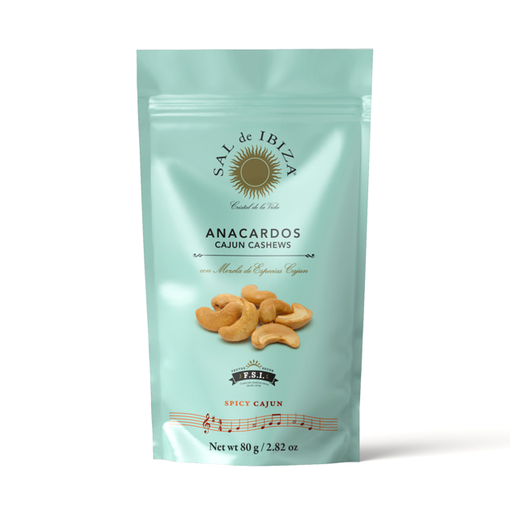 Image unavailable
SAL DE IBIZA Creole Spiced Cashews & Sdi 80 g
If you prefer a spicy recipe in a small packet, this one weighs 80 g; that doesn’t make it a recommended serving. The product page lists 595 kcal and 1,2 g of salt per 100 g, and sunflower oil in the spice mix. It also warns that traces of peanuts, other tree nuts and other allergens may be present: check the product label.
View on Joybuy
Frequently asked questions
Are unsalted cashews low in calories?
The “unsalted” claim doesn’t mean they’re low in calories. The Auchan and Carrefour product pages list 595 and 613 kcal per 100 g respectively for unsalted cashews or cashews with no added salt. You should also consider how much you’ll eat.
Do cashews with no added oil always contain fewer calories?
No: the Auchan product page for the Papapéro option with no added fat lists 631 kcal per 100 g. To make your choice, check the ingredients for oil and the nutrition information for the kcal in the specific product.
Should you choose plain cashews or a sweetened mix for a bike ride?
Choose according to what you want your snack to do, rather than treating these products as equivalent. The Tokapi cashew and cranberry mix listed by E.Leclerc contains 52,4 g of carbohydrates and 40,5 g of sugars per 100 g. The American College of Sports Medicine’s position statement highlights that the type and amount of food, and when you eat it, matter in a sporting context.
What should you look for on the label before buying cashews?
Check the ingredients, kcal per 100 g, sugars, salt and any may-contain warnings specific to the packet you choose. For products sold in France, the Directorate-General for Competition Policy, Consumer Affairs and Fraud Control reminds consumers that allergenic ingredients must be emphasised on the label.
How should you store cashews after opening?
Follow the instructions on the packet you buy. The Auchan cashew product page recommends sealing the packet airtight after opening; the Daco Bello cashews listed by Monoprix should be kept in a cool, dry place and eaten soon after opening.


