People who want to plan their portion
After a workout, you’re looking for a snack whose energy content you can compare, without confusing the amount in the packet with how much you plan to eat.


To choose cashews for after exercise while keeping the energy content of your snack in check, compare the kcal per 100 g and decide how much you’ll eat, rather than relying on the ‘unsalted’ label alone. Carrefour and Monoprix product listings for ETHIQUABLE, Daco Bello and Seeberger show 593, 595 and 603 kcal per 100 g respectively. Even the least energy-dense of the three is still high in energy. Depending on your session and when you’ll next eat, cashews might also be just one part of your snack.
After a workout, you’re looking for a snack whose energy content you can compare, without confusing the amount in the packet with how much you plan to eat.
You want to tell plain cashews apart from seasoned snacks in the nibbles aisle. Check the ingredients list and the ‘salt’ figure to make sure the recipe is right for you.
You’re wondering whether cashews will be enough to tide you over until your next meal. INSEP’s nutrition guidance also covers other foods and hydration as part of an athlete’s diet.
For a post-workout snack, start with the energy content per 100 g, then check the ingredients and decide how much to serve.
| What matters | What to check | Who is it for? |
|---|---|---|
| Energy and portion size | Compare the kcal per 100 g, then decide how much to serve rather than eating straight from the packet. | After a workout, I want to keep track of how much I’m snacking on, without treating the whole packet as one portion. Around 40% of consumers would prioritise keeping an eye on energy and portion size. |
| Salt and ingredients | Check the ingredients list and salt per 100 g, particularly to distinguish a plain recipe from a seasoned one. | If I’m looking for cashews with no added salt, a seasoned snack recipe won’t meet the same need. Ingredients would be the priority for around 30% of consumers. |
| How it fits into your snack | Think about how long it will be until your next meal and what else you plan to eat after exercising. | If my next meal is a while away, I want to know how much of my snack should be cashews. Around 20% of consumers would make this their priority. |
| Shopping at your usual retailer | Check which product is available, then compare its label rather than assuming two recipes are alike. | I prefer to shop at my usual retailer while choosing a recipe that suits my needs. For around 10% of consumers, convenience would come first. |
The Joybuy listing for BENENUTS unsalted cashews gives 624 kcal per 100 g, compared with 593 kcal per 100 g on Carrefour’s listing for ETHIQUABLE dry-roasted cashews. Salt alone, then, isn’t enough to compare the energy content of these two products.
Compare the energy per 100 g, salt and ingredients of the product you’re considering separately.
Carrefour’s listing for CARREFOUR BIO salted roasted cashews includes sunflower oil and salt in the ingredients. This isn’t the same recipe as dry-roasted cashews with no added salt.
If you’re looking for a short ingredients list, check the packet, even when the front mainly highlights the cashews.
Choosing a relatively lower-energy product doesn’t, on its own, determine what’s right after every workout. When you’ll next eat also affects how your snack fits into the day.
Decide on your portion with the rest of your diet in mind, rather than choosing solely on the basis of the lowest kcal figure.
Cashews themselves are an ingredient to consider if you have an allergy. The DGCCRF states that allergenic ingredients must be highlighted in the ingredients list on pre-packed food.
Check the ingredients list and any ‘may contain’ warnings on the packaging of the product you buy. For loose products, check the information provided in the aisle.
The organic, dry-roasted, unsalted product listed by Carrefour gives you a way to compare a recipe with no added oil.
The plain, unsalted roasted product listed by Monoprix has only cashews in its ingredients list.
Monoprix lists a plain cashew product that you can compare with other recipes without declared seasoning.
The products listed at Aldi include unsalted roasted cashews and a dry-roasted version.
These products give you a choice of a large packet of cashews, a dry-roasted version and seasoned recipes. For a post-workout snack, check the ingredients and serve the amount you’ve planned before you start eating.
 Image unavailable
This 500 g packet could suit you if you plan to portion out your snack separately. Check the product’s nutrition information and decide how much you’d like to eat; the packet size isn’t a post-workout portion.
 Image unavailable
If your priority is a snack with no added salt, check the recipe on this 165 g dry-roasted version: it is seasoned. Compare its label with that of a plain product, and don’t treat the whole packet as one portion.
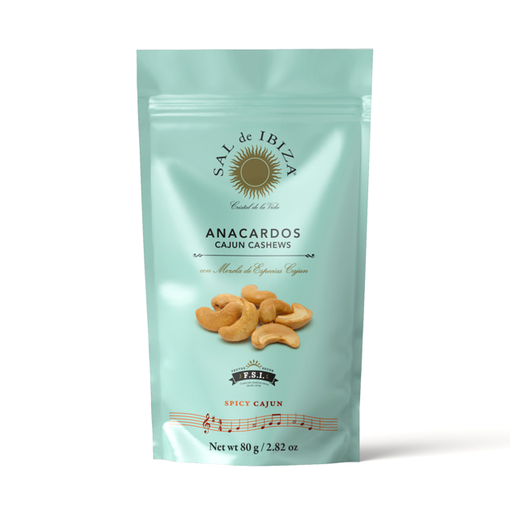 Image unavailable
This 80 g spicy recipe is for anyone who enjoys seasoned cashews, rather than those looking for plain cashews with no added salt. Check the ingredients, allergen information and how much you plan to eat.
 Image unavailable
These salted cashews with skin come in a 120 g packet and aren’t suitable if you’re looking for a recipe with no added salt. If you’re considering them for a post-workout snack, compare their label with plain versions and decide how much to serve separately from the packet size.
The products compared here aren’t low-energy snacks simply because they’re cashews: Carrefour lists 593 kcal per 100 g for ETHIQUABLE, while Monoprix lists 595 and around 603 kcal per 100 g for Daco Bello and Seeberger. To compare two products, use the same 100 g basis, then take account of how much you actually serve.
Compare the energy, fat and salt per 100 g, then read the ingredients list. The ‘unsalted’ label alone doesn’t tell you the energy content or what else is in the recipe.
They can be part of a snack, but what works won’t be the same after every workout. How long it is until your next meal and what else you plan to eat both matter. INSEP’s guidance covers protein sources, starchy foods, fruit and hydration as part of an athlete’s diet.
Follow the instructions for the product you’ve bought. Monoprix’s listings for Daco Bello and Seeberger recommend keeping them away from heat and moisture. Daco Bello’s listing also advises eating them soon after opening.
Read the ingredients list and check for any ‘may contain’ warnings on the specific packet you’re buying. For pre-packed food in France, the DGCCRF states that allergenic ingredients must be highlighted in the ingredients list.