For a ready-portioned snack
If you eat between meetings, compare the weight of each individual packet with the amount you plan to serve. A larger pack can also work well if you prepare your portion before sitting down.


For a work-from-home lunch, start by choosing a plain recipe or one with no added salt, then pick a pack that lets you take out the amount you want: a multipack keeps the individual packets separate, while a resealable pack is easy to portion into a bowl at home. An individual packet isn’t necessarily a small portion, and cashews are best enjoyed as part of a varied lunch rather than as a meal on their own. Check the allergens and storage instructions after opening on the specific product you buy.
If you eat between meetings, compare the weight of each individual packet with the amount you plan to serve. A larger pack can also work well if you prepare your portion before sitting down.
If ingredients are a key factor in your purchase, distinguish plain or no-added-salt cashews from roasted and salted varieties. Check the product name, ingredients and nutritional information to compare different options.
If you need to avoid certain ingredients or traces, check the exact pack you’re buying. Warnings can vary between recipes and pack sizes.
Start with the amount you want to serve and the recipe that suits you, then check how the pack fits into your lunch and how to store it after opening.
| What to consider | What to check | Who is it for? |
|---|---|---|
| Amount per packet | Compare the weight of each individual packet with the amount you want to serve; check whether an opened pack can be resealed. | Between meetings, I’d rather prepare my portion than eat straight from the pack. Around 20% of consumers put this portion-size consideration first. |
| Recipe and salt | Read the ingredients list and the “salt” value per 100 g to distinguish plain, no-added-salt and roasted-and-salted recipes. | If I eat cashews regularly during my break, the recipe’s ingredients determine my choice. This is the top priority for around 33% of consumers. |
| How they fit into lunch | Plan what you’ll have with the cashews, including vegetables or fruit and any other foods you want to include in your meal. | When lunch needs to be quick, I want cashews to go with a meal, not replace it. Putting that lunch together is the priority for around 27% of consumers. |
| Allergens and storage | Check the allergens, any possible traces and the storage instructions after opening for the product you choose. | If I need to consider allergens or store an opened pack, these details determine what I buy. They’re the main concern for around 20% of consumers. |
The TOKAPI multipack featured by E.Leclerc contains three 80 g packets. The pack can be divided up, but each packet doesn’t automatically equal the “small handful” of unsalted nuts mentioned by Manger Bouger.
Check the weight of each packet. If you want to eat less, serve your portion in a bowl or divide the contents between smaller containers.
Two recipes can have different ingredients. Auchan’s information for a no-added-salt option lists 0.01 g of salt per 100 g, while the roasted-and-salted TOKAPI multipack featured by E.Leclerc lists 0.8 g per 100 g.
Compare the ingredients and nutritional values per 100 g for the specific product you’re considering.
Instructions vary: Auchan advises consuming its 200 g option within 5 days of opening, and its 150 g roasted, no-added-salt version within 10 days.
Choose a pack size that suits how quickly you’ll use it, and follow the instructions on the packet.
Salt information doesn’t tell you about allergens. Carrefour warns that its no-added-salt option may contain traces of peanuts and other nuts; Auchan product pages also mention traces, which vary by product.
Check the ingredients and warnings on the pack you buy, rather than relying on information for a different recipe.
Carrefour offers no-added-salt cashews in a 200 g pack, which you can portion yourself for a snack at home.
Monoprix describes its 200 g option as containing raw cashews. You can take some out to serve with a lunch prepared at home.
E.Leclerc offers, among other options, a TOKAPI multipack containing three 80 g packets of roasted and salted cashews.
Auchan offers several cashew options, including no-added-salt varieties and packs in different sizes.
Lidl offers plain cashews in its Alesto range.
ALDI offers TRADER JOE'S dry-roasted cashews in a 150 g pack and roasted, unsalted cashews in a 200 g pack.
These two cashew packs suit different tastes for a work-from-home break: an unsalted option to portion at home and a spiced option in an 80 g pack. The pack weight alone doesn’t determine how much you should serve.
 Image unavailable
To prepare a portion before lunch at home, take the amount you want from this 130 g pack. The recipe is described as unsalted, but the whole pack isn’t an individual serving. Check the ingredients, allergens and after-opening instructions on the packaging.
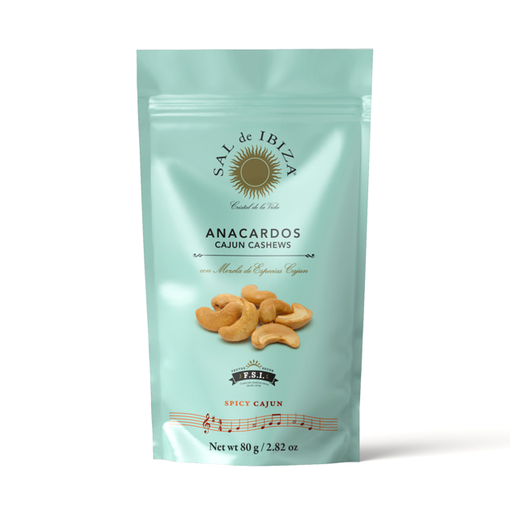 Image unavailable
This 80 g pack is a good choice if you’re looking for spiced cashews to serve alongside a meal. The seasoned recipe isn’t the same as an unsalted option, and the whole pack isn’t automatically a small portion. Check the ingredients, allergens and after-opening instructions.
No, they’re better enjoyed as an accompaniment. To round out the rest of your meal, Manger Bouger suggests foods such as vegetables, starchy foods or pulses, with a source of protein depending on the dish.
Not necessarily. Manger Bouger uses a “small handful” as a guide for unsalted nuts. If you choose an 80 g packet, serve the amount you want to eat rather than assuming the whole packet is one portion.
Check the ingredients list and the “salt” value per 100 g for each product: these descriptions don’t tell you everything about the recipe. A no-added-salt option may also contain other ingredients.
Read the ingredients and trace warnings on the exact pack you’re buying. The DGCCRF says allergenic ingredients must be highlighted on the label; trace warnings vary between products.
Follow the instructions for your product. Auchan advises consuming one 200 g option within 5 days of opening and a 150 g roasted, no-added-salt option within 10 days. These timeframes don’t automatically apply to other packs.