
Livraison le jour même ou le lendemain

Qualité garantie

Débloquez vos offres de bienvenue: Livraison GRATUITE | Jusqu'à -80 % | 30 jours d'essai gratuits à JoyPlus
Téléchargez l'application
A stain on a sofa, a carpet marked by frequent footfall or a heavily soiled car seat can quickly prove too much for a standard vacuum cleaner. A carpet and upholstery cleaner generally injects water or a cleaning solution, then vacuums up the moisture and dirt. This principle is suitable for rugs, carpets, sofas, stairs and vehicle upholstery that are compatible with wet cleaning.
The challenge is knowing how to distinguish genuinely useful features from the figures manufacturers choose to highlight.
Power, expressed in watts, mainly tells you about electricity consumption and the motor. It is not enough to assess the appliance’s extraction capabilities. When this information is provided, look instead at the suction pressure in kPa, the hose length and the nozzle design.
A 500 W appliance may be perfectly suitable for occasional domestic use. However, this figure does not guarantee faster cleaning or shorter drying times.
A small tank limits the number of areas you can treat before you need to empty or refill it. Conversely, a larger appliance may become awkward to store in a flat or carry to the car.
Check the capacity of the clean-water tank and the recovery tank separately. These two volumes serve different purposes. After each use, empty and rinse the dirty-water tank to help prevent odours and residue build-up.
A long hose, several attachments or a hot-water function can make cleaning easier. However, these features require regular maintenance. A blocked nozzle, a damp filter that has not dried properly or a hose stored while still wet can quickly make the appliance less pleasant to use.
Before buying, check how easily you can access removable parts, how the cable is stored or how recharging works, and whether the accessories listed in the product description are available.
For an isolated stain, a compact spot cleaner is often sufficient. For a family rug, carpet or several car seats, it is better to choose a model with a clearly stated suction level and a nozzle designed for textiles.
An extractor vacuum cleaner sprays a controlled amount of water or cleaning solution, then recovers some of the moisture. It does not replace professional cleaning: the result depends on the textile, the type of stain, the product used and the drying time.
Appliances marketed as wet and dry vacuum cleaners may be suitable for several uses. However, make sure the manufacturer specifically permits their use on textile and wet surfaces.
A cordless cleaner is particularly convenient for stairs, a car interior or areas far from a power socket. However, its battery life must be considered alongside the battery capacity and charging time. A stated battery life of “up to” a certain figure generally applies to a specific usage mode, often more favourable than real-world conditions.
A corded appliance can run continuously, with its operating radius determined by the cable and hose lengths. In a home with several rooms, this remains an attractive option if storage and access to power sockets are not an issue.
A hot-water cleaner can change how certain types of dirt are treated, but you must follow the instructions in the manual. Not all rugs, sofas and floor coverings can withstand heat and moisture. Always test the appliance on an inconspicuous area and check the textile’s care label.
For cleaning stairs and car seats, a small, manoeuvrable nozzle is often more useful than a wide head. For rugs and carpets, choose a cleaning width suited to the surface, together with a sufficiently long hose.
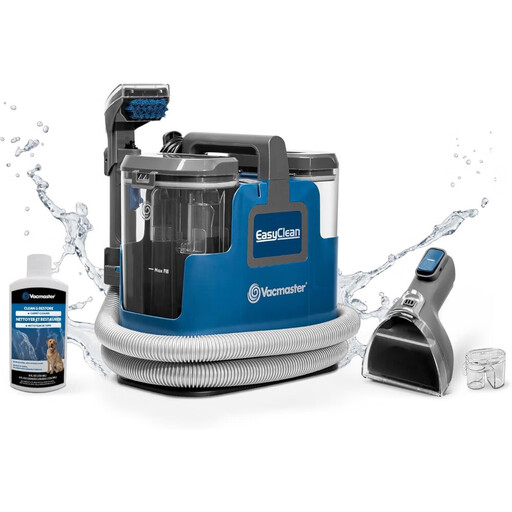
Why this choice suits this profile: With its compact design and stated weight of 3.4 kg, this model is ideal for anyone who wants to tackle the occasional sofa, rug or car seat without bringing out a bulky appliance.
Its compact size takes up little space, while the 1.8 m hose lets you work on an area without having to keep moving the main unit.
Compact design, stated 500 W motor, dual tank listed in the product title and accessories for different surfaces.
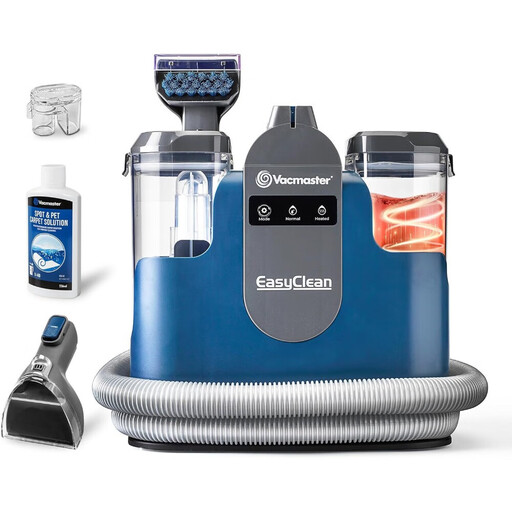
Why this choice suits this profile: This model is designed for households looking for a hot-water function, stated suction of 17 kPa and a set-up suitable for rugs, sofas and car interiors.
The product description clearly distinguishes the 500 W power rating, stated maximum pressure and hot-water function, rather than reducing performance to the wattage alone.
Hot-water function, stated maximum pressure of 17 kPa, 1.8 m hose and stated operating radius of 5 m.
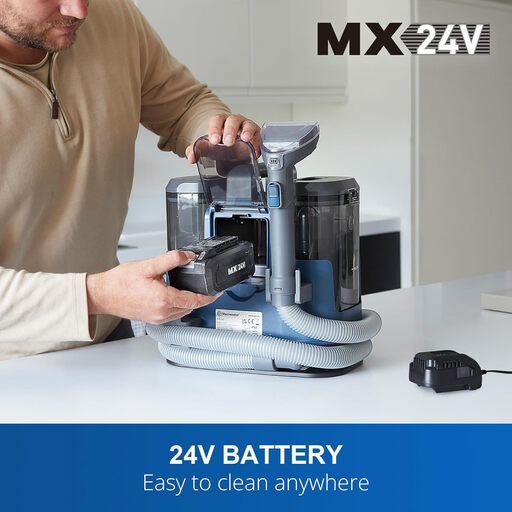
Why this choice suits this profile: Its cordless design is ideal for pet owners, families and motorists who need to act quickly on stairs, on a sofa or inside a car.
With no cable to restrict movement, it is easier to reach areas far from a power socket. However, the stated battery life of “ up to 57 minutes ” must be considered in relation to the mode used.
Stated suction of 15 kPa, 24 V MAX battery, 1.6 L clean-water tank and stated weight of 6.8 kg.
We have put together a complete, real-time updated selection of products that meet these demanding criteria and European safety standards.
To tackle pet hair or ingrained dirt, brushing the surface first with a soft brush can complement the cleaning process. Avoid products that are not designed for the appliance: they may create too much foam or damage the hoses and internal channels.
Yes, provided the manufacturer and the sofa’s care label allow wet cleaning. Use a small nozzle, apply only a little water and test it first on a hidden area. Some delicate textiles, such as velvet, or coverings that are sensitive to moisture require a different method.
Both appliances can work using the injection-extraction principle. The main differences concern the nozzle size, tank capacity, weight and manoeuvrability. A compact sofa shampooer is suitable for small areas, while a larger carpet cleaner will generally be better suited to treating an entire room.
The cost depends on the electricity consumed, the amount of solution and the volume of water used. A 500 W model uses around 0.5 kWh if it runs for one hour, excluding water and detergent. In practice, a cleaning session generally takes less time, but it all depends on the surface being treated and how dirty it is.