
Livraison le jour même ou le lendemain

Qualité garantie

Débloquez vos offres de bienvenue: Livraison GRATUITE | Jusqu'à -80 % | 30 jours d'essai gratuits à JoyPlus
Téléchargez l'application
Whether you're a seasoned craftsman or a weekend DIYer, a reliable carpenter's square is the cornerstone of any successful woodworking project. The problem is, the market is flooded with models of wildly inconsistent quality. A poor choice is a recipe for inaccurate cuts, failed joints, and wasted time and materials. As the Head of the Equipment section, my mission is to guide you through this jungle to find the tool that won't let you down on either precision or durability.
To avoid buyer's remorse, here are the most common pitfalls to avoid.
To avoid these disappointments, focus on a few technical details that never lie.
This is its entire purpose: to guarantee a perfect angle. The blade must be perfectly flat and firmly attached to the stock. On a precision square, the joint between these two parts is a critical point. Sturdy construction, with quality rivets or fastening screws, is an excellent indicator. The blade itself should be made of stainless steel or aluminium of sufficient thickness (around 2?mm) to resist bending.
The metal square is the top choice for durability. Stainless steel offers perfect resistance to rust and wear, while aircraft-grade aluminium provides an excellent balance of light weight and strength. The stock's material also matters: a zinc or aluminium alloy is often preferred for its stability.
Avoid painted markings and opt for laser-etched or stamped markings instead. Fade-proof and precise, they will remain perfectly legible even after years of workshop use. Dual markings (metric and imperial) can be a plus if you work with imperial plans.
The choice will depend on your needs:
To illustrate these criteria, here is a selection of products that meet different needs, all available on Joybuy.
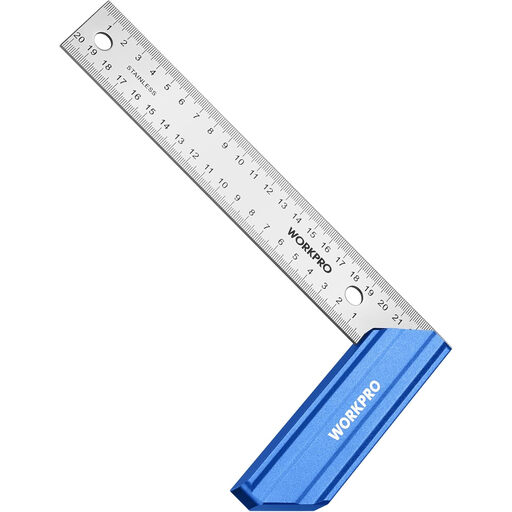
Key Feature: A reliable, no-frills classic for all marking and right-angle checking tasks in joinery. The essential basic tool.
Its stainless steel blade and three-rivet fastening guarantee it maintains its 90° angle, eliminating the risk of an "inaccurate square." The laser-etched markings are permanent.
A sturdy construction with proven materials (stainless steel and aluminium alloy) for rock-solid reliability.
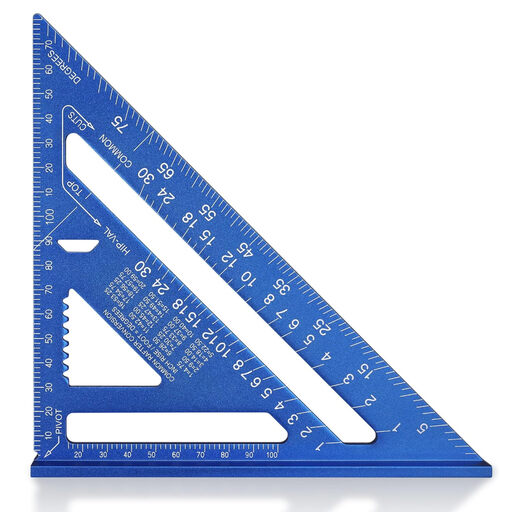
Key Feature: Ideal for carpenters, roofers, or DIYers involved in construction projects. Its speed square format makes it an ultra-fast and versatile tool on the job site.
Cast from a single piece of aluminium alloy, it is warp-resistant and therefore cannot become inaccurate. Its matte, anti-glare finish ensures excellent readability in direct sunlight—an ergonomic detail that makes all the difference.
Multiple tools in one (protractor, saw guide, square) in a compact and robust format, designed for job site efficiency.
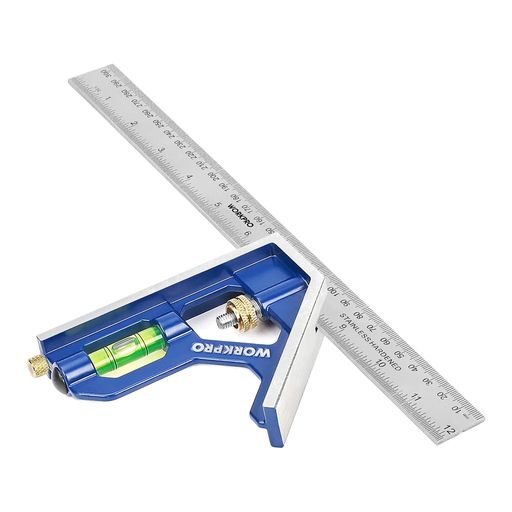
Key Feature: The tool of choice for demanding cabinetmakers, fitters, and joiners. An indispensable all-in-one instrument for complex tasks: setting up machinery, measuring depth, marking, and levelling.
It balances versatility and quality, a common failing in many multi-function models. Its zinc alloy head and stainless steel ruler are guarantees of durability that protect it from the pitfall of fragility.
Maximum versatility thanks to its 300 mm sliding blade, its bubble level, and its integrated scriber. All supported by a reliable locking mechanism.
Discover our full selection of tools that meet our strictest quality and safety criteria.
It's a test that's as simple as it is essential. On a board with a perfectly straight edge, place the stock of your square firmly against it and draw a line along the blade. Then, flip the square over (like a mirror image), place the stock against the same edge, and bring the blade up to your line. If the blade lines up perfectly with the first mark, your square is accurate. If a gap appears, it's inaccurate.
The try square has a fixed blade and is primarily used for marking and checking 90° angles. The combination square, on the other hand, is much more versatile: its blade slides and can even be removed. It allows you to measure depths, scribe parallel lines, and often includes a bubble level as well as a shoulder for 45° angles.
Accuracy depends less on the material and more on the quality of the machining. A high-quality, carefully machined aluminium tool will be just as true as a steel one. The main difference comes down to weight (aluminium is lighter) and long-term wear resistance (steel, being harder, better withstands impacts and scratches). For heavy-duty use, stainless steel remains the benchmark.