
Livraison le jour même ou le lendemain

Qualité garantie

Débloquez vos offres de bienvenue: Livraison GRATUITE | Jusqu'à -80 % | 30 jours d'essai gratuits à JoyPlus
Téléchargez l'application
Investing in a new tool is a major decision, especially when precision is key. With so many options on the market, it can be difficult to distinguish a reliable, durable tool from one that won't live up to its promises. As a Product Recommendation Officer at Joybuy, my role is to bring clarity by analysing the objective features of products, ensuring your choice is informed and perfectly suited to your needs.
A good carpenter's square is the foundation of any successful woodworking project. Whether for marking, measuring angles, or guiding cuts, its reliability is non-negotiable. This article provides concrete selection criteria and a curated selection of two tools with distinct features to guide your decision.
Before looking at specific models, it's helpful to understand the key points that define a quality wood marking tool.
The construction material directly impacts the square's longevity and accuracy.
A sturdy body, for instance made of zinc alloy, ensures the tool will not deform under pressure or from minor impacts.
A multifunction square can replace several tools, saving you space in your toolbox. Some models include:
Assessing your needs will help you determine if a simple layout square is sufficient or if a more versatile model would be a better investment.
A square's precision is useless if its markings are hard to read. Opt for laser-etched or deeply stamped graduations that won't fade over time. The presence of a dual scale (metric and imperial) can be a major advantage, especially if you work with plans that use both systems. Clear, high-contrast markings are essential for fast, error-free work.
Taking the above criteria into account, here are two options that meet different yet complementary needs in the world of woodworking tools.
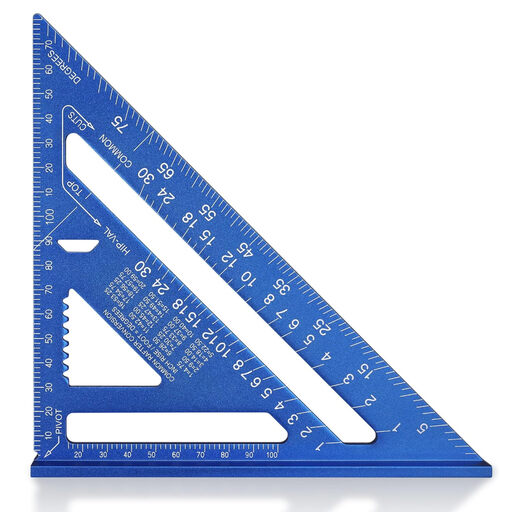
Why We Recommend It
This model, often called a rafter square or "speed square," is a remarkably versatile tool. Made from aluminium alloy with a matte finish, it is both lightweight and robust. Its triangular design makes it an excellent cutting guide for circular saws. It also integrates protractor scales for quickly measuring and marking angles from 0 to 90 degrees, making it extremely practical on a job site.
Pros:
Who is this product for? This is an excellent choice for woodworkers, carpenters, roofers, and avid DIYers. Its portability and multiple functions make it a first-rate companion for construction, renovation, or decorating projects involving frequent angle cuts.
See Product Details on Joybuy.fr
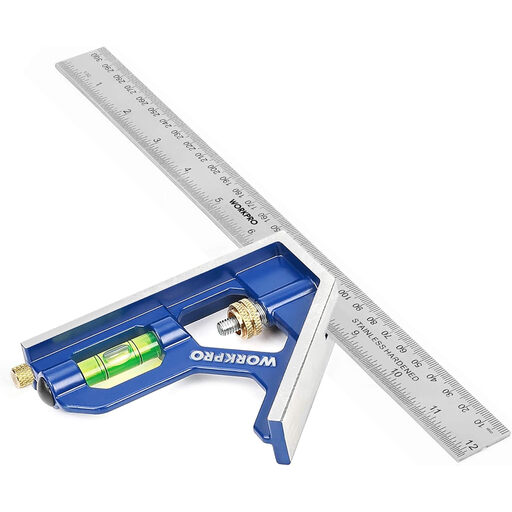
Why We Recommend It
The combination square is a workshop classic, prized for its precision and modularity. This WORKPRO model pairs a 300 mm stainless steel ruler with a robust zinc alloy head. The sliding, lockable head allows you to mark perfect 90° and 45° angles, as well as measure depths and check for level with the integrated spirit level. The scriber housed in the head is a practical detail that saves you from searching for a pencil.
Pros:
Who is this product for? Ideal for engineers, cabinetmakers, and construction professionals who demand high precision for their layout and verification tasks. It is particularly well-suited for machine setup, transferring precise measurements, and checking right angles on joinery.
See Product Details on Joybuy.fr
The selection presented covers two of the most common needs in measuring and marking. However, every project is unique. If you have more specific requirements or simply want to compare other models, many alternatives are available.
? Explore our full range of measuring tools to find the instrument that perfectly matches your needs.
1. What is the difference between a woodworking square and a carpenter's square? Although the terms are often used interchangeably, a "carpenter's square" or "rafter square" generally refers to the triangular "speed square" type described above, widely used for marking rafters and angle cuts. A "woodworking square" can refer to this same tool, but also to the traditional L-shaped framing square or the combination square, which is more geared towards workshop and cabinetmaking tasks.
2. How do you check a square's accuracy? A simple method is to draw a line along the square's blade on a surface with a perfectly straight edge. Then, flip the square over and align it with your line. If the blade is perfectly parallel to the line you drew, your square is accurate. If a gap appears, it is not a true 90°.
3. Why choose a multifunction square? Choosing a multifunction square consolidates several instruments into one. This saves space in your toolbox and time on the job site, as you don't have to switch tools to go from marking a line to measuring an angle or checking for level. It's a pragmatic choice for optimising your toolkit.