
Livraison le jour même ou le lendemain

Qualité garantie

Débloquez vos offres de bienvenue: Livraison GRATUITE | Jusqu'à -80 % | 30 jours d'essai gratuits à JoyPlus
Téléchargez l'application
Invisible and odourless, carbon monoxide (CO) can be released by a boiler, stove, fireplace, water heater or any other combustion appliance that is poorly maintained or inadequately ventilated. Whether you own or rent your home, a carbon monoxide detector provides an additional layer of protection, but it does not replace regular appliance maintenance or proper ventilation.
The key is choosing a model that genuinely suits your home. Here are the common pitfalls to avoid, the criteria to check and a selection of recommended detectors available from Joybuy.
A smoke detector monitors particles produced by a fire. It cannot replace a carbon monoxide alarm, which is generally equipped with an electrochemical sensor capable of detecting CO. Some devices look very similar, but their functions and applicable standards are not the same.
Before placing your order, check that the product listing clearly mentions “carbon monoxide” or “CO”. A model described solely as a smoke detector is not suitable for monitoring carbon monoxide.
A connected CO detector can send notifications to a smartphone. This is convenient in a holiday home or when several occupants need to receive the same alert. However, the feature depends on the Wi-Fi network, the app being used and the property’s power supply.
A Wi-Fi carbon monoxide detector is therefore not necessarily more suitable than a standalone model. In a bedroom, hallway or caravan, an independent audible alarm may even be simpler and more reliable for everyday use.
A long-life battery does not eliminate the need to test the dedicated button regularly. You should also distinguish between the battery’s operating life and the sensor’s service life, which may be different.
Be wary of listings that merely promise a “long service life” without providing a precise figure. Look for the stated lifespan, replacement instructions and maintenance recommendations.
When choosing an EN50291 CO detector, check for a reference to EN 50291, the standard governing household carbon monoxide detection devices. Ideally, this reference should be confirmed on the packaging, in the manual and, where available, in the declaration or compliance documentation.
A simple marketing claim such as “certified” is not sufficient proof on its own. Consult the regulatory information supplied with the product and always follow the manufacturer’s instructions.
A CO detector with an audible alarm should emit a signal powerful enough to be heard from occupied rooms. An indicator light can supplement the alert, but it does not replace the audible signal, especially at night.
Some models also include an LCD screen displaying various readings. This makes it easier to check the device’s status, but it does not remove the need for regular testing.
Models with a built-in long-life battery reduce the need for routine handling. Others use a replaceable battery, which can be useful if you want to keep the housing in service for longer, provided you follow the manufacturer’s recommendations.
Choose the installation location according to the manual. Avoid areas exposed to steam, heavy dust build-up or direct heat. Whether in a house, flat or caravan, consult the recommendations specific to the model and never paint over the detector.
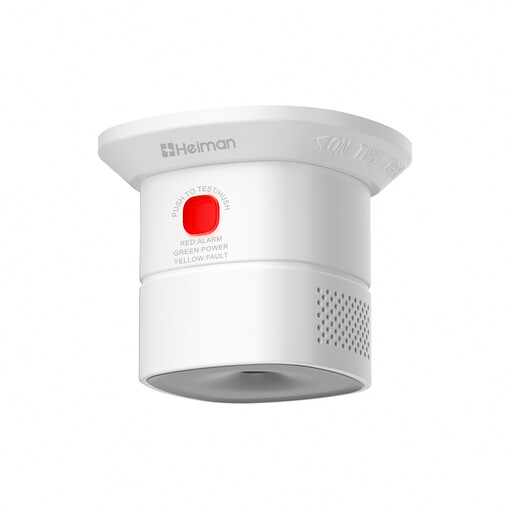
Why choose it: This two-device pack may suit a flat or house that requires several monitoring points, for example near bedrooms and combustion appliances.
The listing states that it has an 85 dB alarm and complies with EN 50291. Nevertheless, verify this information in the supplied documentation before installation.
A compact design, PC+ABS construction and a two-unit pack, as stated in the product title.
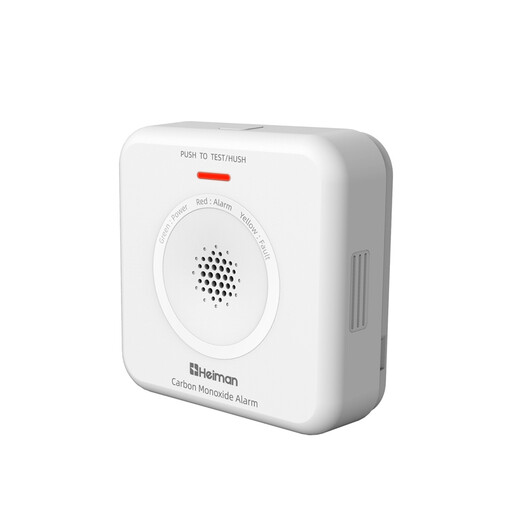
Why choose it: This model is aimed at holiday-home owners, families who are frequently away or anyone who wants to check alerts through an app.
The Wi-Fi connectivity is advertised as compatible with the Tuya and SmartLife apps. It requires a compatible network and a properly configured setup.
A stated 10-year service life, an audible alarm and a reference to EN 50291 in the product listing.
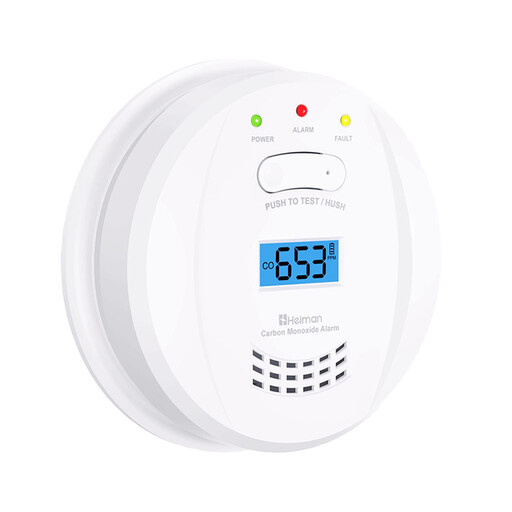
Why choose it: Its screen may appeal to anyone who wants to view information directly on the detector without relying on a mobile app.
The listing states that the battery lasts 5 years and the sensor has a 10-year service life; these two figures should not be confused.
An LCD display and test button mentioned in the product name, along with a sensor rated for 10 years.
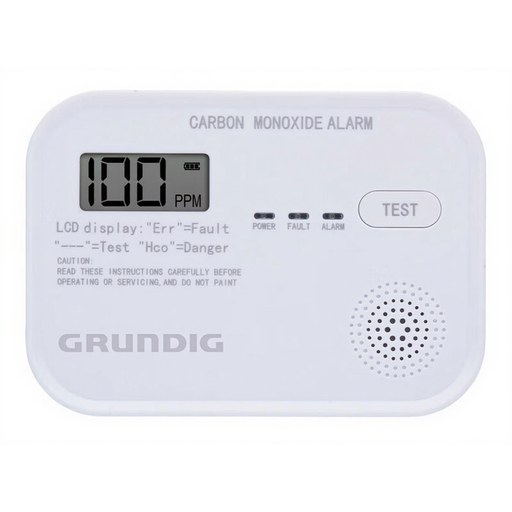
Why choose it: Its design is advertised as suitable for homes, offices, workplaces and caravans, with wall- or ceiling-mounting options.
The listing specifies an electrochemical sensor, continuous monitoring and an audible alarm. As EN 50291 is not mentioned in the supplied information, verify this point in the manual before purchasing.
An electrochemical sensor, LED indicator, compact ABS housing and wall- or ceiling-mounting options.
An alarm should never be ignored. If it sounds, ventilate the property if you can do so without putting yourself at risk, leave the premises and contact the appropriate emergency services according to the situation.
The correct location depends on the manufacturer’s instructions and the layout of the property. It is generally recommended to monitor areas close to combustion appliances, as well as rooms where people sleep. However, avoid placing the detector directly above a heat source, near a window or in an area exposed to steam.
This varies from one model to another. The product listings reviewed, for example, state a 10-year service life for the Heiman WS-725ES. The Heiman 723ESY, meanwhile, specifies a sensor designed to operate for 10 years and a battery rated for 5 years. Always refer to the replacement date shown on the device or in its manual.
Depending on the product’s design, local detection and the audible alarm may continue to operate without an internet connection. Remote notifications, however, generally require Wi-Fi access and the associated app. Check this before purchasing if smartphone alerts are essential for your home.