
Livraison le jour même ou le lendemain

Qualité garantie

Débloquez vos offres de bienvenue: Livraison GRATUITE | Jusqu'à -80 % | 30 jours d'essai gratuits à JoyPlus
Téléchargez l'application
A 28 cm carbon steel frying pan can remain a fixture in a family kitchen for years, provided you choose the right construction and accept that it requires different care from a traditional non-stick frying pan. It is particularly well suited to searing meat, frying vegetables, cooking an omelette or preparing a generous pan of potatoes.
Product listings do not always tell the whole story. Before buying a 28 cm frying pan, check its material, the nature of its surface, whether it is compatible with your hob and the care it requires on a daily basis.
A carbon steel frying pan without an artificial coating is not perfectly non-stick straight out of the box. It needs to be heated, oiled and gradually seasoned. This dark patina develops over successive cooking sessions and helps food release more easily.
The term ‘natural non-stick’ therefore generally refers to a surface that improves over time, rather than a permanent treatment comparable to an industrial coating. If you want to cook straight away without worrying about seasoning, an aluminium frying pan with a ceramic coating will be easier to live with.
At 28 cm, a professional steel frying pan can already be heavy, especially when full. A long handle makes it easier to stir or turn food, while two handles provide greater stability when moving a substantial dish.
Also consider the heat travelling up into the handle. On a steel model, the handle can become extremely hot during cooking. An oven glove or suitable heat-resistant glove is essential, even with a frying pan that is compatible with induction.
Products advertised as PFAS-free may be made from carbon steel, aluminium with a ceramic coating or another non-stick surface. The material of the frying pan and that of its coating are two different things.
A ceramic frying pan is generally quick to clean, but it is best to use wooden, silicone or nylon utensils with it. Carbon steel, on the other hand, withstands high temperatures, but it can rust if left damp or if its thin protective layer of oil is neglected.
Carbon steel is mainly made from iron, with a small proportion of carbon added. It stores heat efficiently and is very well suited to high-heat cooking, particularly for searing or roasting. Heat distribution does, however, depend on the thickness of the base and the power of your hob.
A thin frying pan heats up quickly, but also responds more abruptly to changes in power. A thicker model offers greater heat retention, at the cost of extra weight. For a family, a 28 cm diameter is a good compromise: the cooking surface is comfortably sized without taking up as much room as a large sauté pan.
Before placing your order, look for clear information about:
A 28 cm frying pan compatible with all heat sources will be more versatile. However, this does not automatically mean that it can go in the oven or dishwasher. These two points must be checked separately.
With a de Buyer Mineral B frying pan, first use generally involves removing the protective wax, drying the pan carefully and then applying a thin layer of oil that can withstand high temperatures. After each use, rinse it in hot water, dry it immediately and, if necessary, apply a light coating of oil before storing it.
Avoid the dishwasher and prolonged soaking. Soap and abrasive products can remove the patina. Slightly uneven colouring is perfectly normal; orange marks or a surface that remains damp, however, are signs that oxidation is taking place.
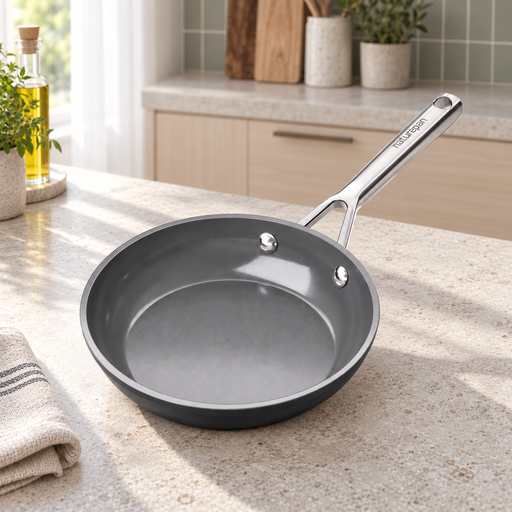
Why this choice suits this profile: Its compact size and ceramic coating make it a good first frying pan for eggs, pancakes and small portions. It is also easier to care for than a carbon steel model.
The listing states that it is compatible with induction, gas, electric hobs and ceramic hobs, and that it can be cleaned in the dishwasher. Please note, however: this model is not a 28 cm carbon steel frying pan.
20 cm size, ceramic surface advertised as free from PTFE, PFAS and PFOA, and oven-safe up to 260 °C according to the listing.
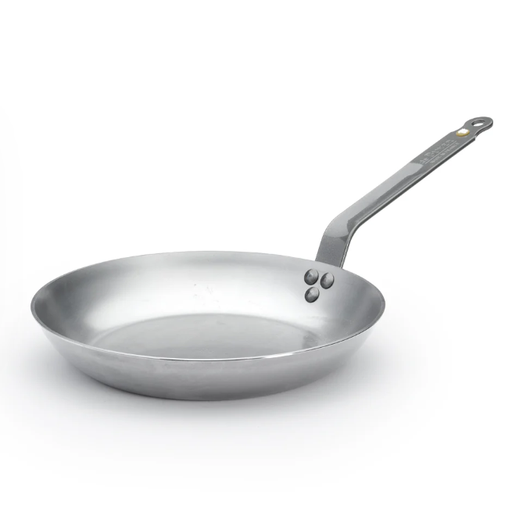
Why this choice suits this profile: Made from 99% iron and 1% carbon, this model is aimed at those who prioritise long-term durability, high-temperature cooking and a surface that improves with seasoning.
The listing clearly distinguishes carbon steel from an artificial coating and explains that the frying pan must be washed by hand and maintained regularly to help prevent oxidation.
28 cm diameter, compatible with induction and other hobs, with no artificial coating according to the product description.
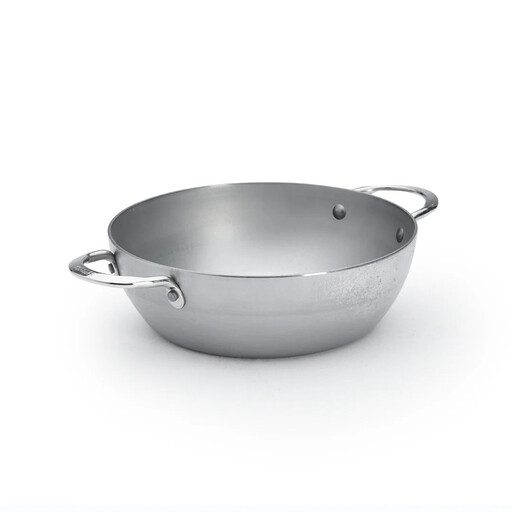
Why this choice suits this profile: Its two handles make it easier to move a full frying pan. Its deep shape is well suited to large quantities, frying and sharing dishes.
The two-handle design solves the problem of gripping a heavy pan. The description also details the steps for removing the wax, seasoning and drying the pan.
Carbon steel construction, deep shape, two handles and a surface without an artificial coating according to the product listing.
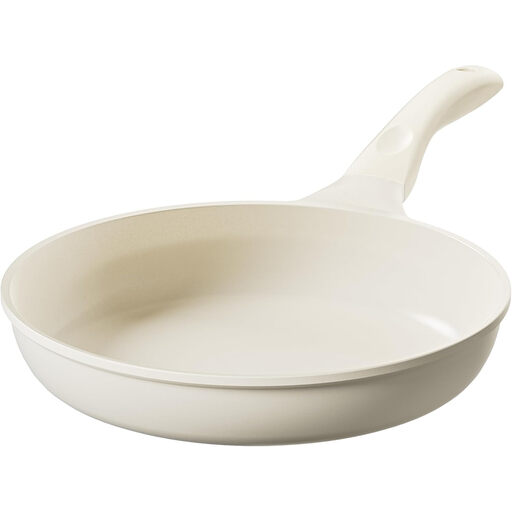
Why this choice suits this profile: This alternative to carbon steel is suitable for households looking for a family-sized diameter, a surface advertised as free from PTFE, PFOA and PFAS, and easy cleaning by rinsing or in the dishwasher, according to the listing.
Unlike carbon steel, this model does not require seasoning. However, you should avoid metal utensils and heating it when empty to protect its surface.
28 cm size, Bakelite handle, compatible with induction, gas and electric hobs, with a ceramic coating advertised as free from PTFE, PFOA and PFAS.
We have put together a complete, real-time updated selection of products that meet these exacting criteria and European safety standards.
With a carbon steel frying pan, a few simple habits are enough to avoid most problems:
With a ceramic coating, use a low to medium temperature and non-metal utensils. The right time to replace the frying pan depends on the actual condition of its surface, not on a theoretical lifespan set in advance.
Yes, many carbon steel models work on induction. However, this compatibility must be explicitly stated in the product listing. Also check the diameter of the magnetic base: it may be smaller than the total 28 cm diameter.
Start by removing the protective coating applied for transport, if the manufacturer has provided one. Then wash the frying pan according to the instructions, dry it and heat a very thin layer of oil. It will take several cooking sessions and gentle cleans to develop an even patina. The first few uses require more care than with a coated frying pan.
Not really: it does not require any costly specialist products. It does, however, require a little time, thorough drying and occasional oiling. If you prioritise convenience, a PFAS-free non-stick frying pan with a ceramic coating will be more practical, provided you follow the necessary precautions to protect its surface.