
Livraison le jour même ou le lendemain

Qualité garantie

Débloquez vos offres de bienvenue: Livraison GRATUITE | Jusqu'à -80 % | 30 jours d'essai gratuits à JoyPlus
Téléchargez l'application
Choosing the wrong car wiper blades can leave streaks, create unwiped patches, or make fitting impossible. Yet packaging often just pushes vague promises like “quiet”, “all-season” or “quick installation”, without giving you the most important information for your vehicle.
Before you buy front wiper blades, watch out for three common pitfalls:
To avoid an unnecessary order, always check the make, model, generation, year of manufacture and the type of fixing.
A pair of wipers isn’t always symmetrical. The sizes might be, for example, 550 mm + 400 mm, 600 mm + 450 mm or 650 mm + 500 mm. The driver’s side blade is often longer than the passenger side one.
Measuring your old wipers can give you a rough idea, but this method doesn’t replace checking against your vehicle. A slightly different length can reduce the wiped area or make the blade hit the edge of the windscreen.
The term U-hook wiper blade refers to a very common system on many vehicles. You can recognise it by the curved end of the metal arm, which slots into the blade’s adaptor.
Other vehicles use a proprietary fixing. In this case, an OE Fit or “direct replacement” blade must be matched to a precise list of models. Don’t choose a product just because it looks like the original equipment.
A frameless wiper blade, also called a flat blade, has a flexible structure built directly into the rubber. This design limits exposed metal parts and can help water or snow drain away, depending on conditions.
The blades featured here state they use natural rubber and have an operating range of -40 °C to +70 °C. The “1 million cycles” claim comes from the product specification, not a guaranteed lifespan in all conditions. Frost, grit, insects, sunlight and use on a dry windscreen can all speed up wear.
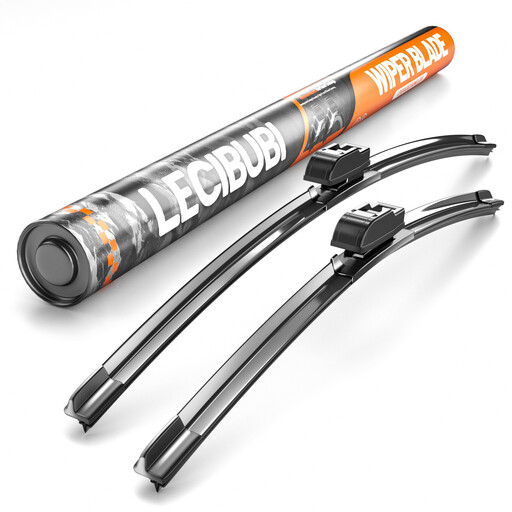
Why this suits this profile: This pair of front wiper blades fits several Dacia, Renault, Ford, Hyundai, Kia and Toyota models with a U-hook fitting. The 550 mm + 400 mm sizes are clearly stated, making it easy to check before you order.
The compatibility list and the “left-hand drive only” note let you check the essential criteria, rather than relying on the brand name alone.
A two-piece set, U-hook fixing, stated natural rubber and installation described as a direct replacement.
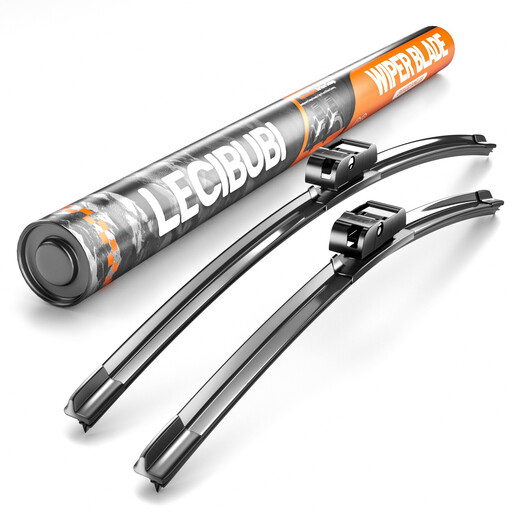
Why this suits this profile: This blade is aimed at drivers of Mercedes-Benz A-Class, B-Class, CLA and GLA who want a precise match for their vehicle, rather than a universal model.
Compatibility is detailed by model and generation. You should still compare this information with your V5C and the blade currently fitted to your car.
600 mm + 475 mm sizes, a frameless design and installation described as an OE Fit.
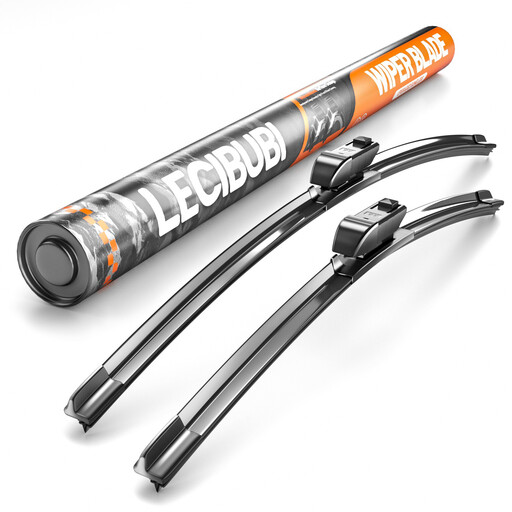
Why this suits this profile: Owners of a van or large vehicle may need a 650 mm + 550 mm pair, suited to a larger windscreen area.
The vehicle category and sizes are clearly stated. This reduces the risk of choosing a blade that’s too short or incompatible with your existing arm.
A two-blade set in 650 mm + 550 mm, stated as compatible with Citroën Jumper, Fiat Ducato, Peugeot Boxer and certain Mercedes-Benz GLS models.
We’ve put together a comprehensive, real-time updated list of products that meet these demanding selection criteria as well as European safety standards.
Even a perfectly compatible blade can leave streaks if the windscreen is dirty. Before fitting, clean the glass and the arm with a soft cloth. Also avoid running the blades on a dry or frozen surface.
For routine maintenance, a microfibre cloth for windows can remove greasy deposits without needing a cleaning product, according to its specification. The Spontex Window Wonder cloth, 35 × 35 cm, can be machine-washed at 60 °C. For hard-to-reach windows at home, a window-cleaning robot can be a practical solution. Use it with its safety cord and in accordance with the instructions.
Compare the make, model, generation, year of the vehicle, the length of each blade and the fixing system. Also check whether it’s marked for left-hand or right-hand drive. If in doubt, measure your old blades and check the compatibility list before buying.
Persistent streaks, unwiped patches, vibrations or a rubbing noise usually mean the blades are worn. A visual check of the rubber is also useful: if it’s cracked, hardened or peeling, it’s time to replace the blade.
It’s usually the simplest approach if both blades were fitted at the same time, as they’ll have experienced similar conditions. However, check their sizes separately: a set can pair two different lengths, such as 600 mm + 400 mm or 650 mm + 450 mm.