
Livraison le jour même ou le lendemain

Qualité garantie

Débloquez vos offres de bienvenue: Livraison GRATUITE | Jusqu'à -80 % | 30 jours d'essai gratuits à JoyPlus
Téléchargez l'application
A 12 V to 230 V car power inverter converts your vehicle's DC battery power into AC mains electricity, so you can run a laptop, a lamp, a small appliance or camping equipment. But not every model suits every use. The most compact units plug into the cigarette lighter socket, while more powerful versions connect directly to the battery.
Before you buy, three common mistakes crop up time and again: relying solely on the stated wattage, thinking that 230 V and 220 V are for different purposes, or overlooking the type of electrical waveform. Here are the key points to consider when choosing the right inverter for your car, motorhome, van, lorry or mobile worksite.
A rating like "2,000 W" can refer to the maximum power delivered for a brief moment, such as when a motor starts up. For prolonged use, it's the continuous rated power that matters.
An inverter advertised at 2,000 W peak might, for example, be limited to 1,000 W continuous. Add up the power consumption of the devices you want to run and leave a safety margin. Heating appliances like a kettle, hairdryer, fan heater or portable hob draw heavily from the battery and can exceed the capacity of a cigarette lighter socket.
A cigarette lighter adapter is generally fine for small inverters and chargers. However, your vehicle's 12 V socket is protected by a fuse with a limited current rating. A 300 W model therefore cannot run at full power from just any interior socket.
For a high-power 12 V to 230 V inverter, it's better to connect directly to the battery using cables of the correct gauge. Always observe the correct polarity, install the unit in a well-ventilated area and avoid using it in damp conditions.
A modified sine wave inverter may be sufficient for a simple lamp or certain chargers. Sensitive electronics, motors, audio equipment and demanding power supplies will generally perform better with a pure sine wave inverter.
Power isn't everything. Also check the output voltage, the 50 Hz frequency, the socket type and the presence of protection against overload, overheating, short circuit and low voltage.
In a standard car, a 150 to 300 W model is often enough to power a laptop, a camera, a lamp or several chargers. For a motorhome inverter, a van and camping inverter or an off-grid setup, you may need significantly higher power.
Always check:
An inverter designed for 12 V must never be connected to a 24 V system unless the specification sheet explicitly allows it.
The 12 V 230 V inverter and the 12 V 220 V car inverter are, in practice, devices designed to supply AC voltage compatible with European equipment. In the UK, the nominal domestic mains voltage is 230 V.
For powering a laptop, television, games console or a device with a motor, a pure sine wave output provides a smoother current, closer to that of the mains supply. This doesn't remove the need to check the actual power required or the manufacturer's recommendations for your device.
If your only aim is to charge phones, tablets, a sat-nav or a camera, an inverter with a mains socket isn't always necessary. A USB-C car charger, a PD QC fast car charger or a multi-port car charger will often be more compact and reduce conversion losses.
Check the power output of each port, not just the total advertised power. A 65 W USB-C port won't necessarily deliver 65 W when several outputs are in use at the same time.
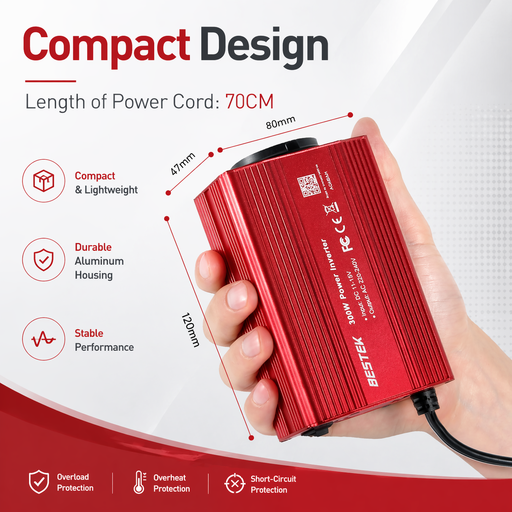
Why this suits this profile: its compact design combines a European mains socket with two USB ports, covering everyday needs in the car, on trips or at the campsite.
The spec states 300 W, a 230 V output and protection against overload, overheating and short circuit. However, you must respect the limit of the cigarette lighter socket.
European socket, two USB ports delivering up to 4.8 A total and built-in fan.
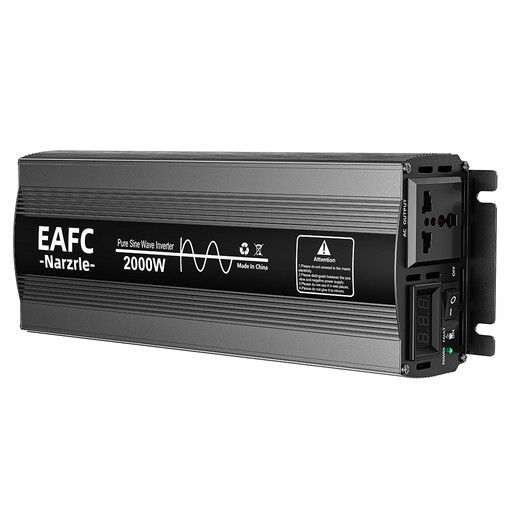
Why this suits this profile: it's designed for motorhome, campervan or backup installations that need a more powerful mains output.
The continuous power is stated as 1,000 W, distinct from the 2,000 W peak power. The pure sine wave output and digital display make it easy to monitor the setup.
Voltage display, auto-start fan and multiple protection features.
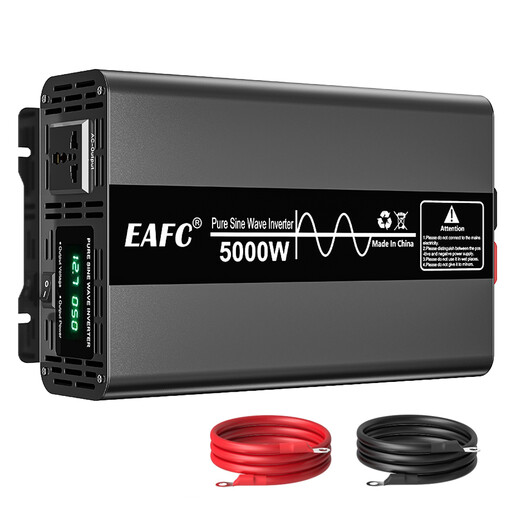
Why this suits this profile: its stated continuous power of 2,500 W makes it suitable for lorries, motorhomes, mobile worksites and off-grid installations with appropriate wiring.
The spec clearly distinguishes the 2,500 W continuous from the 5,000 W peak. Such power is incompatible with a standard cigarette lighter socket.
Pure sine wave output, LCD screen and protection against overload, overheating and reverse polarity.
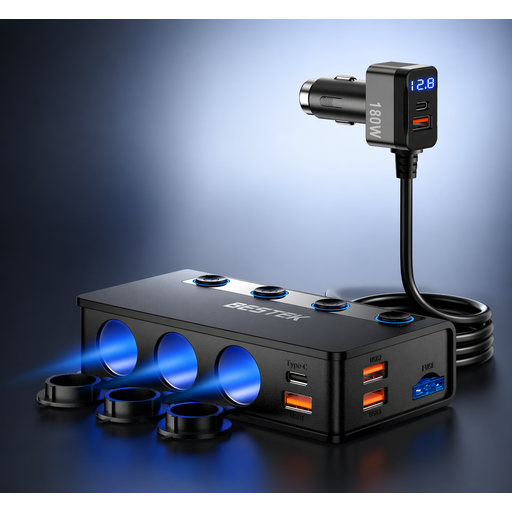
Why this suits this profile: it's ideal for families, teams and drivers who want to charge multiple devices on 12–24 V without needing a 230 V mains socket.
The total power is stated as 180 W. The spec details two USB-C PD ports, four USB-A QC3.0 ports and three cigarette lighter outputs.
12–24 V compatibility, independent switches, voltage display and overcurrent protection.
We've put together a comprehensive, real-time selection of products that meet these demanding criteria and European safety standards.
Yes, provided the inverter is designed for this type of connection and its power draw is compatible with your vehicle's fuse rating. For higher power levels, opt for a direct battery connection using cables of the correct gauge.
Pure sine wave produces a smooth waveform, similar to the domestic mains supply. It's generally better suited to sensitive devices and equipment with motors. Modified sine wave can be adequate for simple uses, as long as you follow the manufacturer's recommendations.
It depends entirely on the power consumption of the device being powered, the inverter's efficiency and your battery's capacity. Even when idle, an inverter typically draws a small amount of power. Switch it off when not in use and keep an eye on the voltage to avoid excessively draining your battery.