
Livraison le jour même ou le lendemain

Qualité garantie

Débloquez vos offres de bienvenue: Livraison GRATUITE | Jusqu'à -80 % | 30 jours d'essai gratuits à JoyPlus
Téléchargez l'application
A gleaming paint job, free of micro-scratches and holograms: it's every car enthusiast's dream. To achieve this, a car polisher is an essential tool. But with the overwhelming number of models available, it's easy to make the wrong choice and regret your purchase. As the Head of Product Recommendations at Joybuy, my mission is to guide you and decode the features that truly make a difference.
Before you get started, watch out for these 3 common mistakes:
To make an informed choice, it's essential to understand a few technical parameters. They determine the tool's safety, versatility, and ultimately, the quality of the finish.
This is THE decisive factor. It defines how the backing plate moves and directly impacts the result.
The choice between a corded model and a cordless polisher depends on your workspace and priorities.
The size of the backing plate (the disc that holds the pad) and the size of the orbital movement are key factors for versatility.
Instead of an endless catalogue, here is our curated selection: the ideal machine for every user profile, chosen based on the criteria we've just detailed.
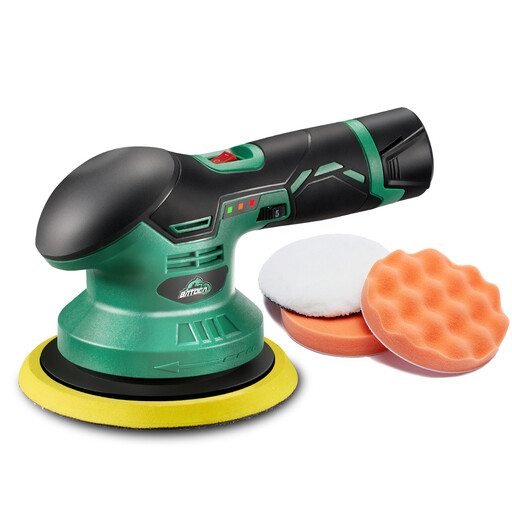
Why we chose it: This is THE ideal machine for getting started. Its 5 mm dual action (DA) orbital movement is ultra-safe and forgives beginner mistakes. Lightweight (approx. 1.3 kg) and cordless, it offers excellent manoeuvrability to learn the ropes without constraints.
It sidesteps the raw power trap. Its orbital movement is designed for safety and finishing, preventing you from "burning" the clear coat—a major risk with the rotary polishers often recommended to novices.
Its battery alert feature (green, yellow, red lights) allows you to manage battery life intelligently, avoiding the frustration of running out of power mid-hood.
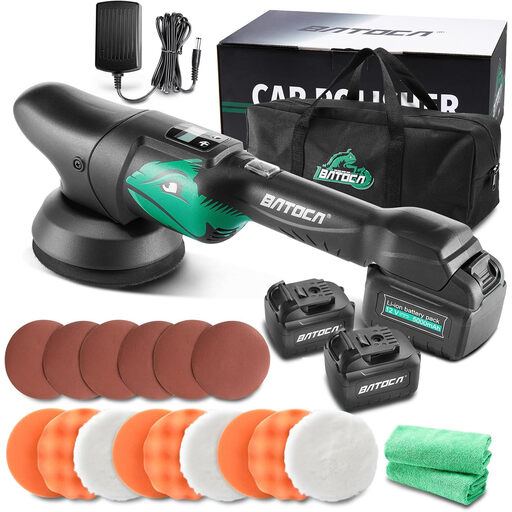
Why we chose it: For those who are serious about their car's paintwork. Supplied with two 5.0 Ah batteries, it ensures extra-long runtime to tackle a full car without interruption. Its LCD screen, which displays speed and battery status, offers pro-level control.
It addresses the problem of low-quality "all-in-one" kits. By investing in a high-performance, long-lasting machine, you get a solid foundation to which you can add a car polishing kit with quality pads truly suited to your needs.
The inclusion of two high-capacity (5.0 Ah) batteries and a fast charger allows for continuous work. This is a non-negotiable feature for complete detailing sessions.
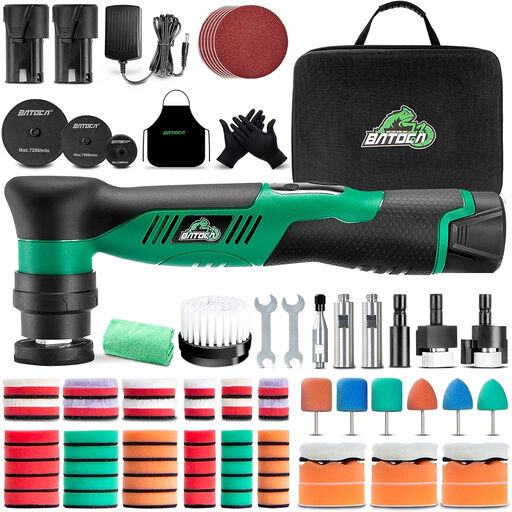
Why we chose it: This is the ultimate precision tool. With its 25, 50, and 75 mm backing plates, it gets into places standard polishers can't reach: emblems, grilles, door pillars, and even for headlight restoration. Its ability to switch between rotary, 3 mm orbital, and 12 mm orbital modes makes it incredibly versatile.
It solves the ergonomic puzzle of detail work. Trying to polish a complex bumper with a 3 kg machine is a near-impossible mission. This mini polisher is designed to be lightweight and manoeuvrable, ensuring precise, fatigue-free work.
Its quick-change drive system (swaps in 5 seconds) lets you switch between modes without tools, offering maximum flexibility to adapt to every nook and cranny of the bodywork.
Explore our full selection of products that meet our quality charter and current safety standards.
In short: the rotary polisher is powerful and fast, ideal for correcting major defects, but it requires real skill to avoid damaging the clear coat (risk of overheating and holograms). The orbital (or dual action) polisher, on the other hand, mimics the motion of the hand. It's less aggressive, much safer, and easier to control. It's the perfect choice for achieving a flawless, risk-free finish, even for beginners.
Yes, absolutely. It's actually one of its most popular applications! For this task, a mini polisher is particularly suitable due to the small surface area. Simply use it with a specific sanding and polishing kit for plastics to remove the oxidised layer and restore the polycarbonate's clarity.
The runtime heavily depends on the battery's capacity (measured in amp-hours, Ah) and the intensity of use. To give you an idea, a 2.0 Ah battery will last about 30 minutes, while a 5.0 Ah model can last close to 60 minutes. To avoid running out of power in the middle of a door panel, opt for a package with two batteries and a fast charger.