
Livraison le jour même ou le lendemain

Qualité garantie

Débloquez vos offres de bienvenue: Livraison GRATUITE | Jusqu'à -80 % | 30 jours d'essai gratuits à JoyPlus
Téléchargez l'application
Whether you're a weekend DIYer ready for your first oil change or a seasoned mechanic, choosing the right car mechanic tool kit can quickly become a headache. The market is flooded with options, the marketing promises are tempting, and the risk of ending up with a case full of useless tools gathering dust is very real. Our mission? To help you cut through the noise. Let's break down the pitfalls to avoid and the essential criteria for making the right choice.
The tool market is saturated with products that look great on paper but are often disappointing in practice. Here are the most common mistakes—the ones that can cost you dearly in both time and money.
To avoid these traps, simply focus on a few non-negotiable technical specifications. These are the true measure of the quality and durability of your future garage tools.
The composition of the steel is a fundamental criterion. For a socket set or wrenches, you will mainly encounter two types of alloys:
For any remotely serious automotive repair job, two items are crucial:
The ratchet wrench is one of the tools you will handle most often. Its effectiveness largely depends on its mechanism. A 72-tooth model needs only a 5-degree swing arc to turn a fastener, a huge advantage when working in the tight corners of an engine bay.
Rather than a one-size-fits-all solution, here is a selection of products that meet specific needs, all validated against the quality and safety criteria we've just established.
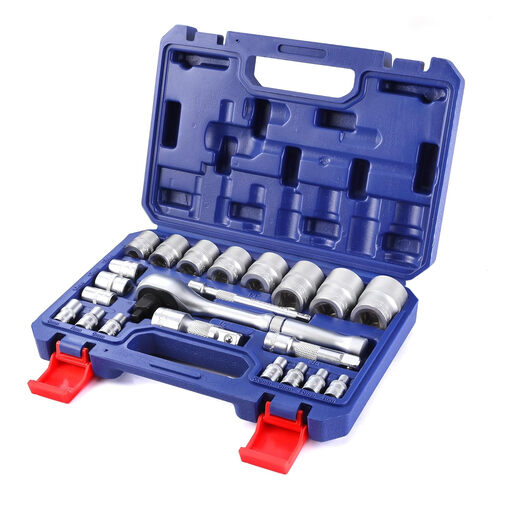
Why we chose it: Ideal for beginners or for basic car maintenance tasks (oil changes, brake pad replacement). It contains the most common essential sockets and ratchets, without the fluff, all in a well-designed storage case.
This kit sidesteps the "catch-all case" trap by focusing on the essentials. The sockets are made of Cr-Mo steel, a robust material that ensures good longevity for everyday jobs.
The set includes 3 ratchets (1/4", 3/8", 1/2") for maximum versatility. The color-coding on the sockets and their thin-wall design are practical details, especially for wheels and tight access areas.
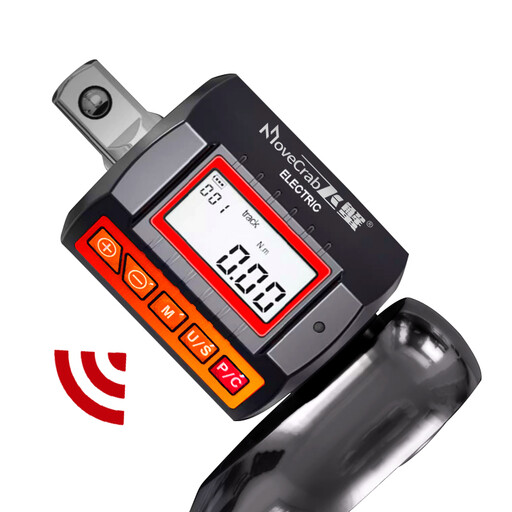
Why we chose it: The perfect solution for someone who already owns a good set of ratchets and wants to achieve a higher level of precision without buying a whole new wrench. This adapter turns any 1/2" ratchet into a high-precision digital torque wrench.
It tackles the imprecision pitfall head-on. With an error margin of just ±2% and audible/visual alerts, it prevents any over- or under-tightening, thereby protecting threads and sensitive mechanical parts.
Its versatility is impressive: multiple measurement units (Nm, lbf.ft, etc.), three working modes (real-time, peak, preset), and a memory for 1000 values. The included 3/8" and 1/4" adapters make it compatible with almost all of your existing equipment.
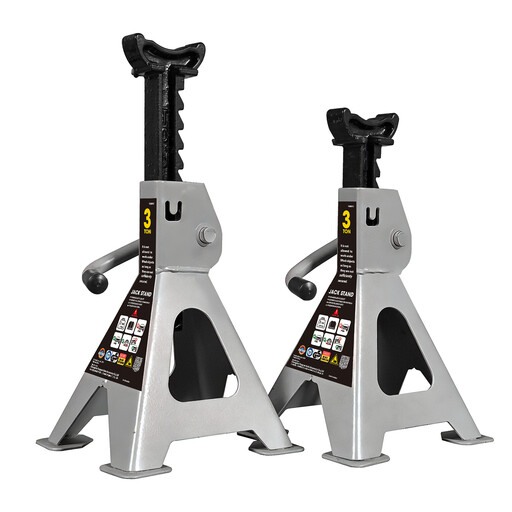
Why we chose it: Essential for anyone who needs to get under a vehicle. Here, safety is the only criterion that matters, and this equipment was designed with that sole purpose in mind. It's suitable for low-profile sports cars and SUVs alike.
It directly addresses the danger of uncertified equipment. This set of jack stands not only complies with the EN 1494 standard, but it also features the independent GS seal, which attests to rigorous testing. The wide, heavy-gauge steel base is fully welded for rock-solid stability.
A 3-ton load capacity per pair, which provides a very comfortable safety margin. The locking "click" is crisp and audible at each adjustment level, confirming that the support is perfectly in place.
Discover our complete selection of products, all rigorously chosen for their compliance with our quality criteria and European safety standards.
Chrome-Vanadium (CR-V) steel is ideal for standard hand tools due to its hardness and corrosion resistance. Chrome-Molybdenum (CR-MO) steel, which is tougher, is designed to withstand impacts, making it indispensable for impact sockets used with electric or pneumatic tools. For versatile use, the best strategy is often to have a basic CR-V set, supplemented by a few CR-MO impact sockets for specific needs.
Absolutely. Tightening wheel nuts, cylinder head bolts, spark plugs, or brake calipers must be done to the torque specified by the manufacturer. Incorrect tightening can warp parts, cause leaks, or, in the worst-case scenario, lead to a wheel coming off while driving. It's a small investment considering the gains in safety and the longevity of your vehicle.
Systematically look for certification marks on the product and its packaging. In Europe, the most important are the CE mark, which certifies compliance with EU requirements, and the GS (Geprüfte Sicherheit) label, a highly respected voluntary German certification known for its thoroughness. Also, ensure the load capacity is clearly indicated (often "per pair") and that it is well above the weight you intend to support.