
Livraison le jour même ou le lendemain

Qualité garantie

Débloquez vos offres de bienvenue: Livraison GRATUITE | Jusqu'à -80 % | 30 jours d'essai gratuits à JoyPlus
Téléchargez l'application
Customising your car's interior is an exciting project. A well-chosen ambient LED strip can completely transform the atmosphere of your drives. The problem? The market is saturated with options, and it's easy to fall into common traps that lead to disappointment and wasted money.
As a product expert for Joybuy, my mission is to help you navigate the choices. Let's cut through the marketing jargon and focus on what really matters. Here are the 3 most common mistakes to avoid and the essential criteria for making an informed choice.
The 3 Pitfalls to Avoid When Buying Your LED Kit?:
To ensure you don't regret your investment, pay close attention to these three technical aspects. They are the true measure of your setup's quality, durability, and user experience.
The visual finish of your lighting entirely depends on this technological choice.
A good interior car LED kit must offer flexible control. Today, the standard is control via a smartphone app. Check the following points:
Not all ambient lights are created equal when it comes to colour.
To help you see how these criteria translate into real-world products, here are a few kits that suit specific user profiles.
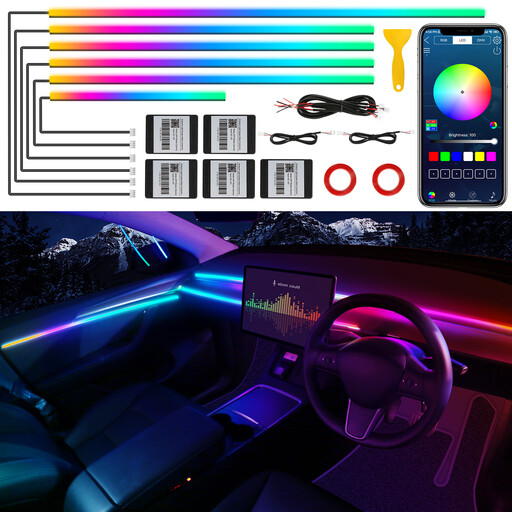
Why this kit? Perfect for a first-time installation. It focuses on key areas (dashboard, centre console, footwells) and offers a complete experience without being overwhelming. It's a great starting point for those who want a noticeable result quickly, without the hassle.
This kit is truly complete for a basic setup. It includes the acrylic strips, footwell lights, and control boxes, saving you from the nasty surprise of needing additional purchases.
RGBIC Dreamcolor technology for dynamic effects, and a simplified installation thanks to one main controller and several sub-controllers.
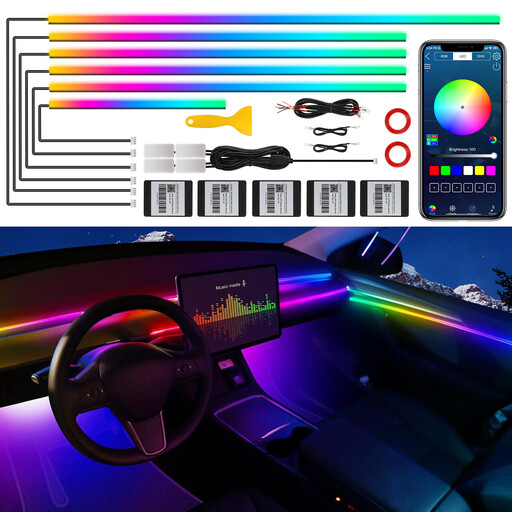
Why this kit? For those who make no compromises on the visual finish. This kit uses high-quality acrylic strips for perfectly uniform light diffusion, creating a high-end ambiance in the cabin.
The acrylic diffusion technology completely eliminates the "dotted" effect. The light is smooth and continuous along the entire length, avoiding the "cheap" look of low-end strips.
High, uniform brightness thanks to the acrylic diffusers. The kit includes lights for the door handles, adding a much-appreciated finishing touch.
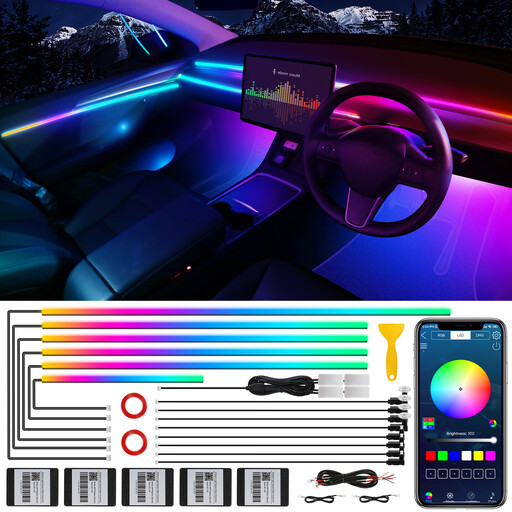
Why this kit? For the demanding user who wants to light up every nook and cranny of their vehicle. This is one of the most comprehensive kits on the market, with lights for the dashboard, all 4 doors, handles, storage bins, and footwells.
By providing specific modules for each area (handles, storage bins), this kit ensures a seamless integration and consistent lighting throughout the cabin, unlike "universal" solutions that often fit poorly.
Maximum coverage with 18 separate elements. The multiple controller system (1 main, 4 secondary) simplifies wiring and ensures perfect synchronisation of all lights.
We have compiled a complete and up-to-date selection of products that meet these quality criteria and comply with current regulations.
1. Is it legal to install an ambient LED strip in my car? Yes, installing ambient lighting inside the passenger cabin is legal. However, traffic laws are very clear: the lighting must not, under any circumstances, obstruct the driver's view or that of other road users. It must also not be visible from the outside to the point of being confused with official signal lights. In short, as long as the lighting remains discreet and directed inwards, you are compliant.
2. How do you power an interior car LED kit? Most kits offer two options. The simplest is the 12V cigarette lighter adapter, a plug-and-play solution that requires no modifications. For a cleaner, more permanent installation, you can connect directly to the vehicle's fuse box using a "fuse tap" adapter. This second option is ideal for completely hiding the wiring.
3. Can you cut fibre optic or acrylic strips? Yes, most strips are designed to be cut to the desired length. However, you must take some precautions. For acrylic strips, it is crucial not to cut through an LED or a resistor. The manufacturer's instructions always indicate the designated cutting points. An incorrect cut can render a segment inoperable or desynchronise it from the rest. The golden rule: measure twice, cut once.