
Livraison le jour même ou le lendemain

Qualité garantie

Débloquez vos offres de bienvenue: Livraison GRATUITE | Jusqu'à -80 % | 30 jours d'essai gratuits à JoyPlus
Téléchargez l'application
Switching to LED lighting for your car is an excellent idea, whether it's to see more clearly at night or simply to modernise your vehicle. The problem: the market is flooded with options, and it's easy to be tempted by an attractive offer that turns out to be a costly disappointment. As the Head of Product Recommendations at Joybuy, my mission is to help you see things… more clearly.
Before you start, here are the three mistakes to avoid when choosing your car LED lighting:
To make an informed choice, you need to look at a few technical parameters. These details make all the difference between a gimmick and genuine safety and comfort equipment.
The first and simplest check is the base type of your original bulb. The most common references are H7 LED bulb, H4, H1, or T10 W5W bulb for parking lights and license plate lighting. This information can usually be found in your vehicle's manual or via a quick online search with your car model.
Next, an anti-error Canbus LED system is crucial for modern cars (generally post-2005). The Canbus system monitors the proper functioning of electrical components. Since an LED bulb consumes far less power than a halogen, the on-board computer (OBC) might think the bulb is burnt out and display an error message. "Canbus Ready" or "error-free" kits integrate a resistor that "tricks" the computer by simulating normal consumption. Problem solved!
An LED bulb, even if it heats up less than a halogen, still generates heat that must be evacuated to guarantee its performance and longevity. There are two main technologies:
Good cooling is the guarantee of a lifespan that can reach several tens of thousands of hours.
A good LED car kit isn't just about being powerful; it must perfectly replicate the light beam of the original halogen bulb. This ensures the light is projected onto the road, not into the rearview mirror of the car in front. To achieve this, quality models position their LED chips to mimic the filament of a halogen bulb. This is the secret to a sharp and safe beam.
The colour temperature, expressed in Kelvins (K), defines the hue of the light. A value between 6000K and 6500K produces a very modern, pure white light that improves the readability of road signs and the perception of contrasts at night.
Every driver has different expectations. Here is a selection of products tailored to distinct user profiles, taking into account quality and compatibility criteria.
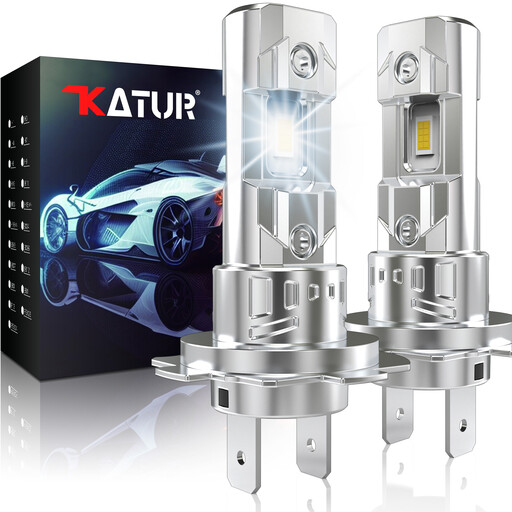
Why we chose it: Ideal for those seeking a real visibility boost without the hassle. Its compact size and "plug-and-play" installation make it a simple and effective upgrade to replace tired halogens.
Its 1:1 mini size design guarantees installation even in the tightest headlight housings. The passive (fanless) cooling eliminates any risk of mechanical failure and ensures completely silent operation.
Direct installation without adapters or modifications. The aviation-grade aluminum body ensures efficient heat dissipation, which means a long lifespan.
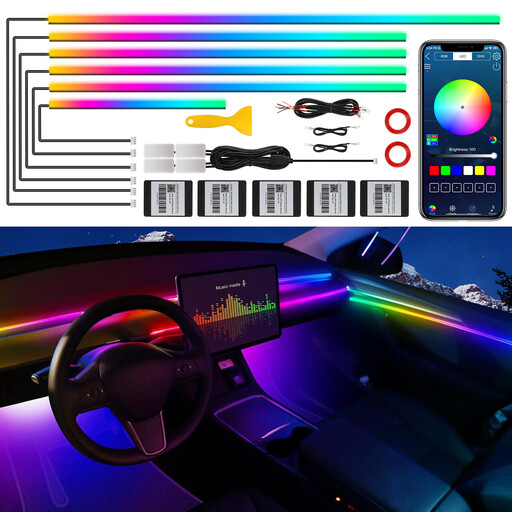
Why we chose it: For those who want to transform their car's interior with fully customisable ambient car lighting. Perfect for lighting customisation, this kit offers total control at your fingertips via a smartphone app.
Unlike entry-level LED strips, this kit uses acrylic car fibre optics for perfectly uniform light diffusion, without the tacky "Christmas light" effect of low-end models.
Control via Bluetooth app with a palette of millions of colours (RGB car LED), dynamic modes, and music synchronisation. The kit is comprehensive enough to equip the dashboard, doors, and footwells.
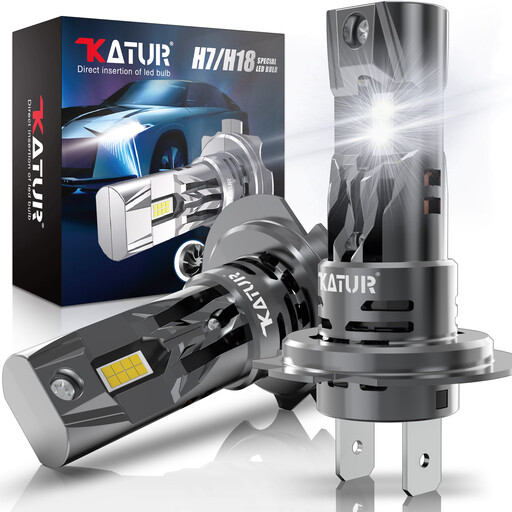
Why we chose it: Designed for drivers who demand absolute lighting performance for maximum safety on poorly lit roads or in bad weather. The power lets you see farther and wider, turning night into day.
High power means high heat. To manage it, this kit includes a 16,000 RPM turbo fan that prevents any overheating and guarantees consistent performance. Its external control box (driver) ensures Canbus compatibility with 98% of cars on the road.
Phenomenal light output (30,000 lumens per pair) for long-distance visibility. The chip design is engineered to sculpt a precise beam that limits glare despite the raw power.
If customising your car's interior is what excites you, discover our complete selection of products that meet the same high-quality standards.
This is a sensitive topic. Regulations can be strict. To be compliant for use on public roads, replacement bulbs must be officially approved (e.g., carry an ECE marking). Many LED kits available on the market are, in theory, intended for off-road use only. In practice, the decisive factor during a technical inspection is the quality of the light beam: it must not dazzle others under any circumstances. This is why it's crucial to choose a quality kit and, ideally, have your headlights professionally realigned after installation.
Almost. A "Canbus Ready" kit will work on about 98% of cars. However, some vehicles, often German models, have such a sensitive monitoring system that an error may persist. The solution? Add an external Canbus decoder (a small additional resistor) which will definitively solve the problem.
The figures advertised by manufacturers (30,000, 60,000 hours...) sound amazing. But in reality, the longevity of an LED bulb depends on a single factor: the quality of its cooling system. A poorly cooled model will quickly lose brightness and its lifespan will plummet. This is THE reason why the thermal dissipation system is a non-negotiable selection criterion.