
Livraison le jour même ou le lendemain

Qualité garantie

Débloquez vos offres de bienvenue: Livraison GRATUITE | Jusqu'à -80 % | 30 jours d'essai gratuits à JoyPlus
Téléchargez l'application
Upgrading from old halogen bulbs to an LED kit is a tempting proposition. Better visibility, a record-breaking lifespan, reduced power consumption... on paper, the benefits are compelling. However, faced with a jungle of options and sometimes misleading marketing claims, the risk of ending up with a disappointing product is very real. Before taking the plunge, it's essential to review the common pitfalls to make a truly informed—and, most importantly, safe—choice.
Our mission: to help you see things more clearly. Let's break down the key points to watch out for and the technical criteria you shouldn't underestimate.
The excitement of buying a car LED kit can quickly turn to disappointment if the product doesn't live up to expectations. Here are the three most common mistakes:
To avoid these setbacks, it's best to focus on objective technical criteria.
This is the essential starting point. Each light on your vehicle (low beams, high beams, fog lights, interior lighting) requires a specific base type. To replace a halogen bulb with an LED, you must match this format exactly.
Our advice: The most reliable way to find your bulb's base type is to check your vehicle's owner's manual or remove the original bulb to read the reference number printed on it.
The lifespan of an LED bulb directly depends on the efficiency of its cooling system. Two main technologies compete:
Modern cars are equipped with a system that constantly checks if the bulbs are working correctly. Since an LED consumes far less power than a halogen, the on-board computer (OBC) may think the bulb is burnt out and trigger a dashboard warning.
The solution? Opt for an error-free CAN bus LED bulb. These integrate a resistor that "tricks" the vehicle's diagnostic system by simulating the power consumption of a standard bulb. On some particularly sensitive vehicles (often German brands), an external anti-error module may still be necessary.
Instead of a simple list, we've selected products tailored to specific user profiles. There's an LED for everyone!
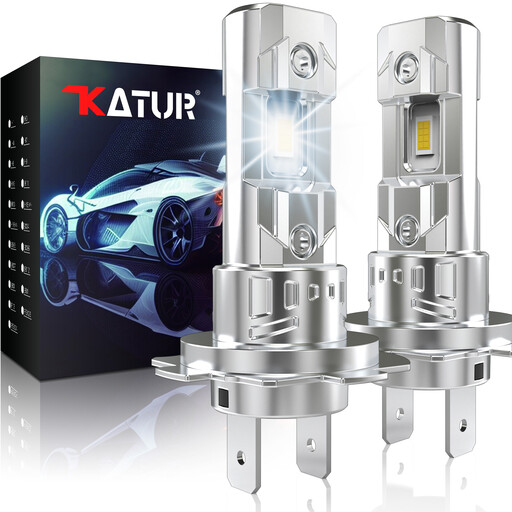
Our take: The perfect solution for drivers looking to modernise their lighting for everyday trips without any hassle. This choice prioritises reliability and ease of installation over raw performance.
Its fanless design eliminates any risk of mechanical failure or noise, a common pitfall of entry-level models. Its compact size, modeled after a halogen bulb (a 1:1 ratio), ensures a true plug-and-play installation without needing to modify the headlight housing.
The reliability and absolute silence of passive cooling. Its 6000K colour temperature provides a crisp, white light that improves visibility without being harsh on the eyes.
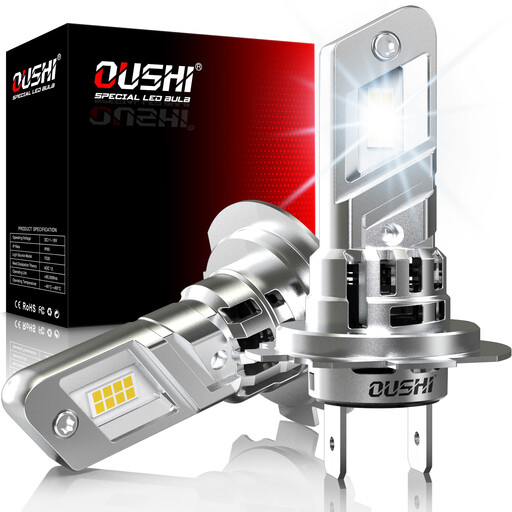
Our take: For those who won't compromise on power and are looking for a dramatic improvement in visibility, especially on poorly lit country roads. A modern look is a bonus.
It avoids the overheating trap with its high-speed turbo fan and aviation-grade aluminum body, ensuring optimal heat dissipation even at full power. Its built-in CAN bus system promises compatibility with 98% of vehicles, minimising the risk of an OBC error.
Impressive light output to see and be seen. The 6500K temperature generates a cool white light, very close to daylight, which enhances contrast and reduces eye strain.
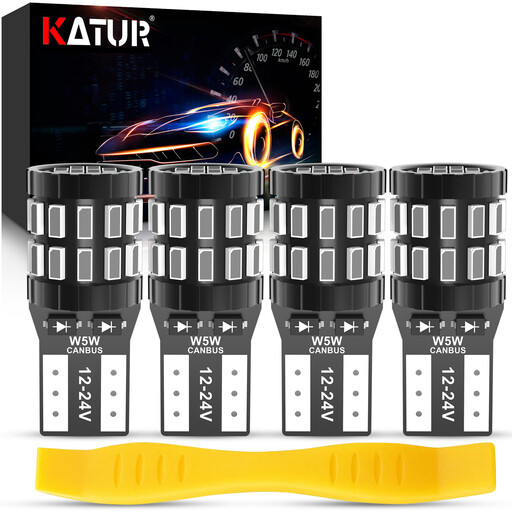
Our take: The smart buy for the DIYer who wants to give their vehicle's entire lighting system a modern upgrade. With this set of W5W LED bulbs, you can modernise everything at once: dome light, glove box, parking lights, license plate, and more.
For these small bulbs, the #1 pitfall is the OBC error. This model is specifically "Canbus error free" for maximum peace of mind. Its 360-degree design ensures perfectly uniform light distribution, without the unsightly "hotspot" effect of many low-end LEDs.
Unbeatable versatility and excellent value for money. One pack for multiple uses. Their wide voltage range (12-24V) makes them compatible with almost all vehicles, including trucks.
Discover our full selection of products that meet our quality standards and current regulations.
Regulations on this are very strict. For aftermarket bulbs to be street legal, they must have the proper certification for on-road use (e.g., ECE or DOT approval). To date, the vast majority of LED replacement kits do not have this certification and are therefore, in theory, reserved for off-road or private track use only. It is the user's responsibility to check the compliance of the installed equipment and, most importantly, to ensure the light beam does not cause glare for other road users.
Absolutely not. The beam pattern geometry is just as, if not more, important than the raw light output (lumens). A good car LED bulb must perfectly replicate the beam pattern of the original halogen bulb. This is the essential condition for effectively illuminating the road without blinding oncoming drivers. Raw power that is poorly directed is counterproductive.
The first step is to choose an error-free CAN bus LED model from the start. In most cases, this solves the problem. If the error persists (a common issue on certain German brands known for being finicky), adding an external CAN bus module—a simple resistor that plugs into the wiring harness—will resolve the issue in 99% of cases.