
Livraison le jour même ou le lendemain

Qualité garantie

Débloquez vos offres de bienvenue: Livraison GRATUITE | Jusqu'à -80 % | 30 jours d'essai gratuits à JoyPlus
Téléchargez l'application
Thinking of replacing your old halogen bulbs with a modern automotive LED kit? The idea is tempting. More powerful lighting, better night-time visibility, and a much longer lifespan: the promises are certainly motivating. However, the market is a real minefield, and it's easy to turn a promising purchase into a costly disappointment.
Before you dive into replacing a halogen bulb with an LED, learn how to see through misleading marketing claims. Here are the three most common mistakes to avoid:
This guide gives you all the keys to making an informed choice by focusing on the technical specifications that truly matter.
To avoid making a mistake, forget the marketing hype and focus on these few technical points. They are the true indicators of an automotive LED kit's quality and suitability.
This is the non-negotiable starting point. Every vehicle uses specific bulb types for its low beams, high beams, or fog lights. The most common are:
The essential first step: Before any purchase, consult your vehicle's manual or, even better, remove a bulb to identify its socket type. A mistake at this stage will render your kit completely useless.
An LED chip heats up during operation. Without effective heat dissipation, its brightness decreases and its lifespan collapses. There are two main technologies:
A good cooling system, whether active or passive, is essential for the bulb to maintain its performance over the tens of thousands of hours advertised.
Since the 2000s, most cars have been equipped with a multiplexing system (CANbus) that monitors the proper functioning of electrical components. An LED bulb consumes much less power than a halogen one, which can lead the car's computer to believe the bulb is burnt out and display an error message.
An error-free CANbus LED bulb integrates a resistor or electronic circuit to simulate the power consumption of a standard bulb and prevent this issue. For any vehicle less than 15-20 years old, this feature is almost mandatory to avoid headaches.
The colour of light is measured in Kelvin (K). A 6000K LED bulb produces a cool white light, similar to daylight. It's a popular choice as it improves contrast and the perception of detail on the road.
Even more important than raw lumens, the bulb's design must replicate the beam pattern of a halogen bulb as closely as possible. A good LED headlight focuses light onto the road, without dark spots and without glaring at oncoming drivers. The so-called "1:1" models (same size as a halogen) are often a good indicator of a well-thought-out design.
Here are a few options that cater to different user profiles, taking into account the pitfalls and selection criteria mentioned above.
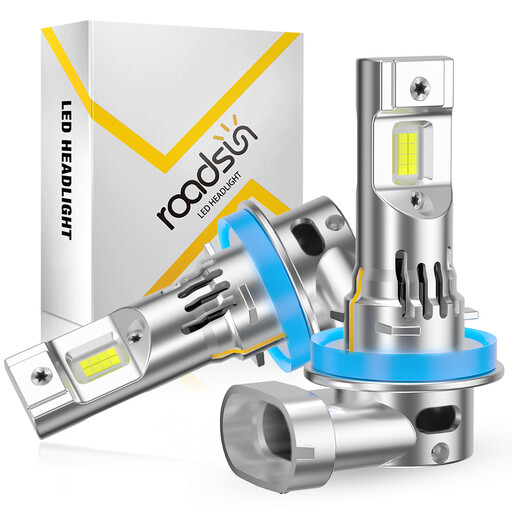
Why this model? Ideal for a first-time upgrade to LEDs. This model is designed for those who want immediate results without the hassle of modifications or polarity issues. Simplicity itself.
Its 1:1 design (identical to a halogen bulb) and non-polarity technology eliminate physical compatibility and connection problems. It truly delivers on the "Plug-and-Play" promise.
Installation in minutes, with no tools required. Broad compatibility with H11, H9, and H8 sockets, which are very common for low beams and fog lights.
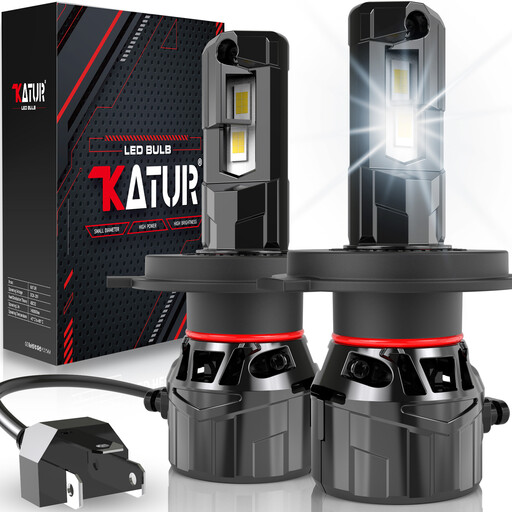
Why this model? For those who drive long distances at night or on poorly lit roads, and for whom raw power is the number one criterion. This H4 model handles both high and low beams with formidable intensity.
It eliminates the risk of overheating with a robust cooling system: a 16,000 RPM turbo fan, an aluminium body, and a hollow-carved heat sink. This design ensures stable brightness, even over the long term.
Colossal light output (30,000 LM per pair) for maximum visibility. Its compact 1:1 design makes it easy to install, even in the tightest headlight housings.
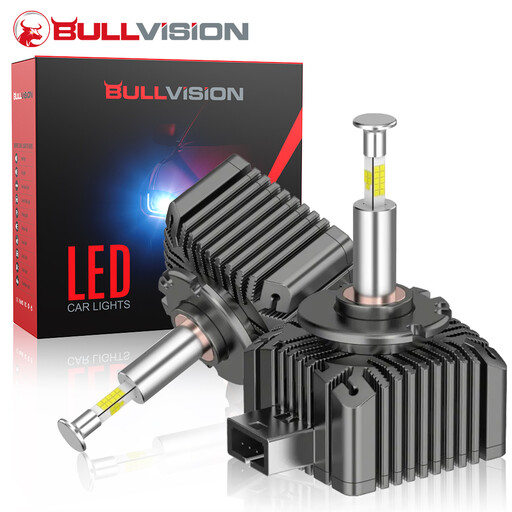
Why this model? Specially designed for modern cars, particularly those originally equipped with Xenon headlights (D2S socket). Here, the absolute priority is to avoid electronic conflicts while ensuring a perfectly sharp beam pattern.
It tackles the pitfall of dashboard errors head-on. Its intelligent driver and "CANbus ready" design are engineered for compatibility with 99% of vehicles, eliminating the risk of warnings or flickering.
Rock-solid electronic compatibility. The 1:1 beam technology ensures a clean light projection that never glares at other road users.
We have put together a complete selection of products that meet our selection criteria and safety standards.
Regulations on replacing a halogen bulb with an LED can be very strict. To be road-legal, a replacement bulb must have an ECE approval (e.g., ECE R37 for halogens). However, most aftermarket LED kits on the market do not have this approval for retrofitting. In theory, this means they are reserved for off-road or track use only. It is crucial to check your local regulations and look for products that explicitly state they are compliant for road use.
Yes, by a long shot, but on one condition: they must be well-designed. A standard halogen bulb has a lifespan of 500 to 1,000 hours. A well-designed LED with effective cooling can exceed 30,000 hours. Conversely, a low-quality model that overheats will fail much sooner. The quality of the cooling system is therefore the key to longevity.
It all depends on your vehicle. Most kits are designed to be "plug-and-play" and fit directly into the original socket. However, some cars (notably from Volkswagen, BMW, or Mercedes) use proprietary retaining clips for the halogen bulb. In this case, an adapter will be essential to mount the LED kit. Be sure to check this point before placing your order.