
Livraison le jour même ou le lendemain

Qualité garantie

Débloquez vos offres de bienvenue: Livraison GRATUITE | Jusqu'à -80 % | 30 jours d'essai gratuits à JoyPlus
Téléchargez l'application
Upgrading your car's lighting to LED? It promises better night-time visibility and a modernised look. But with a jungle of options and sometimes misleading marketing claims, it's hard to know where to start. Our mission: to help you sort through the noise, make a truly informed choice, and avoid disappointment.
Changing your bulbs should be a breeze. Yet, too many drivers end up with disappointing products that don't deliver the expected results. Here are the three most common pitfalls to avoid before you replace a halogen bulb with an LED.
powerful LED bulb that is poorly designed will produce a scattered beam, dazzling other road users without actually lighting the road any better. Beam quality and precision always trump raw power.To avoid unpleasant surprises, a few technical points are essential to check. They are the true guarantee of quality and compatibility for your future car LED kit.
Before you even look at price or power, you must identify the base type of your original bulb. This is the metal base that connects to the headlight housing, and different types are absolutely not interchangeable.
led car headlight): The most common bases are H4 (which handles both low and high beams in a single bulb) and H7 (one dedicated bulb per function). Other types like H1, HB3, HB4, or HIR2 also exist.Consulting your vehicle's manual or checking the marking on the original bulb itself is a non-negotiable step.
The Canbus (Controller Area Network) system is your car's electronic brain. Among other things, it monitors the proper functioning of the bulbs. Since an LED bulb consumes far less power than a halogen, the system may register it as a fault. To avoid this trap, you must opt for an error-free Canbus LED bulb. These models integrate a resistor that "tricks" the on-board computer by simulating standard power consumption, thus preventing dashboard warnings.
Colour temperature, measured in Kelvin (K), defines the hue of the light. A halogen bulb emits a warm (yellowish) white at around 3200K. LEDs offer a purer white, typically between 6000K and 6500K, which improves contrast perception at night.
But that's not the most critical factor: the performance of a led car headlight is judged by its ability to perfectly replicate the halogen bulb's beam pattern. A good model must focus the light where it's needed—on the road—without creating dark spots and, most importantly, without dazzling oncoming drivers. This is a non-negotiable criterion for your safety and for passing vehicle inspections without issue.
Rather than a long list, we've matched user profiles with products that meet clear needs, based on our selection criteria.
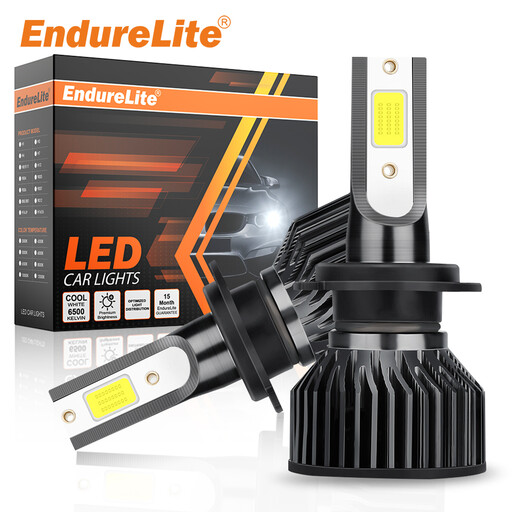
Why we chose it: The perfect solution for those who want a visible, simple, and effective upgrade for their main headlights. The very common H4 LED bulb format handles both low and high beams in a single bulb, simplifying installation.
This model features a smart driver and a "CANbus ready" design to eliminate the risk of errors. Its active fan ensures optimal cooling, sidestepping the pitfall of overheating and a shortened lifespan.
Its 1:1 size, identical to a halogen bulb, and its "plug and play" design ensure easy installation in most original headlight housings.
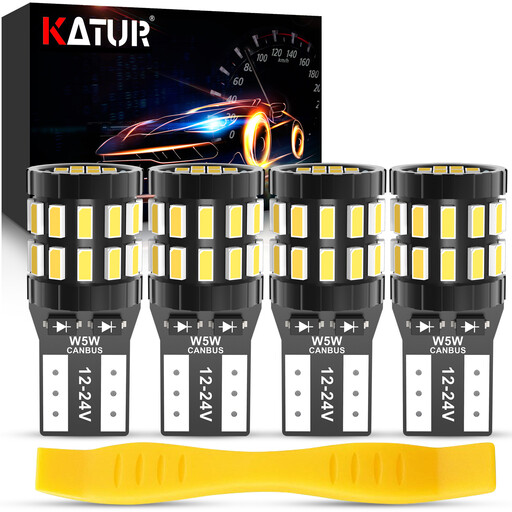
Why we chose it: Ideal for modernising your car's interior lighting, sidelights, or number plate light. Sold as a multi-pack, it allows you to standardise all your auxiliary lighting with a pure white (6000K) hue for a consistent look.
The "Canbus Error Free" feature is essential here, as these small bulbs are very often monitored by the OBC. This model therefore perfectly addresses the problem of false "plug and play" compatibility.
The versatility of the T10 / W5W base and the multi-pack format make it a smart, cost-effective solution for a complete aesthetic makeover.
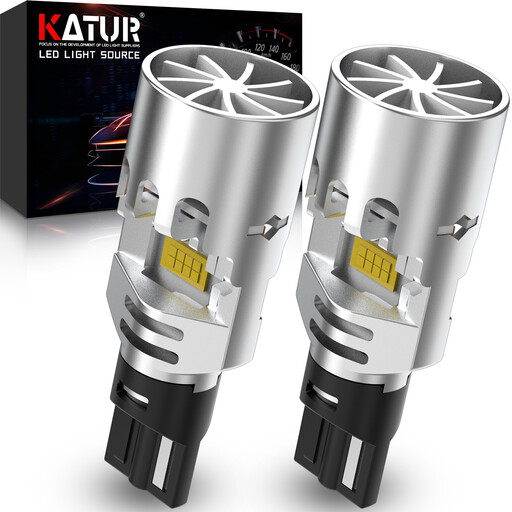
Why we chose it: Specifically designed for LED reverse lights, this model focuses entirely on maximum brightness to make reversing safer. A real safety boost, both at night and in bad weather.
For this type of product, power isn't a marketing gimmick but a genuine functional asset. The inclusion of an active fan is a sign of serious design, engineered for lasting performance.
The active fan cooling, which is rare on W16W/T15 bulbs, guarantees far superior heat dissipation. This is a hallmark of reliability and consistent brightness.
Explore our complete selection of LED bulbs, all chosen for their reliability and compliance with our quality criteria.
Yes, but with conditions. The car LED kit must be certified for road use in your region (look for certifications like ECE on the packaging). Most importantly, the resulting light beam must be identical to the original halogen bulb's pattern to avoid dazzling other drivers and to pass vehicle inspections. Proper installation and headlight alignment are therefore essential.
This is a classic problem on modern cars. The on-board computer (via the Canbus network) detects the LED's low power draw and flags it as an error. The simplest solution is to choose an error-free Canbus LED bulb from the start. If you've already installed them, an external anti-error module can be added, but a bulb with integrated Canbus remains the cleanest solution.
The staggering figures advertised by brands (sometimes over 50,000 hours) are theoretical values obtained in a lab. In the real world, an LED's longevity depends almost exclusively on the efficiency of its cooling system. A well-designed model with a solid aluminium heat sink or a fan will live up to its promises for far longer than a low-end bulb that will eventually overheat.