
Livraison le jour même ou le lendemain

Qualité garantie

Débloquez vos offres de bienvenue: Livraison GRATUITE | Jusqu'à -80 % | 30 jours d'essai gratuits à JoyPlus
Téléchargez l'application
Replacing old halogen bulbs with a car LED kit is an idea that appeals to more and more drivers. The promise is appealing: far better night-time visibility, a tenfold increase in lifespan, and a modernised look thanks to a cool white 6000K LED light. But be warned, the market is a real jungle where it's easy to fall into traps that turn this promising upgrade into a costly disappointment. Before you start replacing your halogen bulbs, here are the most common pitfalls to avoid.
To navigate the jungle of LED bulbs, focus on a few essential technical points. They are the guarantee of your future kit's compatibility, performance, and durability.
This is the absolute starting point. Each location on your vehicle (low beams, high beams, indicators, LED car interior lighting) requires a specific type of bulb, identified by its base. The most common for headlights are H7 LED bulbs and H4. For sidelights or license plate lighting, you'll often find T10 LED bulbs (also known as W5W LED).
The CAN bus (Controller Area Network) is, in a way, your car's electronic nervous system. It monitors, among other things, the proper functioning of the bulbs. Since an LED bulb consumes much less power than a halogen, the system can interpret this low consumption as a failure and display an error on the dashboard.
To avoid this inconvenience, choosing a CAN bus LED bulb or an error-free model is essential. These models integrate a resistor or an electronic circuit that simulates the consumption of a conventional bulb, making them "invisible" to the majority of modern vehicles' multiplexed systems.
Looks are good. Safety is better. The two are not mutually exclusive.
To help you see more clearly, we have identified products that meet distinct user profiles, based on the objective selection criteria mentioned above.
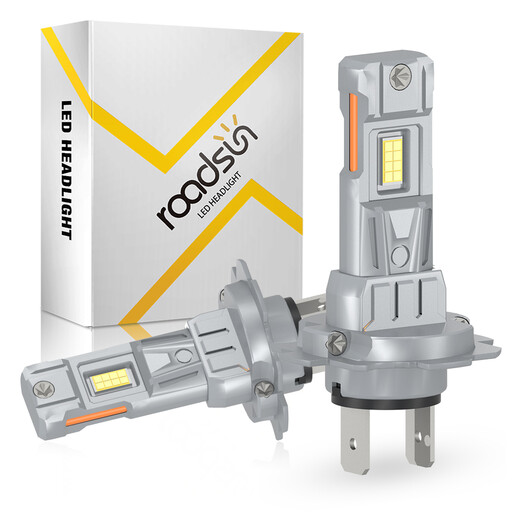
Why we chose it: Perfect for a first, simple, and effective conversion to LED. This kit provides an immediate and noticeable gain in daily visibility with a hassle-free installation.
Its 1:1 mini-size design ensures direct installation into the original housing, thus preserving a correct beam pattern and preventing glare. The plug-and-play system is designed for broad compatibility, minimising the risk of OBC errors.
An excellent balance between brightness gain (6000K white light), ease of installation, and a very accessible price point.
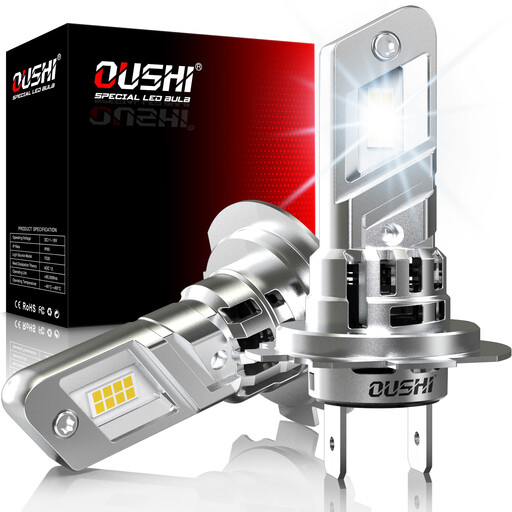
Why we chose it: For those who want maximum performance and a radically improved night-time visibility. This model focuses on high light output while ensuring stable, long-term performance.
It incorporates a high-speed turbo fan and an aviation-grade aluminium body for active and efficient heat dissipation. This prevents overheating and loss of brightness, a common trap with entry-level models. Its CAN bus system is advertised as compatible with 98% of vehicles.
The combination of high light output (6500K xenon white) and an active cooling system for durability and performance that goes the distance.
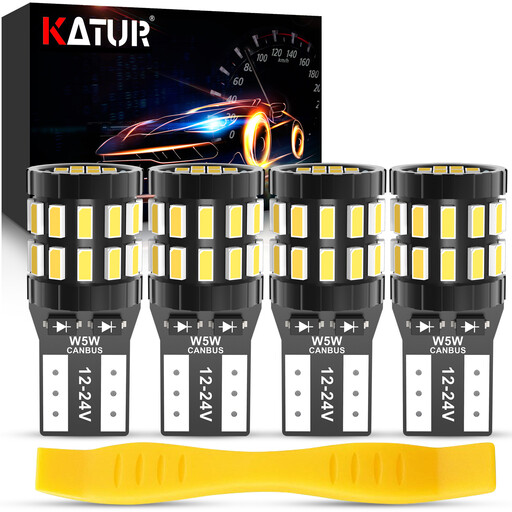
Why we chose it: Ideal for giving a fresh look to interior lighting (dome lights, map lights, glove box) or exterior lights (sidelights, license plate). A simple solution to modernise your vehicle's appearance with a crisp, white light.
These small bulbs are a frequent source of OBC errors. This model is specifically designed as error-free CAN bus, which prevents alerts on most vehicles and ensures stable operation.
Versatility and simplicity. A single reference (T10/W5W) covers many locations, and installation is a simple standard replacement. The low power consumption also preserves the battery.
We have put together a complete selection of products that meet our quality and compatibility criteria.
Regulations are very strict. To be used on public roads, replacement bulbs must have European approval (ECE marking). Many aftermarket LED kits are technically intended for track or off-road use only. It is therefore the user's responsibility to verify that the installed products comply with legislation and the requirements of vehicle safety inspections.
A fan provides active cooling, which helps maintain maximum brightness more consistently and extends the life of the LED chips, especially on high-power models. On the downside, it is a moving part that could potentially fail and may generate a slight noise. Fanless models use passive heat sinks. They are completely silent but may be less effective at dissipating heat on the most powerful bulbs. The choice depends on the kit's power and the space available in the headlight.
Most quality bulbs today are "CAN bus Ready" or "error-free" and work on the majority of vehicles without issue. However, certain car models, particularly German ones, are especially sensitive. If an error message appears despite installing a CAN bus bulb, adding an external decoder (an additional resistor) is usually the solution. It's therefore best to opt from the outset for a kit known for its broad compatibility to maximise your chances of success.