
Livraison le jour même ou le lendemain

Qualité garantie

Débloquez vos offres de bienvenue: Livraison GRATUITE | Jusqu'à -80 % | 30 jours d'essai gratuits à JoyPlus
Téléchargez l'application
By the Joybuy Editorial Team
Driving at night or in heavy rain can quickly become stressful, especially when your vehicle's lighting leaves something to be desired. With ageing halogen bulbs, not only is your field of view reduced, but so is your reaction time to unexpected events. Upgrading to a car LED kit is therefore an excellent idea to improve safety, as well as to modernise your vehicle's look.
This guide is designed to shed some light (no pun intended) on choosing your next car LED bulb. We'll review the key technical criteria to consider and present our selection of the best products currently available.
Before you start replacing your headlights, low beams, or fog lights, a few checks are necessary to ensure perfect compatibility and optimal performance.
The essential starting point: the socket type of your original bulb. References like H7 LED bulb or 9006 LED bulb correspond to specific connection standards. It is therefore imperative to consult your vehicle's manual or remove the original bulb to identify the correct reference.
On modern vehicles, another point of attention arises: the multiplexing system (the onboard computer), which monitors the proper functioning of the bulbs. An LED bulb consumes much less power than a halogen, which the onboard computer can interpret as an error. To avoid error messages on the dashboard or flickering headlights, the solution is simple: opt for a Canbus LED bulb (Controller Area Network bus). These models integrate a resistor that "tricks" the computer by simulating the power consumption of a standard bulb.
The output of an LED bulb is measured in lumens (lm). The higher the lumen count, the more intense the light and the better your visibility.
Colour temperature, expressed in kelvins (K), defines the hue of the light. For comparison, a standard halogen bulb emits a warm yellow light around 3200?K. Most LED bulbs for car LED headlights are around 6000?K, a cool white that is very close to daylight. This white hue improves contrast and reduces eye strain on long night drives.
Contrary to popular belief, an LED bulb does get hot, mainly at its base. A good cooling system is therefore crucial to ensure its longevity and stable performance over time. Cooling systems vary:
Finally, for use as LED fog lights or on a 4x4, the Ingress Protection (IP) rating is a criterion not to be underestimated. An IP68 rating, for example, guarantees it is completely sealed against dust and protected against prolonged immersion in water.
Let's get practical with our selection of models that tick all the boxes for performance and reliability.
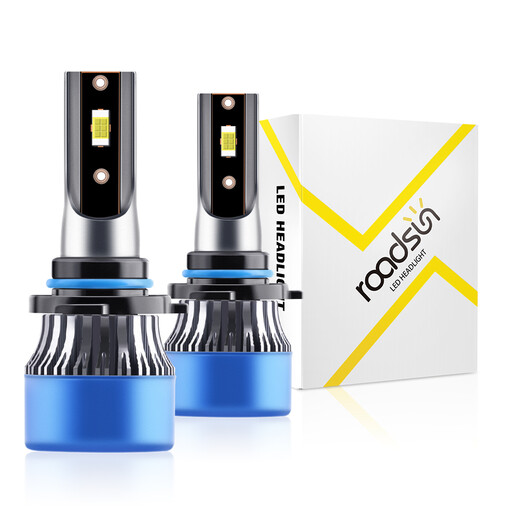
Key features: This model combines high light output with active cooling, a dynamic duo for intensive use as LED low beams or high beams.
The pros:
Who is it for? For high-mileage drivers and motorsport enthusiasts (quads, UTVs) looking for a high-performance lighting solution ready to face the toughest conditions.
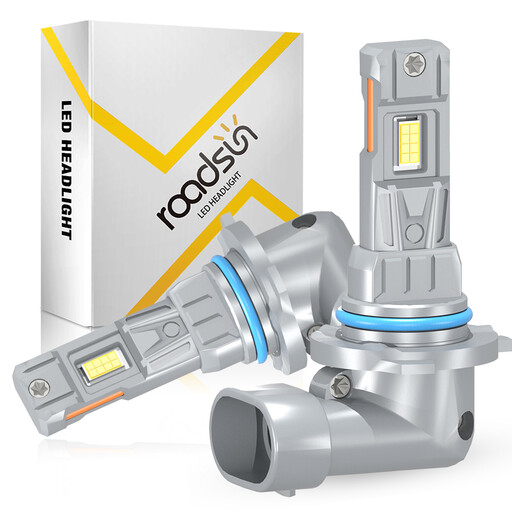
Its key advantage: Its main asset? An ultra-compact design, built to a 1:1 scale compared to a standard 9006/HB4 halogen bulb. This guarantees a hassle-free installation, even in the tightest headlight housings.
The pros:
Who is it for? For those who aren't mechanically inclined or for owners of vehicles where space behind the headlight is limited. A simple, fast, and effective solution.

The Powerhouse Choice: This kit plays in the big leagues. It stands out for its versatility (compatible with numerous sockets) and, above all, its impressive light output of 20,000 lumens per pair, for a literally transformed view of the road.
The pros:
Who is it for? For demanding drivers looking for a powerful LED bulb to completely transform their lighting, especially on recent vehicles requiring flawless Canbus compatibility.
Our selection covers the most common needs, but every vehicle and driver is unique. To explore a wider range of equipment and accessories to customise your car, take a look at our dedicated category.
? Discover more accessories in our Sports Car section
Regulations are particularly strict and vary by country and region. For on-road use, aftermarket bulbs must typically have official certification (e.g., ECE approval in Europe, DOT in the US). Be aware that the majority of LED kits sold online are intended for off-road or track use only. Before any purchase, carefully verify that the product is certified for road use if that is your requirement.
Not necessarily. Glare is less about power and more about a poorly aligned beam pattern. Quality LED bulbs are specifically designed so their chips are positioned in the same spot as a halogen bulb's filament. This trick allows the headlight's original beam geometry to be maintained, illuminating the road and not the eyes of oncoming drivers. In any case, a quick visit to a professional to have your headlight alignment checked after installation is a highly recommended precaution.
Simply put, the Canbus is the computer network that connects and monitors the various electronic components in your car, much like its nervous system. Since an LED uses far less power than a halogen, the onboard computer (OBC) might think the bulb is faulty and display a warning. As a general rule, if your vehicle was manufactured after 2005, it is highly likely to be equipped with a Canbus system. In this case, choosing a Canbus LED bulb (or "error-free" bulb) is the easiest solution to avoid any unwanted warning messages.