
Livraison le jour même ou le lendemain

Qualité garantie

Débloquez vos offres de bienvenue: Livraison GRATUITE | Jusqu'à -80 % | 30 jours d'essai gratuits à JoyPlus
Téléchargez l'application
Upgrading your car to LEDs is a tempting idea. Better night-time visibility, lower power consumption, and a modern look: the promise is compelling. However, the market is a jungle, and the pitfalls are numerous. The wrong bulb can cost you dearly and, more importantly, put your safety at risk. As a product expert, my mission is to guide you in making the right choice.
Before taking the plunge, here are the three classic mistakes to avoid:
To avoid getting ripped off, focus on these key technical points. They are the real deciding factors for assessing the quality of a car LED bulb.
Each light on your vehicle (low beams, high beams, LED fog lights) requires a specific bulb type, identified by its "base". The most common are the H7 LED kit, the H4 LED bulb (which handles both low and high beams), and the H11. For LED interior car lighting or parking lights, you'll often find the W5W LED bulb.
Your mission, should you choose to accept it:
Colour temperature, measured in Kelvin (K), defines the hue of the light. A standard halogen bulb emits a yellowish light (around 3200K), whereas most LEDs offer a cool white 6500K, which is very close to daylight. This white hue improves contrast and makes it easier to read the road ahead.
But colour isn't everything. The crucial point is the beam pattern's geometry. A good LED bulb must perfectly replicate the sharp cut-off line of the original beam. The goal is to:
A sloppy beam pattern is not only dangerous but also a reason to fail a technical inspection. A guaranteed fail.
Modern cars (generally, those made after 2000) are multiplexed and use a CAN bus system to monitor all components, including the light bulbs. Since an LED consumes far less power than a halogen, the on-board computer (OBC) thinks the bulb is burnt out and triggers a warning.
The solution? Choose error-free CAN bus LED bulbs. They integrate a resistor that "tricks" the on-board computer by simulating the power consumption of a standard bulb. Reputable manufacturers state a compatibility rate, often around 98%.
To put theory into practice, here are our top picks for three different user profiles, based on the criteria we've just covered.
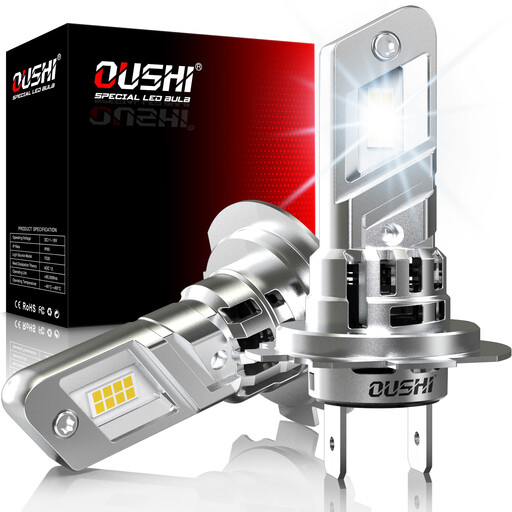
For whom? The weekend DIYer who wants to upgrade their lighting without spending the entire weekend on it. Their top priority: simplicity.
Its 1:1 "mini size" design is an exact copy of the original halogen bulb. Say goodbye to the headache of a dust cover that won't close. Its integrated, 98% compatible Canbus module drastically reduces the risk of an OBC error.
A true plug-and-play experience. No adapters, no modifications. Installation takes just a few minutes, even for a novice.
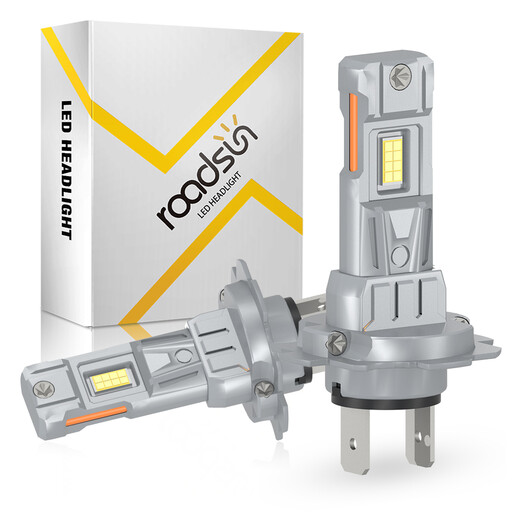
For whom? For those who clock up miles at night, on poorly lit country roads, or in difficult weather. For them, excellent visibility isn't a luxury—it's a matter of safety.
Instead of just blasting light everywhere, this model is engineered for a beam that projects farther and wider. Roadsun claims 800% more brightness than halogen, but it's the precise beam calibration that truly makes the difference, ensuring you don't blind other drivers.
Vastly improved visibility to anticipate hazards and reduced eye strain on long night drives.
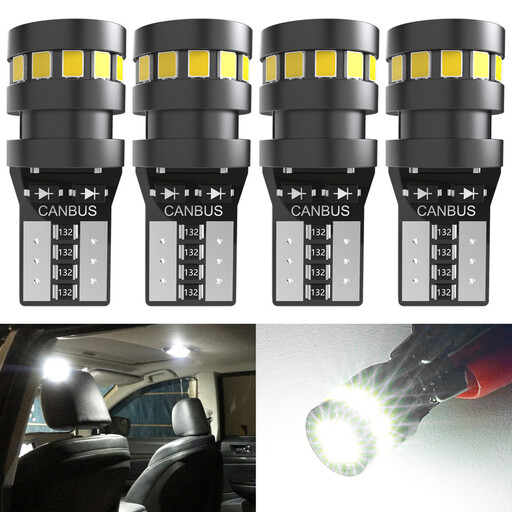
For whom? The perfectionist who wants a 100% LED look, from the headlights down to the number plate lights. The goal: complete aesthetic consistency.
Small, low-quality W5W LED bulbs tend to flicker or burn out quickly. This model stands out with its aluminium body (for better cooling) and its reliable error-free Canbus circuit.
Harmonise the lighting in the cabin, on the number plate, and in the parking lights with the 6500K cool white hue of the headlights. The finishing touch for a modern and polished look.
If you'd rather stick with a reliable and 100% road-legal option, our selection of high-performance halogen bulbs is for you. These are hand-picked products that comply with all regulations.
This is the tricky question: road legality. To put it simply, in most regions, for an aftermarket LED kit to be legal on public roads, it needs a specific certification for your exact headlight model. This is extremely rare. Therefore, their use is theoretically restricted to track or off-road applications. Our advice: always keep your original halogen bulbs. You will need them to pass your technical inspection without any issues.
This is a sign that your car's CAN bus system isn't being "fooled" by the bulb. Even with an "error-free CAN bus" bulb, some particularly sensitive vehicles may still show a warning. The solution is to add an external error canceller (a small additional resistor) that plugs in between the bulb and the original connector. This is a definitive fix.
The 30,000 or 50,000 hours you see advertised are theoretical figures obtained in a lab. In the real world, the longevity of a car LED bulb depends on one thing: the quality of its cooling system. A model with a high-quality aluminium body and an efficient fan (or a good passive heat sink) will live up to its promises. A low-quality product that overheats is doomed to a premature failure.