
Livraison le jour même ou le lendemain

Qualité garantie

Débloquez vos offres de bienvenue: Livraison GRATUITE | Jusqu'à -80 % | 30 jours d'essai gratuits à JoyPlus
Téléchargez l'application
Driving at night or in the rain can quickly become a headache when your car's lighting is subpar. Let's face it: original halogen bulbs, with their yellowish glow and limited range, have had their day. They no longer meet today's standards for safety and comfort. Upgrading to a powerful car LED bulb is therefore the solution of choice for many drivers looking to modernise their vehicle and, most importantly, see more clearly.
The problem is, the market is flooded with options, and it's easy to get lost. This guide is here to give you clear benchmarks and practical advice for choosing the car LED kit that truly meets your needs, based on essential criteria?: compatibility, performance, and ease of installation.
Before making the switch, a few checks are necessary to ensure your transition to LED lighting goes smoothly.
This is the essential starting point?: the physical compatibility of the bulb with your headlight. Each vehicle uses specific sockets for its various lights (low beam, high beam, fog lights). The most common are H7 LED bulbs, H4, H11, or 9005/HB3 bulbs.
To find the exact reference, the easiest way is to check your car's manual or look at the original bulb. A 1:1 size bulb (identical dimensions to the halogen) is often the ideal solution. It guarantees a "plug and play" installation without any need to modify the headlight or the dust cover, which preserves the headlight housing's waterproof seal and the shape of the light beam.
High power generates significant heat. Good thermal dissipation is crucial to ensure the bulb's longevity and maintain a constant light intensity over time. There are two main systems?:
Durability also depends on the manufacturing quality. An IP68 protection rating means the bulb is completely dust-tight and can withstand prolonged immersion. This is a true mark of reliability, no matter the weather.
On modern cars (roughly, those made after 2005), the onboard computer (via the CANbus system) constantly monitors the proper functioning of the bulbs. Since an LED consumes far less power than a halogen, the system may think the bulb is burnt out and display an error message on the dashboard.
To avoid this minor hassle, opt for an error-free CANbus kit (sometimes called "CANbus ready"). These models integrate a resistor that simulates the consumption of a conventional bulb, thus tricking the onboard computer. Add to that a "plug and play" design, and the replacement becomes a breeze?: no special tools or wiring modifications required.
To help you see more clearly and take action, here is our selection of LED kits that stand out for their design and performance.

Key Feature Its main advantage?: its 1:1 Mini Size design. Its dimensions are modelled after a standard 9005/HB3 halogen bulb, ensuring perfect compatibility and installation without any adjustments. It fits perfectly into the original housing without interfering with the dust cover.
Benefits
Who is it for? Ideal for motorists and weekend mechanics who want a simple, fast, and reliable solution, without the hassle of compatibility or space issues inside the headlight assembly.
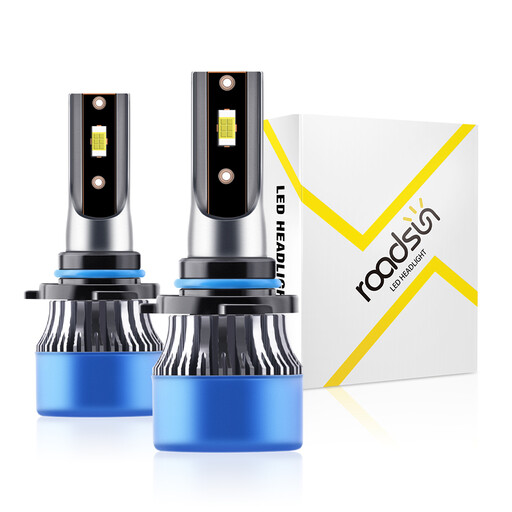
Key Feature This model includes an active cooling fan for state-of-the-art thermal management. This technology keeps the LED chips at an ideal temperature, even over long distances, which prevents any drop in brightness and extends the bulb's lifespan.
Benefits
Who is it for? This kit is aimed at high-mileage drivers, those who frequently drive at night, or those who use their vehicle in harsh conditions (off-road, high heat), where active cooling is a real asset for reliability.

Key Feature Available in numerous socket types (H4, H7, H11, 9005, etc.), this model plays in the big leagues. The manufacturer claims a power output of 20,000 lumens per pair, providing 300% more light than halogen, thanks to latest-generation CSP LED chips. Its integrated CANbus-ready system ensures compatibility with 99% of vehicles on the road.
Benefits
Who is it for? For drivers who want maximum light output for optimal safety and who need flawless electronic compatibility with a modern vehicle.
Our selection focuses on flagship models, but the automotive lighting market is much broader. If you're looking for a different socket type or are curious to discover other technologies, many alternatives are available to you.
? Discover our full range of LED Headlights
French regulations on LED "retrofitting" are very strict. For a replacement LED bulb to be approved for use on public roads, it must have received a specific ECE certification, not only for the bulb itself but also for the specific headlight model in which it is installed. Without this dual approval, the use of these kits is, in theory, restricted to a private track or property. Be sure to check this crucial point before any purchase.
It all depends on your vehicle. Cars equipped with a CANbus system (the majority of post-2005 models) are indeed likely to display an error. To avoid this, it is essential to choose a car LED kit marked as "error-free CANbus" or "CANbus Ready".
Glare is caused less by power and more by a poorly adjusted beam. A quality LED bulb, especially a model with a 1:1 design, is engineered to respect the original sharp beam cutoff and not send stray light upwards. That said, after installation, it is crucial to check the height adjustment of your headlights (and have it corrected by a professional if necessary) to ensure the safety of all road users.