
Livraison le jour même ou le lendemain

Qualité garantie

Débloquez vos offres de bienvenue: Livraison GRATUITE | Jusqu'à -80 % | 30 jours d'essai gratuits à JoyPlus
Téléchargez l'application
Many drivers dream of giving their car's cabin a modern facelift. To upgrade your interior without breaking the bank, a car LED ambient lighting kit is an excellent choice. The problem? With a plethora of options on the market, it's easy to end up with a disappointing product. Before you commit, it's best to know the tricks for seeing through the marketing hype and making the right choice.
As a Product Expert for Joybuy, I'm here to shed some light on the subject. Let's scrutinise the criteria that truly separate a quality automotive ambient lighting system from a gadget you'll quickly regret.
Marketing often highlights millions of colours and spectacular effects, but true quality lies in the details. Here are the three most common flaws that can ruin your experience.
To avoid these unpleasant surprises, a few technical criteria should be examined closely. They are the key to guaranteeing the quality, durability, and user-friendliness of your installation.
The final visual effect depends entirely on the technology used.
Customisation is the whole point of these kits. Make sure the control system is up to the task.
The names "5-in-1," "10-in-1," or "18-in-1" refer to the number of parts and lighting zones included. Before choosing, decide which areas of your cabin you want to illuminate:
A more comprehensive kit isn't necessarily more complex if it's well-designed, with secondary controllers to manage power for the different elements.
To help you turn your idea into reality, we've selected products that meet different needs and budgets, based on the quality criteria we've just discussed.
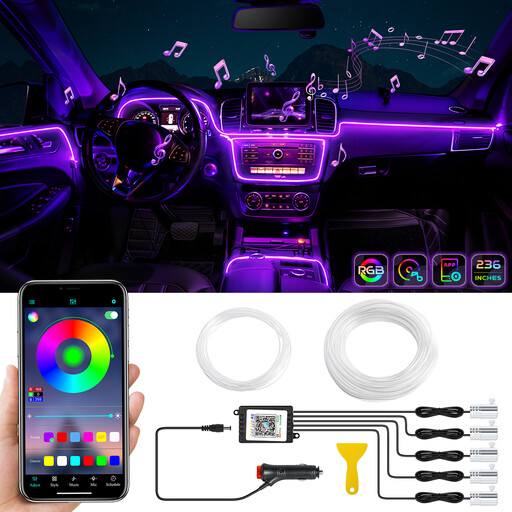
Why we chose it: Perfect for a first-time installation or a simple DIY project. It allows you to get familiar with car fibre optic technology at an affordable price point, focusing on key areas like the dashboard and front doors.
This clever kit provides a single, long fibre optic tube for you to cut yourself. This approach offers maximum flexibility to fit any vehicle and avoids the headache of wires that are too short or too long.
A simple, economical, and fully length-customisable kit. It includes RGB technology for a wide range of colours and control via the "Lotus Lantern" Bluetooth app.
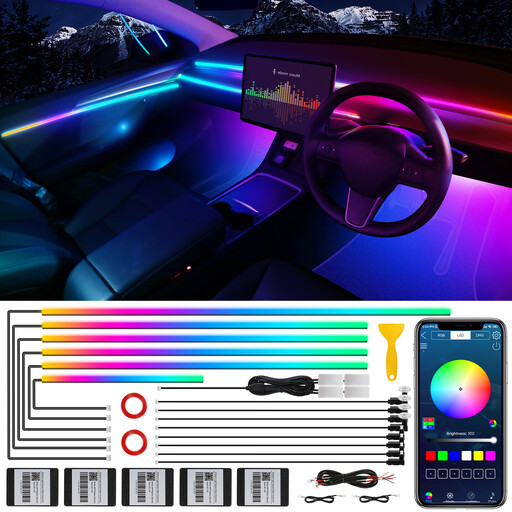
Why we chose it: For those who want zero compromises and a total cabin transformation, with synchronised lighting in every corner for complete immersion.
Its secret? A multi-controller architecture (1 main, 4 secondary) to manage complexity. This ensures stable power and uniform brightness across all elements, even the most distant ones, thus preventing voltage drops and the "string light" effect.
Maximum coverage (dashboard, 4 doors, floor, handles, storage bins). The Dreamcolor RGBIC technology and zone-based app control allow for customisation down to the finest detail.
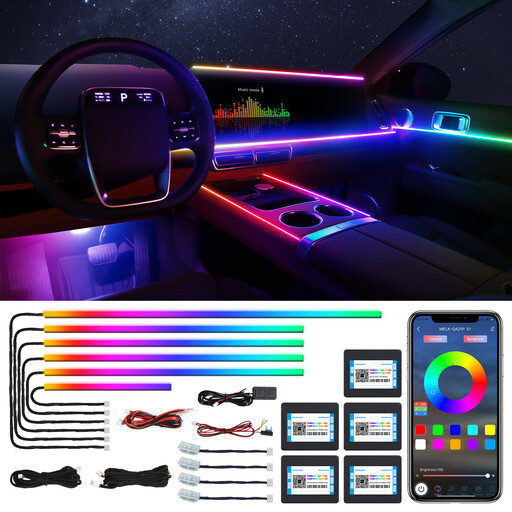
Why we chose it: This is the perfect balance between extensive coverage (dashboard, doors, floor) and everyday ease of use, without sacrificing advanced features.
In addition to app control, it includes a discreet touch button. No more fumbling for your smartphone for a quick adjustment or to turn the system on/off. A simple solution that bypasses the problem of sometimes slow-to-respond apps.
Dual control modes (app + touch button) for maximum flexibility. It offers comprehensive coverage of essential areas and Dreamcolor technology for dynamic effects.
We've compiled a complete list of products that meet our quality standards and safety requirements.
Modern kits have very low power consumption and run on a 12V supply. Most are connected to a power source that turns off with the ignition (cigarette lighter, fuse box, etc.), which prevents any battery drain when the car is off. Many models also include a memory function and short-circuit protection for total peace of mind.
Yes, the majority of car interior LED strip or fibre optic kits can be trimmed to size. However, it is crucial to follow the manufacturer's instructions. The fibre optic tube can usually be cut to the desired length with a simple tool. For LED strips, you must cut only at the specifically marked points to avoid damaging the electrical circuit.
Traffic laws are often very clear on this point: interior lighting must not impair the driver's vision or be visible from the outside to the extent that it distracts other road users. Using colours that could be confused with emergency vehicles (flashing blue or red) should be avoided while driving. It's best to stick to static colours and a moderate intensity while on the move, and save the dynamic effects and music sync for when the vehicle is parked.