
Livraison le jour même ou le lendemain

Qualité garantie

Débloquez vos offres de bienvenue: Livraison GRATUITE | Jusqu'à -80 % | 30 jours d'essai gratuits à JoyPlus
Téléchargez l'application
By Joybuy, our product expert – Published August 26, 2026
Finding yourself with a dead battery, especially on a freezing winter morning, is a situation every driver dreads. The first instinct is often to look for a jump starter, but the market is flooded with often confusing marketing promises. Between inflated power figures and superfluous features, it's easy to make a bad investment.
This guide is here to separate fact from fiction. We'll break down the common pitfalls and identify the technical criteria that truly matter, so you can choose a reliable device that will be there when you need it most.
Before you buy, it's essential to know how to spot the claims that often hide a poor-quality product. Here are the three most common mistakes.
To make an informed choice, focus on a few key technical specifications that determine your device's performance and safety.
Don't rely solely on peak amps. Two other values are fundamental:
Be careful not to confuse them; each device has its purpose:
If your goal is to never get stranded on the side of the road again, a jump starter is the tool you need. If you're looking to extend your battery's life in the garage, a charger/maintainer is more appropriate.
A quality jump starter must be equipped with "smart" clamps featuring multiple protections. This is a non-negotiable feature. Look for at least the following safety measures:
To illustrate these criteria in practice, here is our selection of recommended models, each designed for a specific use case.
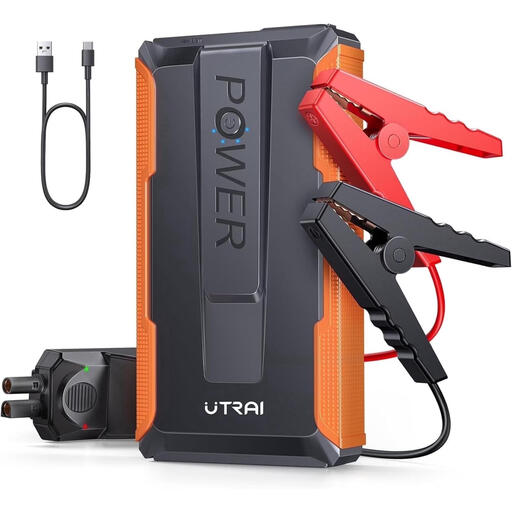
Why we chose it: Ideal for drivers of city cars, sedans, or small SUVs. It's compact enough to fit in the glove box while offering 2000A of power, more than enough for most medium-sized petrol and diesel engines. It gets straight to the point: starting your car, and doing it well.
It doesn't promise superfluous features. Its spec sheet clearly states its compatibility (up to 7.5L petrol / 5.5L diesel engines), avoiding the pitfall of an undersized device.
Excellent balance of compactness and power. Its robust design and smart clamps with audible alerts make it a reliable and easy-to-use emergency tool.
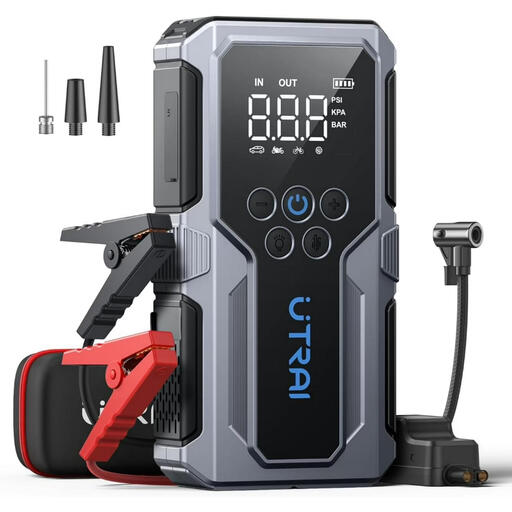
Why we chose it: For those who want more than just a starter. It combines a powerful 3000A jump starter with a 150 PSI air compressor, which is very handy for maintaining car, motorcycle, or bicycle tires. It's a comprehensive tool for long trips and outdoor activities.
The compressor is a genuinely useful and high-performing feature, not a gimmick. The 3000A power provides a safety margin for a wide range of vehicles, including SUVs and vans.
Well-integrated multifunctional solution. The LCD screen displays tire pressure and battery level, and the compressor automatically stops at the preset pressure.
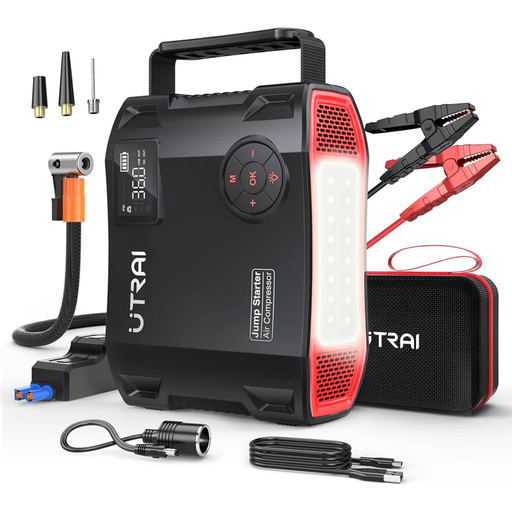
Why we chose it: Designed for owners of trucks, RVs, boats, or large diesel engines (up to 10.0L). With 6000A peak current and a 27,000 mAh battery, it delivers colossal starting power for the most demanding situations and cold climates.
Here, the advertised power isn't just a marketing gimmick; it's necessary and justified for its target audience. It avoids the incompatibility trap by covering almost all 12V vehicles on the market.
Extreme starting power (6000A) and great versatility with its 160W DC output, capable of powering devices like a car cooler or a vacuum cleaner.
Explore our full selection of products that meet our selection criteria and safety requirements.
A jump starter is a portable, standalone device that provides a strong burst of current to start an engine when the vehicle's battery is too low. It's an emergency solution. A car battery charger, on the other hand, plugs into a wall outlet and slowly recharges the battery over several hours. It is used for maintenance and prevention, not for an instant start.
Most quality models can hold their charge for 3 to 6 months. However, due to the natural self-discharge of lithium batteries, it is highly recommended to check the charge level and recharge your jump starter every 3 months. This ensures it will be ready to use in an emergency.
Yes, most jump starters are designed for all 12V electrical systems, which includes cars, motorcycles, SUVs, riding lawnmowers, and many boats. Always check the voltage compatibility (12V) and ensure the jump starter's power is suitable for your vehicle's engine, especially for larger boat engines.