
Livraison le jour même ou le lendemain

Qualité garantie

Débloquez vos offres de bienvenue: Livraison GRATUITE | Jusqu'à -80 % | 30 jours d'essai gratuits à JoyPlus
Téléchargez l'application
A dead battery. It's one of the most common and frustrating setbacks a driver can face. That dreaded click replacing the expected roar of the engine, always at the worst possible moment. In this situation, a car jump starter is the go-to solution: a compact device to get you back on the road in minutes. But there's a catch: the market is flooded with marketing promises that are more mirage than reality. As a product expert for Joybuy, my mission is to help you navigate this jungle. Let's break down the pitfalls to avoid for a truly informed purchase.
Before jumping on the first discounted model you see, it's crucial to read between the lines of the spec sheets.
To make the right choice, forget the marketing hype and focus on the technical specs that truly matter for performance and safety.
Not all engines have the same starting power requirements.
Forget peak current; the real difference lies in the battery technology.
A good portable car jump starter should be more than just a pair of clamps.
Here are a few models that stand out from the crowd, each tailored to a specific user profile and based on our criteria for performance and reliability.
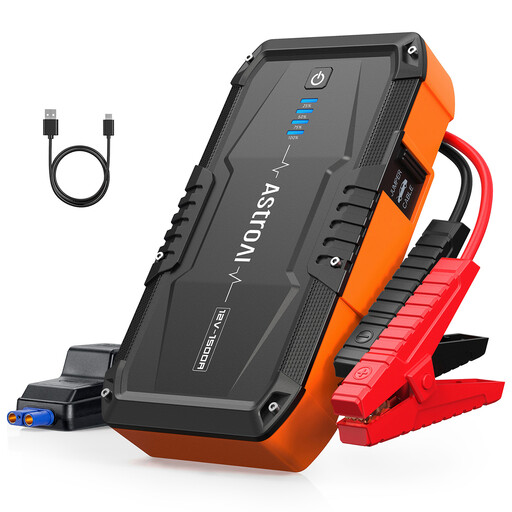
Why we recommend it : Perfect for drivers of small to mid-size cars looking for a reliable and compact solution to keep in the glovebox. It delivers just the right amount of power for most vehicles (up to 6.0L gasoline and 3.0L diesel) without being weighed down by unnecessary gadgets.
It doesn't try to impress with fantasy peak current figures, but instead delivers balanced performance, perfectly calibrated for the real-world needs of most drivers. Its design gets straight to the point: starting your car, period.
Compact and lightweight : Easy to store and handle. "BOOST" Mode : Allows you to force a start even on very weak or completely dead batteries.
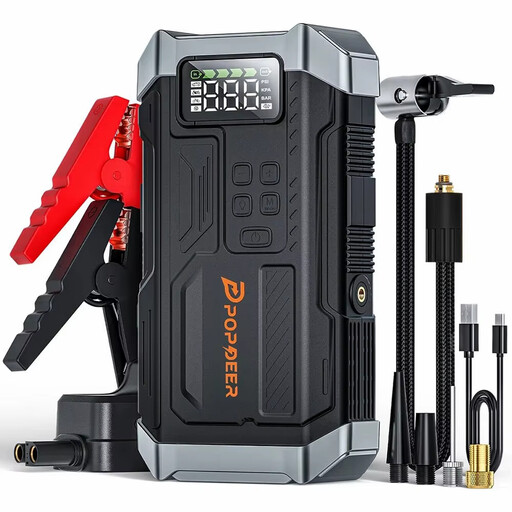
Why we recommend it : For those who want a true Swiss Army knife for the road, camping, or the garage. It combines high starting power (perfect for large SUVs and vans) with an effective air compressor for tire maintenance.
Here, the extra features aren't an afterthought. The compressor reaches 150 PSI with a flow rate of 35 L/min, making it a truly functional tool, not just a marketing gimmick.
True 4-in-1 : Powerful starter (up to 10L gasoline / 8L diesel), high-performance compressor, power bank, and flashlight. Thermal Management : Its design provides effective heat dissipation, a guarantee of safety and longevity.

Why we recommend it : Built for the most demanding vehicles (pickup trucks, 4x4s, RVs, diesel engines up to 10L). It focuses on a single mission: delivering colossal and reliable starting power, even in freezing cold.
Its impressive peak current (4000A) isn't just for show: it translates into a real-world ability to start the largest engines on the market. Here, power is a promise kept.
Raw Power : Capable of starting any gasoline engine and diesels up to 10.0L. Heavy-Duty Clamps : All-metal construction, designed for heavy use and rock-solid durability.

Why we recommend it : For those who prioritise long-term peace of mind. Its sodium-ion technology sweeps away the limitations of lithium batteries: you can forget it in your car all year round, as it requires almost no maintenance.
It doesn't just promise power; it tackles the core problem: battery lifespan and safety. Its promise is long-term reliability and security, even if you forget about it or leave it in extreme conditions.
Sodium-Ion Technology : Can remain on standby for 5 years, supports over 6,000 cycles, and offers intrinsic safety (no fire risk). Extreme Temperature Range : Operational from -40°C to 80°C.
Explore our full selection of products that meet our performance criteria and the strictest safety standards.
For a standard lithium-ion model, checking and recharging it every 3 to 6 months is recommended to compensate for its natural self-discharge. In contrast, new sodium-ion models can be stored for several years without a recharge thanks to their very low self-discharge rate. True peace of mind.
Most lithium jump starters can handle a range of -20°C to +60°C. However, be careful: leaving the device in a car in direct sunlight during a heatwave can damage the battery. Sodium-ion models, with their resistance up to +80°C, are far better suited to being left in the car year-round, regardless of the weather.
The procedure is simple and risk-free if you follow these steps exactly: