
Livraison le jour même ou le lendemain

Qualité garantie

Débloquez vos offres de bienvenue: Livraison GRATUITE | Jusqu'à -80 % | 30 jours d'essai gratuits à JoyPlus
Téléchargez l'application
By Joybuy, your high-tech expert
Silence. It's the sound every driver dreads when turning the ignition key. A dead battery is a source of stress and delays, whether you're on your way to work, heading out for vacation, or stuck in the middle of the night. Fortunately, a battery jump starter is the modern, compact solution to avoid calling a tow truck or relying on another driver for help.
This guide will walk you through the best options on the market. We'll break down the essential features and present a curated selection of models to help you choose the perfect car battery starter for your needs and your vehicle.
Before you make a purchase, let's review the key technical criteria that will make all the difference when it matters most.
Peak amperage (A) is the number one criterion. It indicates the maximum power the booster can deliver in a short burst to start your engine.
Today, a jump starter does more than just start your car. A jump starter with a built-in compressor is a major asset: it not only gets your car running but also lets you top up your tires anywhere, turning it into an emergency car tire inflator.
Most models also double as a power bank thanks to their USB ports, allowing you to charge your phone, tablet, or other electronic devices in a pinch.
Safety is non-negotiable. Ensure the model you choose includes all essential protections: against reverse polarity, short circuits, overcharging, and overheating. Smart clamps that signal an incorrect connection provide real peace of mind.
The battery technology (Lithium-ion, Sodium-ion) directly impacts its lifespan, safety, and ability to hold a charge over time.
Here are three options that stand out for their features and versatility, designed for different user profiles.
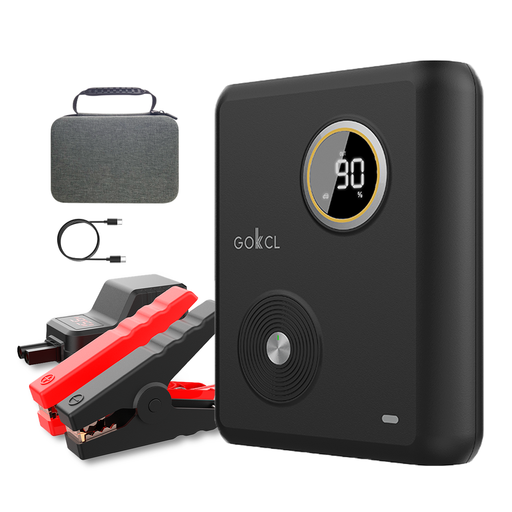
Why it stands out: The GOKKCL GK03 sets itself apart with its sodium-ion battery technology. Unlike lithium batteries, it offers remarkable stability and safety, including the ability to operate in extreme temperatures (-40°C to 80°C). Its main advantage is its extremely low self-discharge rate; as a result, it can remain charged and ready for up to 5 years without needing a top-up.
Advantages:
Who is it for? For the driver looking for a "set it and forget it" solution. Ideal for those who want an ultra-reliable device to leave in their trunk year-round without worrying about regular recharging.
See details for the GOKKCL GK03
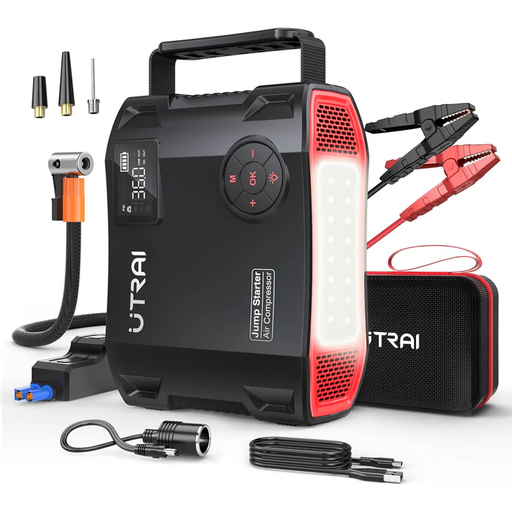
Why it stands out: The UTRAI JS5 is a powerhouse. With a peak current of 6000A, it's designed to start the largest vehicles, including all gasoline engines and diesel engines up to 10.0L. Its 150 PSI air compressor is also highly efficient, capable of inflating a tire in just a few minutes.
Advantages:
Who is it for? For owners of large vehicles (SUVs, 4x4s, utility vans, RVs) and road professionals. It's also an excellent choice for outdoor enthusiasts who need a versatile and robust power source.

Why it stands out: The BUTURE BC02 strikes the perfect balance with its 4500A of peak power, enough for almost all cars and SUVs (up to 9.0L gasoline / 8.0L diesel). Its jump starter with compressor is especially convenient with 5 preset inflation modes (car, motorcycle, bicycle, etc.) and an automatic shut-off, making it very easy to use.
Advantages:
Who is it for? For the everyday driver looking for a reliable, powerful, and easy-to-use 5-in-1 device. Its versatility makes it an ideal road companion for families and daily commutes.
The models featured here are versatile solutions, but your needs may differ. If you're looking for a simpler, more compact model or one with specific features, feel free to explore our full range.
Discover our entire collection of battery jump starters
The required power depends on your vehicle's engine size and type. For a standard gasoline car, 1000A to 1500A is sufficient. For a diesel engine, SUV, or utility van, you should look for a model with 2000A or more, especially if you live in a cold region.
This depends on the battery technology and the device's operating temperature range. Models like the GOKKCL GK03, with its sodium-ion battery, are specifically designed to withstand extreme temperatures (-40°C to 80°C) and can be left in a vehicle year-round. For lithium models, it is advisable to check the manufacturer's recommendations and avoid prolonged exposure to high summer heat.
Using one is very simple, as long as you follow the steps. Make sure the jump starter is sufficiently charged (over 50%). Connect the red clamp to the positive (+) terminal of the battery, then the black clamp to the negative (-) terminal. Turn on the booster, then try to start the car. Once the engine is running, remove the clamps in the reverse order (black first, then red). Modern models are equipped with safety features that prevent sparks even if you connect them incorrectly.