
Livraison le jour même ou le lendemain

Qualité garantie

Débloquez vos offres de bienvenue: Livraison GRATUITE | Jusqu'à -80 % | 30 jours d'essai gratuits à JoyPlus
Téléchargez l'application
Working under your car is serious business: safety is non-negotiable. Yet, the market for car jack stands is flooded with misleading marketing claims that can put your life at risk. As a product expert at Joybuy, my mission is to help you decode the spec sheets to make an informed decision based on objective criteria.
Before you pull out your credit card, watch out for these two common pitfalls:
Whether for the DIY mechanic or for professional garage equipment, safety depends on specific technical features. Here are the three non-negotiable points to inspect.
This is THE fundamental criterion. The load capacity must always be greater than the weight it needs to support. For maximum safety, never rely on the advertised number alone.
The height adjustment range (minimum and maximum) determines if the jack stand is compatible with your vehicle.
The locking mechanism is a vital safety component. The ratchet and safety pin system is the most common and reliable. Opt for a cast iron ratchet bar, which is much more robust than stamped steel. The base, meanwhile, must be made of thick, fully welded steel to ensure perfect load distribution and rock-solid stability.
Rather than a generic list, we've matched specific equipment to clear user profiles, based on the safety and compatibility criteria we've just discussed.
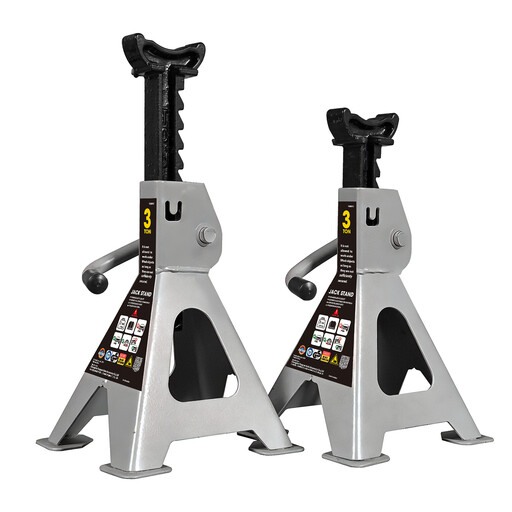
Why we chose it: Ideal for maintaining sedans, compacts, or mid-size SUVs. Their versatility makes them an excellent first piece of equipment for your garage.
Their true per-stand capacity of 3 tons is certified to EN 1494 and GS standards, offering a wide safety margin. The wide, welded base eliminates the risk of instability found in entry-level models.
Their height range (276-420 mm) is highly versatile, adapting to everything from a city car to a compact SUV.
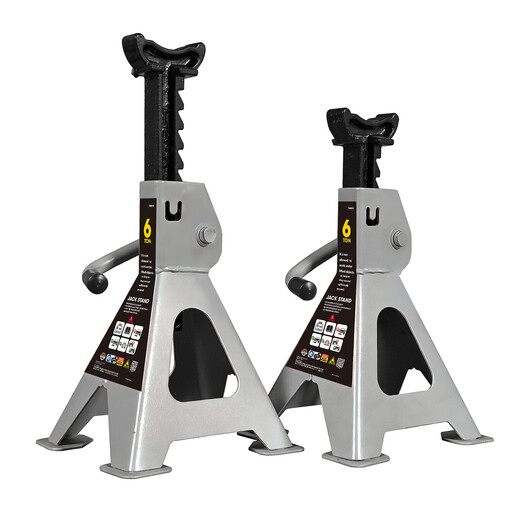
Why we chose it: Built for heavy loads. This is essential equipment for owners of large SUVs and 4x4s, off-roaders, light-duty vans, or motorhomes.
The 6-ton per-stand capacity is clearly specified and EN 1494 certified. Their welded steel structure and cast iron ratchet bar, designed for heavy use, leave no doubt as to their robustness.
Their wide height range (388-580 mm) creates a very comfortable workspace under tall vehicles. The rubber pads protect the chassis's lifting points.
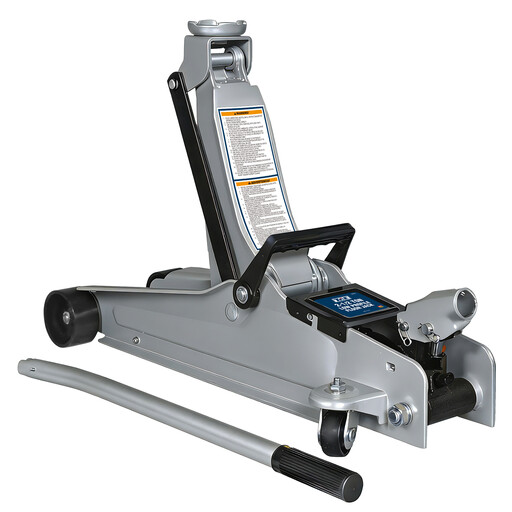
Why we chose it: Note, this isn't a jack stand, but the essential companion tool for lifting a sports car or supercar. Without a low-profile jack, it's impossible to lift the vehicle high enough to slide jack stands underneath.
It solves the underbody access puzzle. Its entry height of just 85 mm allows it to slide under the lowest chassis, where a standard jack would fail.
Certified EN 1494 + CE, it secures the critical lifting phase. Its 2.5-ton capacity covers the majority of cars on the road, including sedans and SUVs.
Discover our full selection of garage equipment that meets the same safety criteria and European standards.
A jack (hydraulic or mechanical) is only used to lift or lower a vehicle. It is absolutely not designed to hold a load for an extended period: it can fail at any moment. A jack stand, on the other hand, is a fixed mechanical support whose sole purpose is to hold the vehicle at height stably and safely once it has been lifted. Golden rule: Never, EVER, work under a car that is only supported by a jack.
The general rule is to choose jack stands with a capacity (per pair) of at least 1.5 times the total vehicle weight. However, it's safer to think in terms of axle weight. An axle supports about 60?% of the vehicle's total weight. For example, for a 2-ton (2000 kg) car, the heaviest axle weighs around 1200 kg. A pair of 3-ton jack stands (1.5 tons each) provides a very comfortable safety margin. For heavy vehicles like 4x4s or vans, go directly for 6-ton pairs.