
Livraison le jour même ou le lendemain

Qualité garantie

Débloquez vos offres de bienvenue: Livraison GRATUITE | Jusqu'à -80 % | 30 jours d'essai gratuits à JoyPlus
Téléchargez l'application
Changing a wheel, inspecting the chassis or carrying out DIY work in your garage requires a car jack suited to your vehicle’s weight and ground clearance. The difficulty is that product specifications do not always provide everything you need to make the right choice: stated capacity without explanation, missing minimum height or safety features that are not described in detail.
Before placing your order, three common mistakes should be avoided:
Capacity is expressed in kilograms or tonnes. A 1.5-tonne car jack, a 1.8-tonne car jack and a 3-tonne model do not meet the same needs.
Start by checking the vehicle’s maximum authorised mass on its registration document. Then add the weight of passengers, luggage and any equipment in the boot. For a family car, SUV, MPV or van, it is generally best to allow some extra capacity. High-capacity upright models, such as the hydraulic bottle jack, are better suited to heavy vehicles and workshop use.
The stated maximum capacity must never be exceeded. It also does not mean that the jack can support the vehicle on its own throughout an entire repair.
The minimum height must allow you to slide the jack under the lifting point specified by the manufacturer. This is an essential consideration for a low vehicle or one with modified suspension. A low-profile hydraulic jack with an entry height of 85 mm may be suitable for certain vehicles, provided you check the exact height of the lifting point beforehand.
The maximum height, meanwhile, must be sufficient to lift the wheel clear of the ground. Compare it with the height of the bottom of the bodywork and the suspension travel. For example, the 1.8-tonne MICHELIN hydraulic jack offers a range of 105 to 350 mm, while the 1.5-tonne MICHELIN rack jack lifts from 115 to 390 mm.
A trolley jack fits easily into a garage thanks to its swivelling wheels and good manoeuvrability. Hydraulic operation generally reduces the effort required for pumping, but the overall unit is bulkier than a scissor jack.
For regular use, check in particular:
The EN 1494 standard and CE marking may appear on certain product specifications. However, they should be considered alongside the manufacturer’s information and the stated conditions of use. In all cases, position suitable axle stands before working under the vehicle: a jack alone is never a safety support.
The products below cover several uses: changing a wheel, routine maintenance, home garages and lifting heavier vehicles. Always check your vehicle’s dimensions and the manufacturer’s recommendations before placing your order.
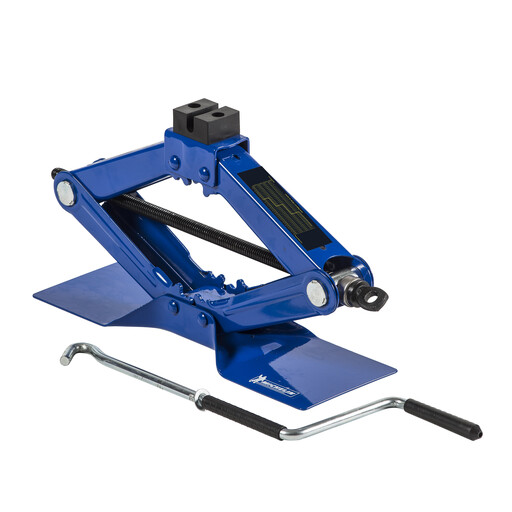
Why this choice suits this profile : This compact scissor jack is aimed at motorists who want to keep a tool in the boot in case they need to change a wheel occasionally.
Its minimum height of 115 mm and extra-wide base provide clear, practical reference points rather than relying solely on a simple promise of compactness.
Capacity of 1,500 kg, lifting range of 115 to 390 mm, U-shaped rubber saddle and padded handle.
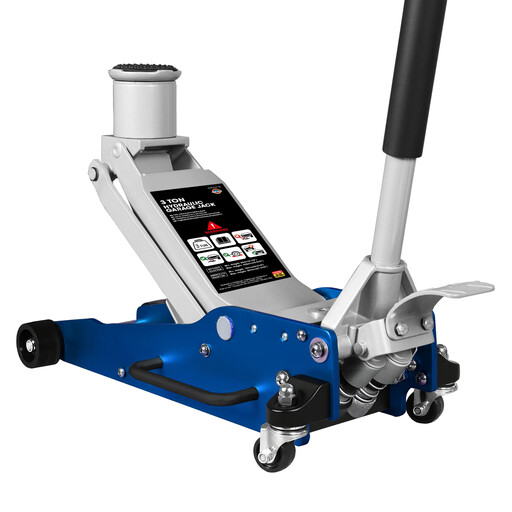
Why this choice suits this profile : Its horizontal design and dual pumping system are aimed at users looking for smoother operation, whether they have a low car, an SUV or an MPV.
With a stated entry height of 85 mm, you can make a practical comparison between the jack and your vehicle’s ground clearance.
3-tonne capacity, lifting range of 85 to 465 mm, extension up to 541 mm, aluminium and steel construction. The product specifications mention EN 1494 and CE certification.
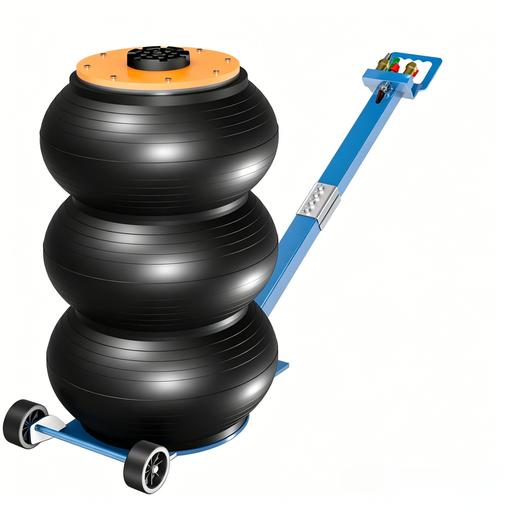
Why this choice suits this profile : This pneumatic jack is intended for garages and workshops equipped with a compressor, as well as repeated work on cars and commercial vehicles.
Its compressed-air operation must be taken into account from the outset. This model is therefore not presented as a universal solution to keep in the boot.
Stated capacity of 5 tonnes, pneumatic lifting, controlled lowering via a valve and removable handle for easier storage.
We have put together a complete, real-time selection of products that meet these criteria, as well as European safety regulations.
A jack intended for changing a wheel must be used on a hard, level and clear surface. Before lifting the vehicle:
Never get underneath a vehicle supported only by a jack. Also observe the stated maximum capacity and do not use a hydraulic jack on soft or sloping ground.
For an SUV or light commercial vehicle, consider the vehicle’s weight, the height of the lifting points and the jack’s capacity. A 3-tonne SUV and van jack may be suitable for some models, while a 6-tonne bottle jack or larger is intended for heavier vehicles. High capacity never removes the need to check the dimensions.
A hydraulic jack uses fluid and a pump to lift the vehicle with fewer handle turns. A trolley jack is practical in a garage, but it takes up more space. A scissor jack is generally more compact and easier to transport, but its mechanism requires more effort.
Its service life depends on how often it is used, storage conditions and whether the maximum load is respected. Store it in a dry place, clean exposed parts and regularly check the wheels, saddle, handle, welds and any hydraulic leaks. A deformed part or persistent leak means you must stop using the jack immediately, then replace it or have it inspected by the manufacturer.