
Livraison le jour même ou le lendemain

Qualité garantie

Débloquez vos offres de bienvenue: Livraison GRATUITE | Jusqu'à -80 % | 30 jours d'essai gratuits à JoyPlus
Téléchargez l'application
Choosing a car jack can quickly become a headache. Between the technical jargon and marketing promises, it's easy to end up with an unsuitable, or even dangerous, tool. This guide is here to cut through the noise and help you find the equipment that truly fits your needs, whether for a simple tyre change or for regular vehicle maintenance.
Before comparing models, let's review the most common pitfalls that lead to a bad purchase:
To avoid these pitfalls, you need to focus on a few key parameters. Far from being mere details, these technical specifications ensure your safety and the effectiveness of your tool.
The capacity your jack needs does not correspond to your vehicle's total weight. A jack only lifts one corner or one side of the car, which is about half of its mass. For a comfortable safety margin, choose a jack with a capacity equal to 75% of the vehicle's total weight.
For example, for a 1.8-tonne saloon, a 1.5-tonne jack (1800 kg × 0.75 = 1350 kg) is more than sufficient. For an SUV or a light commercial vehicle weighing 2.5 tonnes, a 3-tonne jack will provide the necessary safety and stability.
The lifting range is defined by two values:
Each technology meets a specific need:
Safety comes before everything else. Check that the jack complies with European standards, such as CE or EN 1494 certification. And most importantly, never forget: a jack is for lifting, not for holding. Once the vehicle is in the air, it must be secured on a pair of jack stands before you perform any work.
To help you make your final choice, here are a few recommended options, each tailored to a distinct user profile.
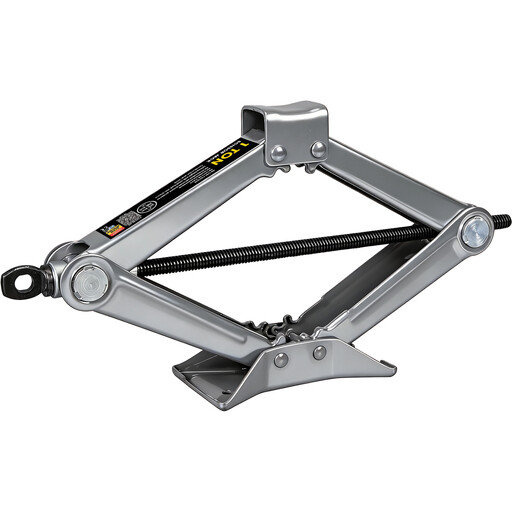
Why we chose it: The ultimate emergency solution. Reliable and compact, it stores easily in the boot next to the spare wheel. Its simple operation makes it the perfect tool for a roadside tyre change.
Its minimum height of 88 mm allows it to slide under most vehicles, including those with low ground clearance, thus avoiding the "jack is too tall" trap. Its 1-tonne capacity is perfectly calibrated to lift a corner of a saloon or city car.
Ultra-compact and foldable for easy storage. Its crank handle is designed to reduce effort, making the operation accessible to everyone.
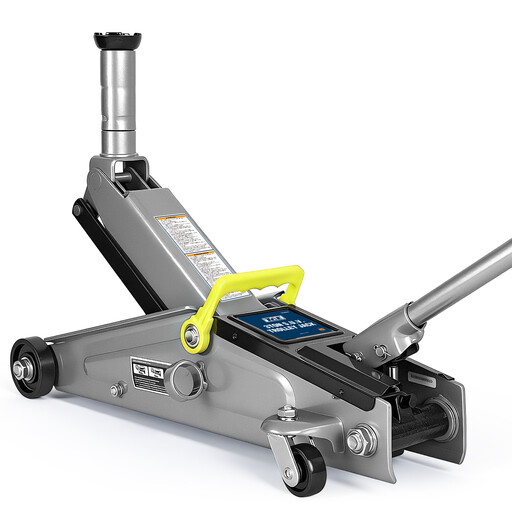
Why we chose it: The go-to tool for DIY mechanics who regularly maintain their car, SUV, or MPV. This hydraulic trolley jack offers the power, speed, and stability essential for working with peace of mind in your garage.
Its true 3-tonne capacity and CE certification with a safety overload valve eliminate the risks of misleading capacity and lack of safety. Its lifting range (150-530 mm) makes it highly versatile.
Robust steel construction guarantees excellent durability. The hydraulic system ensures fast, effortless lifting, saving considerable time and energy.
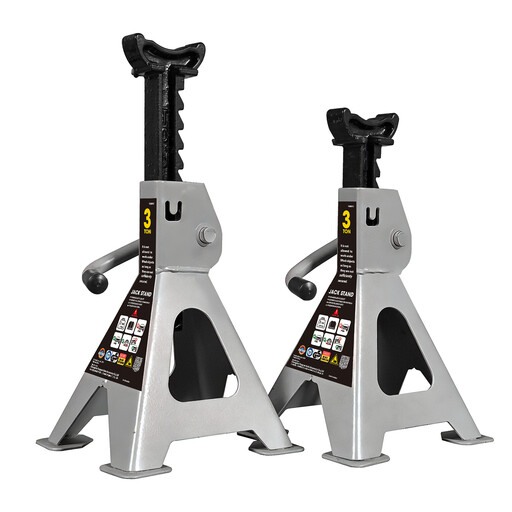
Why we chose it: This accessory isn't an option—it's a necessity. For anyone spending more than a couple of minutes under a vehicle, these stands are the life insurance that prevents serious accidents in case of jack failure.
It counters the most dangerous pitfall: trusting a jack, even a hydraulic one, to support a load. The EN 1494 / GS certification and welded steel frame guarantee a real and reliable load capacity of 3 tonnes per pair.
Adjustable height range (276-420 mm) compatible with most cars and SUVs. The ratchet-style locking mechanism provides a reassuring click that confirms it's securely in place.
We have curated a full range of products that meet our strict selection criteria and European safety standards.
Aim for a capacity of about 75% of your vehicle's total weight. You can find this information (the mass in running order) on your vehicle's registration document. Never underestimate this criterion: a good safety margin is essential.
Absolutely not. This is THE fundamental safety rule. A jack, even a hydraulic jack, is designed to lift a load, not to hold it indefinitely. It is not infallible: a seal can leak, causing the vehicle to lower slowly or drop suddenly. Always use jack stands, correctly positioned on a flat, stable surface, to support the car's weight before getting underneath it.
Every vehicle has specific jacking points designed to support its weight without damaging the chassis or sills. These points are always indicated in your car's owner's manual. Look for a small notch or triangle on the sill, usually near the wheel arches. It is imperative to use only these points to ensure a stable lift and to avoid damaging your vehicle's bodywork.