
Livraison le jour même ou le lendemain

Qualité garantie

Débloquez vos offres de bienvenue: Livraison GRATUITE | Jusqu'à -80 % | 30 jours d'essai gratuits à JoyPlus
Téléchargez l'application
Changing tyres, inspecting the chassis, or performing a last-minute repair… A reliable car jack is an essential tool for any driver. But with all the different models, capacities, and technologies available, it's not easy to navigate the options. This guide is here to break down the key criteria and help you choose a safe lifting equipment that's right for your needs, cutting through the jargon.
Before you start, a few basic principles are essential to ensure your safety and the effectiveness of your equipment.
Load capacity, expressed in tons (T), is THE number one criterion. The golden rule: choose a jack capable of supporting at least 75% of your vehicle's total weight. Rest assured, a jack never lifts the entire car, only one side or corner.
Beyond tonnage, compliance with standards is your best guarantee. Prioritise certified products, such as those that meet the European standard EN 1494. The GS (Geprüfte Sicherheit) label, issued by an independent body, is also an excellent indicator of reliability, as it certifies that the product has undergone the strictest testing.
The lifting height must be perfectly suited to your vehicle. Two scenarios are most common:
The smart move: measure the distance between the ground and your car's lifting points to ensure the jack's height range is a match.
The absolute golden rule: NEVER work under a vehicle supported only by a jack. A jack is for lifting, not for holding. Once the car is in the air, it must be supported by jack stands. This is a non-negotiable safety rule. Ideally, opt for adjustable jack stands to fine-tune the working height with precision.
Here are a few recommended options, selected for their compliance, practicality, and user-safety-focused design.
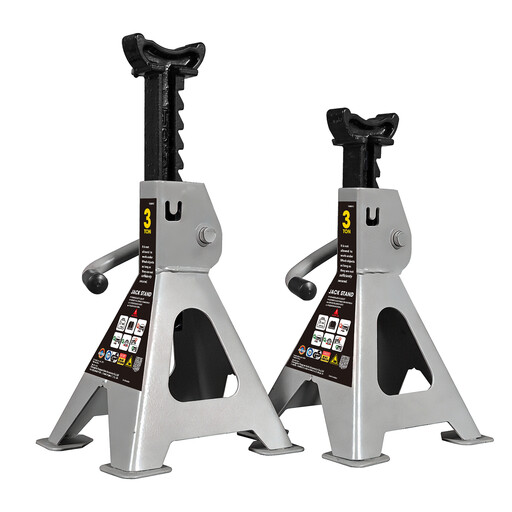
Why we recommend them: These 3-ton jack stands are designed for those who make no compromises on safety. Their 3-ton capacity per pair offers a more than comfortable safety margin. Compliant with the EN 1494 standard and GS certified, they are made of high-strength steel with a welded base for rock-solid stability.
Key features:
Who is it for? Perfect for the home mechanic who spends time under their car and for owners of various vehicles (saloons, SUVs, light utility vehicles) looking for a reliable and secure support solution.
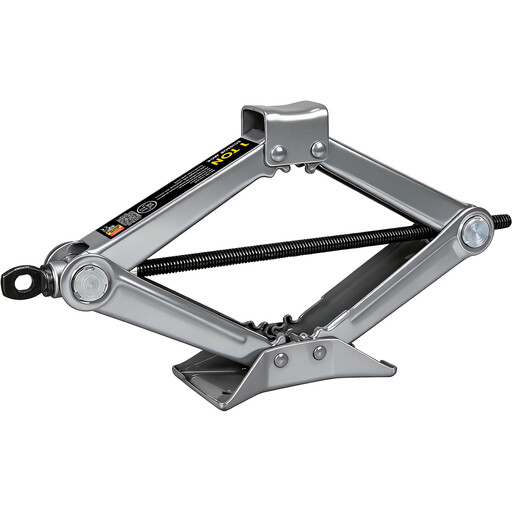
Why we recommend it: This scissor jack is the ultimate emergency tool. Compact, foldable, and with its 88 mm low-profile design, it's the ideal emergency jack to keep in your boot. Its ergonomic crank handle allows you to lift the vehicle without strain, making it accessible to everyone.
Key features:
Who is it for? For the prepared driver who wants a reliable and compact tool in case of a flat tyre. It is perfectly suited for saloons, city cars, and vehicles with low ground clearance.
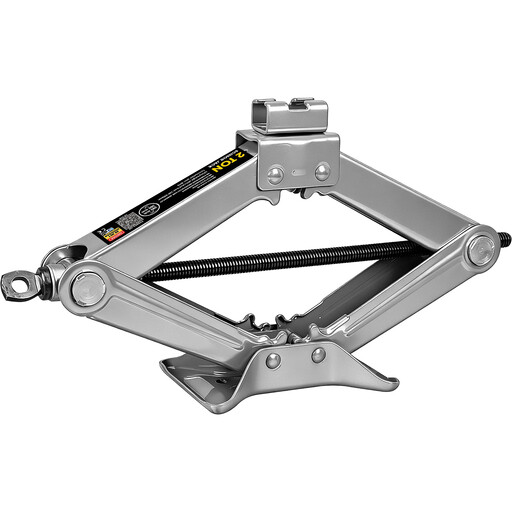
Why we recommend it: With its 2-ton capacity, this scissor jack is the heavy-duty version of the previous model. It's built for heavier vehicles like compact SUVs or large saloons. It remains just as compact and easy to use as the 1-ton model, but with added versatility.
Key features:
Who is it for? For owners of SUVs, MPVs, and family saloons who are looking for an emergency jack suited to their heavier vehicle.
Mechanics is a matter of passion and good equipment. If you are a well-equipped enthusiast, whether for the workshop or for your hobbies, take a look at our other departments. For example, discover our selection of Hunting Accessories.
For a 2-ton car, a 1.5-ton capacity jack is theoretically sufficient, as it only supports a portion of the total weight. However, for greater safety and versatility (especially if you own multiple vehicles), a 2-ton model is highly recommended.
Absolutely not! A jack, whether mechanical or hydraulic, is a LIFTING tool, not a SUPPORT tool. Its stability is not designed to last, and the risk of failure is real. For any work, the use of jack stands is not only mandatory but vital.
This is a crucial step to avoid damaging the chassis. The manufacturer designates specific lifting points—reinforced areas specially designed for this purpose. The first thing to do: consult your vehicle's owner's manual. It will show a precise diagram of where to position the jack safely. Generally, these points are located on the chassis frame, near the wheels.