
Livraison le jour même ou le lendemain

Qualité garantie

Débloquez vos offres de bienvenue: Livraison GRATUITE | Jusqu'à -80 % | 30 jours d'essai gratuits à JoyPlus
Téléchargez l'application
A car dashcam can provide video evidence in the event of a collision, dispute or vandalism. The problem is that product descriptions often list resolution, viewing angle and connected features without explaining the conditions in which they work. As a result, you could buy a front-facing camera that looks very convincing on paper, only to find that it quickly becomes overwhelmed by oversized files, or discover that parking mode requires an accessory sold separately.
A 4K dashcam captures more detail than a 1080p model, but actual image quality also depends on the sensor, lens, exposure and video compression. At night, a poorly optimised 4K camera can produce less readable footage than a good 2K model.
Before making your choice, check whether it has an HDR mode, along with the lens aperture and advertised night-vision performance. Resolution is not everything: an effective sensor and well-calibrated video processing often matter more.
The term 24-hour dashcam parking mode does not necessarily mean that the camera can remain powered on by itself. On many models, monitoring while the engine is switched off requires a hardwire kit, usually sold separately.
This kit must be compatible with your vehicle and include protection against excessive battery discharge. Without this safeguard, parking mode can turn simple monitoring into an unpleasant surprise when you try to start the car again.
4K videos fill the available storage quickly. A U3 or faster microSD card, designed to withstand repeated writes, is often essential.
GPS, Wi-Fi and 4G also serve different purposes. Wi-Fi is mainly used to transfer files to a smartphone, while 4G can allow you to view the camera remotely. However, the latter requires a compatible module and, in some cases, a subscription.
For everyday use, 2K is generally sufficient for urban and commuting journeys. 4K provides more detail at the front, particularly for number plates and road signs, provided there is enough light and the lens stays clean.
A Sony STARVIS 2 dashcam uses a family of sensors designed for poorly lit scenes. This alone does not guarantee perfect footage, but it is a useful feature to compare alongside the lens aperture, HDR and software processing.
A frame rate of 60 frames per second makes movement smoother and can make it easier to analyse a scene, but it also increases the size of the recorded files.
A front-facing dashcam mainly records the road ahead. A front and rear car camera adds a view of the rear, which is useful in the event of a rear-end collision or while manoeuvring.
Four-channel systems cover the front, rear and sides. A 360° wide-angle or rotating dashcam is designed to reduce blind spots.
However, bear in mind that an extremely wide field of view does not guarantee more detailed footage. The wider the angle, the more the edges of the image may be distorted. Compare the number of cameras, their respective resolutions and their actual fields of view.
A dashcam with GPS generally records your location, speed, time and route. This information makes it easier to organise videos, but check it carefully before submitting it as part of an insurance claim or using it in a dispute.
The G-Sensor detects sudden changes, such as an impact, and can automatically lock the relevant recording so that it is not overwritten by loop recording.
Wi-Fi makes it easier to watch and download videos through an app, without removing the memory card. A dashcam with voice control can take a photo or lock a video without manual operation. However, check the supported languages: some devices only recognise English.
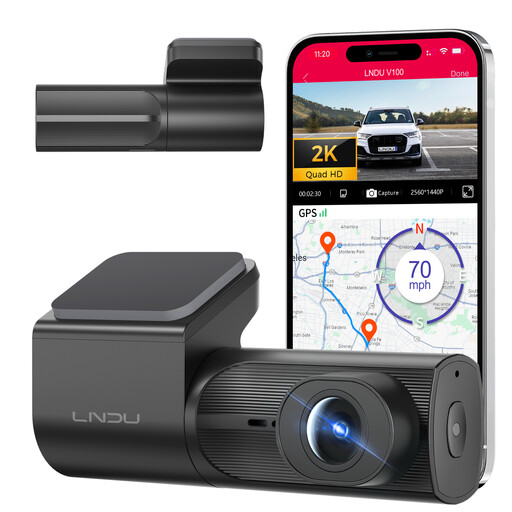
Why this choice suits this profile : Its front-facing design and mobile app make it a straightforward option for a first installation, particularly for urban or suburban journeys.
The product description clearly states the 2K resolution, Wi-Fi and G-Sensor, as well as the need for a separate kit to activate parking mode.
Loop recording, night vision, F1.8 aperture and control through the LNDU app.
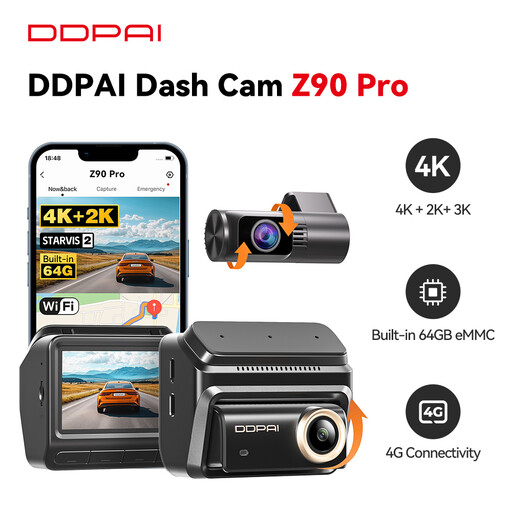
Why this choice suits this profile : Its advanced features are aimed at drivers who regularly combine motorway and long-distance journeys and want to manage their videos directly from their smartphone.
The product description clearly distinguishes between the 64 GB of internal memory, the external card capacity of up to 512 GB and the kit required for 24-hour monitoring.
Sony STARVIS 2 IMX678 sensor at the front, 4K HDR video, 2K HDR rear camera, GPS, 5 GHz Wi-Fi and supercapacitor.
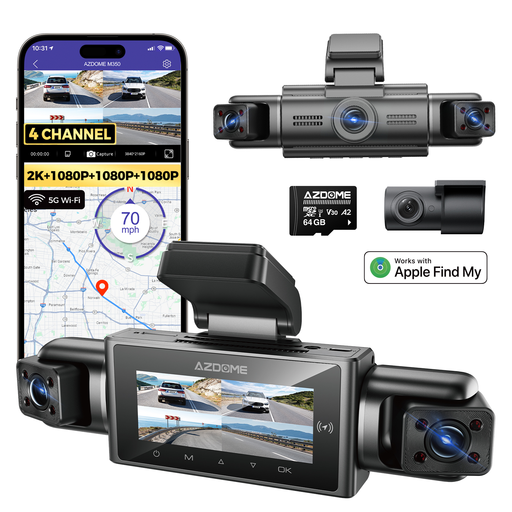
Why this choice suits this profile : Professional drivers, vehicles parked on the street and users who want to monitor the sides can make the most of its four channels.
Coverage at the front, rear, left and right means you do not have to rely on a single viewing angle.
2.5K front camera, three 1080p cameras, built-in GPS, infrared night vision, 5 GHz Wi-Fi and English voice control.
We have brought together a complete, real-time updated selection of products that meet these demanding criteria, as well as European safety requirements.
Install the camera behind the rear-view mirror, without obstructing the driver’s field of vision. Clean the windscreen before attaching the mount, then route the cable along the trim so that it does not interfere with driving.
With a front and rear car camera, measure the required length to the tailgate before placing your order. This will help you avoid ending up with a cable that is too short or impossible to hide neatly.
Format the memory card regularly using the camera and choose a model designed to withstand repeated writes. Activate loop recording and check that locked clips cannot be deleted automatically.
In France, avoid sharing images that could identify faces or number plates without taking the necessary precautions. GPS data and recordings of the vehicle interior must also be handled carefully.
Using an in-car camera is generally possible for private purposes, but the sharing of identifiable images and respect for privacy must be taken into account. In the event of a dispute, keep the original file and check whether your insurer or the relevant authorities have any specific requirements.
Choose a Class 10, U3 or faster microSD card, with enhanced endurance and a capacity that complies with the manufacturer’s recommendations. A 128 or 256 GB card may be suitable for regular use. 4K, however, requires more storage space, especially if the camera records continuously.
Yes, if the camera remains powered while the engine is switched off. A hardwire kit with under-voltage protection can reduce the risk of battery discharge, but check its settings and compatibility with your vehicle.
Parking mode is therefore not necessarily included or completely self-contained.