
Livraison le jour même ou le lendemain

Qualité garantie

Débloquez vos offres de bienvenue: Livraison GRATUITE | Jusqu'à -80 % | 30 jours d'essai gratuits à JoyPlus
Téléchargez l'application
Staying connected in your car has become a necessity, whether for GPS, music, or keeping in touch. Yet, choosing the right car charger is often a challenge. Between promises of ultra-fast charging and futuristic designs, it's easy to end up with a device that charges at a snail's pace, overheats, or fails after just a few weeks.
As the Head of Product Selections at Joybuy, I spend my time testing accessories to find the best models on the market. My goal? To help you cut through the noise. Let's forget the marketing jargon and focus on what's essential. Here are the most common pitfalls to avoid and the criteria that truly matter for making the right choice.
To avoid these pitfalls, simply keep an eye on a few key features. This will guarantee you long-term performance and safety.
Charging speed doesn't just depend on watts. It's dictated by communication protocols between the charger and your device.
Your needs determine the ideal configuration.
A wireless car charger offers undeniable convenience: no more cables to plug in.
To illustrate these criteria in action, here are a few models that meet specific needs while avoiding the pitfalls we've mentioned.
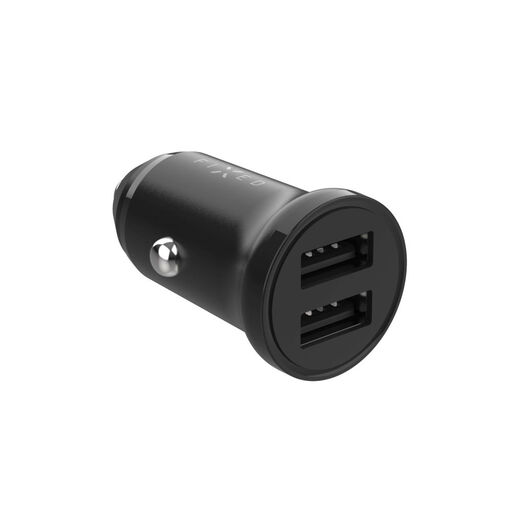
Why it's a good choice: Ideal for those with simple needs: keeping their phone and another device (GPS, headphones) charged during daily commutes. Its minimalist design blends discreetly into any car interior.
It doesn't promise ultra-fast charging, but rather a stable and reliable 15W of total power. It does what it's supposed to do, no frills: efficiently charge two devices simultaneously.
Two USB-A ports for broad compatibility; compatible with 12V (car) and 24V (truck) sockets.
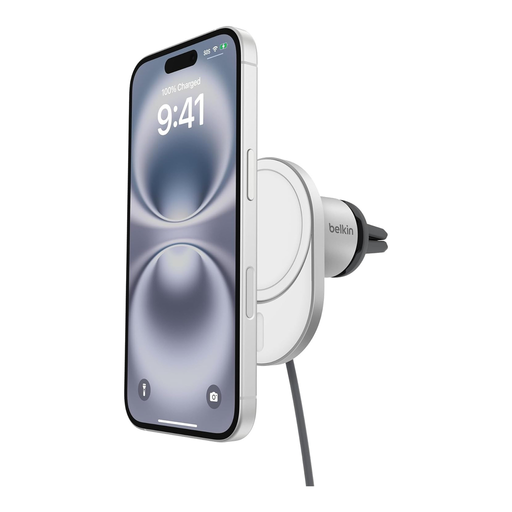
Why it's a good choice: Perfect for iPhone owners who want a completely seamless experience. The magnetic mount is reliable, wireless charging is fast, and it all comes in a sleek design that clips onto your air vent.
It solves the problem of compatibility and alignment. The Qi2 certification and MagSafe compatibility guarantee a perfect connection and 15W charging, unlike generic mounts that struggle to deliver on their promises.
15W fast wireless charging (Qi2); powerful magnetic mount; 360° rotation for portrait or landscape viewing.
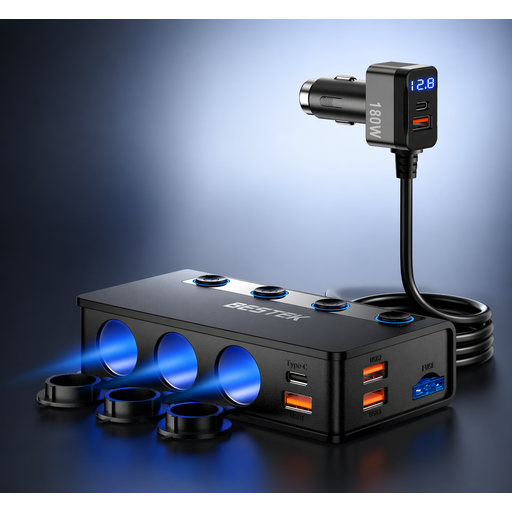
Why it's a good choice: This is the ultimate in-car charging station. It can simultaneously power the whole family's smartphones, a tablet, a GPS, and even a laptop, thanks to its massive power and comprehensive connectivity.
It ends the headache of power sharing. With 6 dedicated charging ports (including 65W PD and QC3.0) and 3 additional cigarette lighter sockets, every device gets the power it needs, without compromise.
180W total power; 6 fast-charging ports (PD and QC); 3 additional cigarette lighter sockets; independent power switches.
We've curated a complete selection of products that meet our standards for performance and safety.
Can a car charger drain my vehicle's battery? Most cigarette lighter sockets turn off when the vehicle's ignition is off. In this case, there's no risk. If your socket stays powered continuously, a charger left plugged in consumes a negligible amount of power. However, as a precaution, it's a good idea to unplug it if you won't be using your car for several days.
What's the difference between PD and QC fast charging? These are two competing technologies that aim for the same goal: to charge your device faster. Power Delivery (PD) is a more universal standard, supported by Google and Apple, that primarily works via the USB-C port. Quick Charge (QC) is a Qualcomm technology, commonly found on Android devices. For maximum compatibility, it's best to choose a charger that supports both protocols.
My charger is overheating. Is this normal? A slight increase in temperature is normal during fast charging, as the energy transfer generates heat. However, if the charger becomes so hot that it's difficult to touch, it's a sign of poor quality or a malfunction. Stop using it immediately for safety reasons and replace it with a certified model that has built-in overheating protection.