
Livraison le jour même ou le lendemain

Qualité garantie

Débloquez vos offres de bienvenue: Livraison GRATUITE | Jusqu'à -80 % | 30 jours d'essai gratuits à JoyPlus
Téléchargez l'application
As a product expert at Joybuy, I see users every day who are lost in the jungle of car chargers. The scenario is a classic one: a long road trip ahead, a dead smartphone battery, and a new charger that only delivers a trickle of power... It's a frustrating and all-too-common situation.
The problem isn't always the charger itself, but often marketing promises that do a poor job of hiding design flaws. Before you make a decision, beware of these three pitfalls that could make you bitterly regret your purchase.
To avoid these unpleasant surprises, you just need to check a few simple technical points. This is what will make all the difference between a useless gadget and a true ally on the road.
Power, expressed in watts (W), determines charging speed. But it's not enough on its own: it must be paired with the right protocol.
The ideal number of ports simply depends on your needs.
For long trips, RV life, or mobile professionals, a simple USB charger is no longer enough. If you need to power a laptop, an electric cooler, or even small appliances, you need a 12V to 230V converter, also known as a car power inverter. This device converts the 12V DC power from your car's battery into 230V AC power, just like at home. Opt for "pure sine wave" models, which protect your most sensitive electronic devices.
To help you make an informed decision, here is our selection of models that meet different needs, all chosen for their performance and safety.
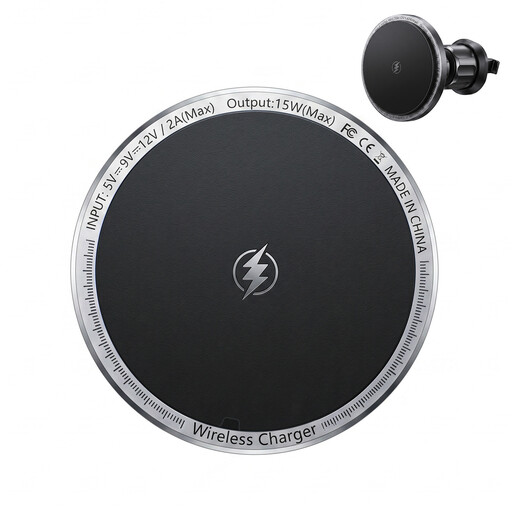
Why it's a great choice: Perfect for drivers with an iPhone 12 or newer. It combines a phone mount and wireless charger, freeing up your hands and keeping your car's interior free of cables for a safer drive and a clutter-free look.
Specifically designed for the MagSafe ecosystem, it guarantees a perfect magnetic alignment and efficient 15W wireless charging, whereas generic chargers waste energy and overheat unnecessarily.
Combines a mount and charger in one simple action. Its metal heat sink prevents overheating, protecting the phone's battery in the long run.
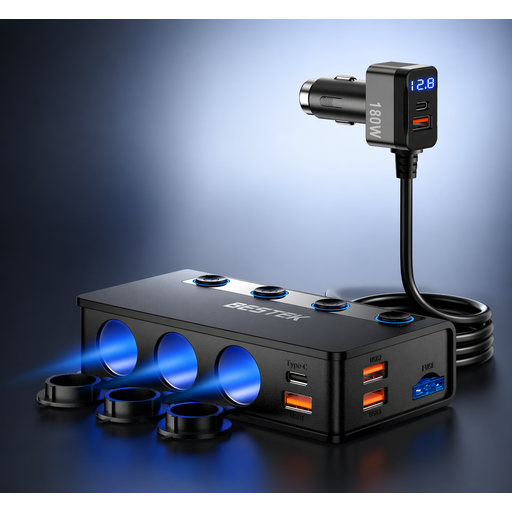
Why it's a great choice: This is THE solution for long family road trips or for professionals on the move. It allows you to charge up to 9 devices simultaneously, including a 65W PD port for a laptop and QC3.0 ports for compatible smartphones.
It doesn't just split the power. It delivers a total of 180W with dedicated fast-charging ports (PD & QC) and independent switches for each socket. A real plus for safety and power management.
Extreme versatility with 6 charging ports and 3 cigarette lighter sockets. The switches and battery voltage display are genuine safety features.
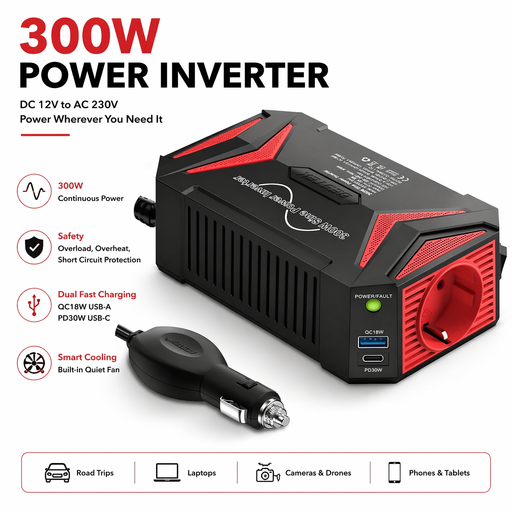
Why it's a great choice: For those who need much more than a simple USB charge. This inverter transforms your car's 12V socket into a true 230V power outlet, capable of powering a laptop, a game console, or a small cooler during your trip.
It uses "pure sine wave" technology, which produces stable, clean power identical to that from a household outlet. This protects sensitive electronics (computers, specialized equipment) from damage caused by low-end inverters.
Provides 300W of continuous power and includes PD and QC USB ports for maximum versatility. Its smart fan and multiple protections (over-voltage, overheating) ensure safe operation.
Discover our full selection of products that meet our performance criteria and current safety standards.
Yes, if the engine is off and you leave it plugged in for too long. Most cars cut power to the cigarette lighter when the ignition is turned off. However, be aware that on some models, the socket remains powered continuously. A good charger has almost no idle power consumption, but as a precaution, it's best to unplug it if you don't use your car for several days. Note: Some kits, especially for dashcams, include a protection feature that cuts power to avoid draining the battery.
These are two competing fast-charging technologies.
For standard charging, don't worry: compatibility is nearly universal. For fast charging, it's a different story. You need to check the protocol supported by your phone (this information can be found on its spec sheet) and choose a charger that explicitly mentions the same protocol (e.g., "Power Delivery 3.0" or "Quick Charge 3.0"). When in doubt, a USB-C Power Delivery charger remains the most versatile and future-proof choice.