
Livraison le jour même ou le lendemain

Qualité garantie

Débloquez vos offres de bienvenue: Livraison GRATUITE | Jusqu'à -80 % | 30 jours d'essai gratuits à JoyPlus
Téléchargez l'application
A dead battery: every driver's nightmare. A frosty winter morning, headlights left on all night, and disaster strikes: the car won't start. It's a hassle we'd all rather avoid. Fortunately, the days of fumbling with jumper cables and searching for a good Samaritan are over. The battery jump starter, also known as a portable car starter, has emerged as the ultimate modern, compact, and self-contained solution.
But with an overwhelming number of options on the market, how do you make the right choice? This guide is here to decode the spec sheets and help you find the model that will save the day when you need it most.
Before you jump on the first model you see, let's look at the technical specifications that make all the difference.
This is the number one criterion. Expressed in amperes (A), power is broken down into two values: peak amps, which is the maximum burst the jump starter can deliver in a fraction of a second, and cranking amps, the sustained power it provides for several seconds to start the engine.
Most devices operate on a 12V lithium jump starter system, which is compatible with the vast majority of passenger vehicles.
A good emergency starter does more than just revive your battery. The best models are true roadside Swiss Army knives, packed with highly practical features:
No need to be a mechanic! Modern jump starters are designed to be used by anyone, completely safely. Make sure the model you choose includes essential protections: reverse polarity, short circuits, overheating, overcharging... A clear LCD screen or LED indicators are also a real bonus, showing the jump starter's charge level and connection status at a glance.
To help you make your choice, we've selected three models with distinct profiles, from the everyday companion to the powerhouse for pros.
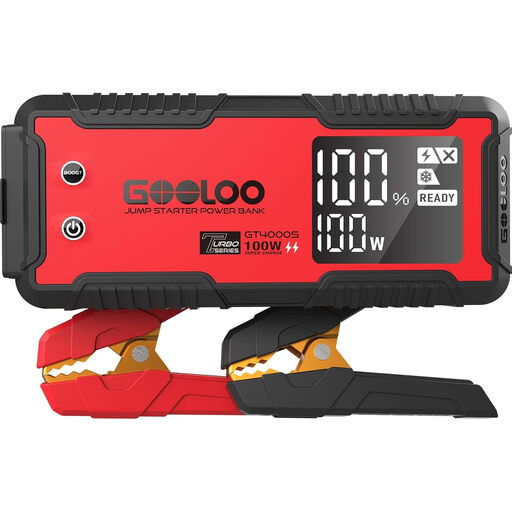
GOOLOO GT4000S 4000 Amp Jump Starter
Why it stands out: Its standout feature? Its 100?W two-way fast charging capability. According to GOOLOO, a full recharge takes only 1.2 hours, and just 5 minutes is enough to provide an emergency start.
Pros:
Who is it for? For owners of large vehicles (SUVs, trucks, motorhomes, boats) and professionals who demand a reliable, ultra-powerful tool that can be recharged in record time between jobs.
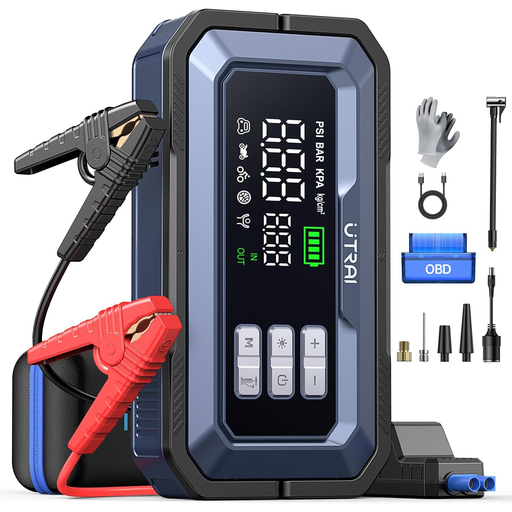
UTRAI JS-30 7000A Car Jump Starter with Air Pump
Why it stands out: It's much more than a simple jump starter: it's a true all-in-one emergency station. It includes an air compressor, an OBD2 fault code reader, a work light, and even a 160?W output.
Pros:
Who is it for? For road professionals, camping and outdoor activity enthusiasts, or any driver who wants to be prepared for (almost) any eventuality with a single device: battery, tyre, engine light...
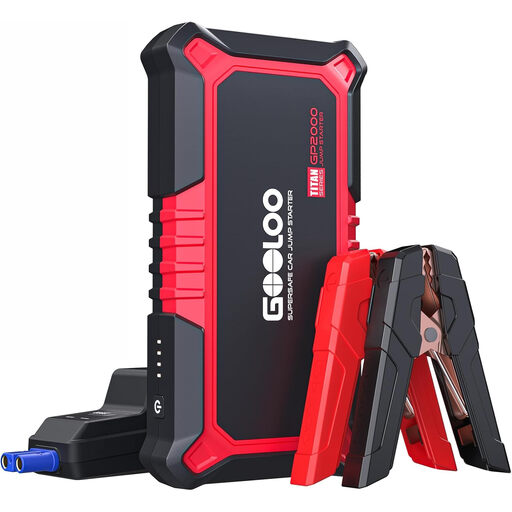
GOOLOO GP2000 Car Jump Starter and Power Bank
Why it stands out: It represents the perfect compromise between power, compact size, and price. It's the smart choice for the majority of drivers.
Pros:
Who is it for? For the everyday driver of a car, SUV, or motorcycle who is looking for a reliable, simple, and discreet portable car starter without unnecessary frills.
Our selection highlights three very different profiles, but the market is full of alternatives. Looking for different power levels, a tighter budget, or specific features? Don't hesitate to explore other options.
1. What power is needed for a diesel engine? Diesel engines are more power-hungry at startup. For a standard diesel car, a jump starter with at least 1500?A peak current is recommended. For vans, trucks, or large-displacement engines, it's better to look for models with 2500?A or more.
2. Does a jump starter replace a battery charger? Absolutely not. They are two complementary tools, but with very distinct roles. The battery jump starter is a sprinter: it delivers a very intense, brief burst of current to start the engine. The car battery charger, on the other hand, is a marathon runner: it recharges a battery deeply over several hours and can maintain its charge over the long term.
3. What is the standby life of a jump starter? Modern lithium models have very low self-discharge. Most can hold a useful charge for 6 to 24 months. However, it's good practice to check its charge level and top it up every 3 to 6 months. This ensures it will always be ready for use on the day you really need it.