
Livraison le jour même ou le lendemain

Qualité garantie

Débloquez vos offres de bienvenue: Livraison GRATUITE | Jusqu'à -80 % | 30 jours d'essai gratuits à JoyPlus
Téléchargez l'application
A flat battery can leave a city car, SUV, van or motorhome stranded at the worst possible time. A car battery booster lets you try to restart the vehicle without relying on another vehicle. Some models also double as a portable tyre inflator, power bank or emergency LED lamp.
However, the figures highlighted on the packaging are not enough to help you make the right choice. Here are the key points to check to avoid buying an unsuitable product and choose a 12 V battery booster that matches both your vehicle and how you use it.
The advertised current ratings — 3,000 A or 6,000 A, for example — generally refer to the peak current. On their own, they do not show how much power is actually available during starting. You should also check the stated compatibility with your engine size and engine type:
An impressive figure cannot make up for insufficient compatibility with your vehicle.
A maximum pressure of 150 PSI may sound impressive, but it says nothing about how quickly the compressor will inflate a tyre. Airflow, expressed in L/min, matters just as much. A 35 L/min compressor and a 45 L/min model will not inflate at the same speed.
For tyres, also check whether the product has a display, automatic shut-off and units that match the manufacturer’s recommendations. The recommended pressure can be found in the vehicle handbook, on the door pillar label or near the fuel filler flap.
A car jump starter is not a device you can simply forget about in the boot for several years. Manufacturers generally recommend recharging it regularly, often every two to four months depending on the model. Prolonged heat inside the vehicle during summer, as well as cold temperatures, can temporarily reduce the performance of its lithium battery.
Before buying, check the following:
Most of the portable models featured here are designed for 12 V vehicles. This voltage is suitable for many cars, motorbikes, SUVs and small vans, but that does not mean the device is compatible with every vehicle.
Compare your engine size with the capacity supported by the manufacturer. For the same engine size, a diesel engine often requires more current to start than a petrol engine. For a commercial vehicle, motorhome or large-engine vehicle, it is best to keep a safety margin.
Capacity, expressed in mAh, mainly indicates the available runtime for car power bank functions, the lamp or the compressor. It is not enough to estimate how many starts are possible. Instead, consider all of the following:
A car battery charger connected to the mains remains better suited to regularly maintaining the battery than a portable booster. The latter is primarily intended as an emergency solution.
A booster with compressor can reduce the number of accessories you need to carry, but it will generally be heavier than a standard portable car jump starter. For regular use, check the weight, cable length and how easily you can access the battery terminals.
The advertised electronic protections are safety features, not a reason to ignore the instructions. You should always:
Do not use the device with a damaged, leaking or frozen battery. Keep it away from water and flammable materials, and never use damaged cables. When buying in France, choose a product with clear instructions, transparent warranty information, and the relevant safety markings and information.
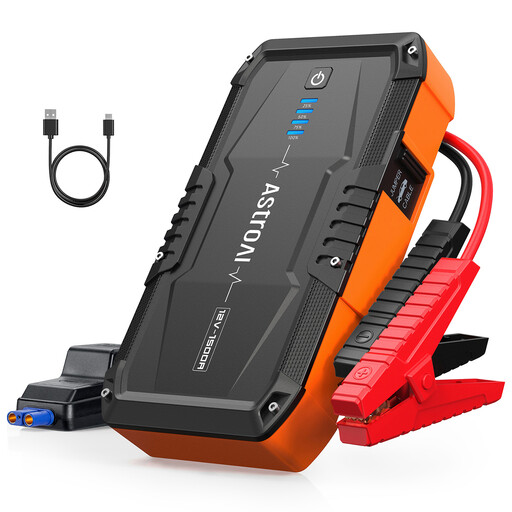
Why this choice suits this profile: Its compact design is ideal for a car, motorbike or small vehicle used every day.
The stated compatibility reaches 6.0 L for petrol engines and 3.0 L for diesel engines, helping you avoid choosing an oversized device for a small car.
Advertised peak current of 1,500 A, integrated protection, three-mode lamp and two USB charging functions.
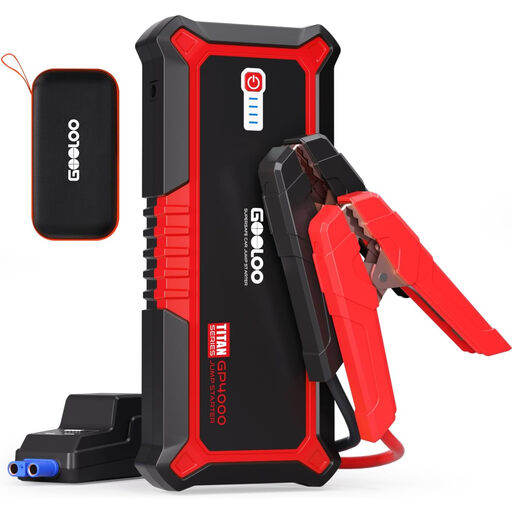
Why this choice suits this profile: Its advertised power and USB outputs meet the needs of drivers who cover long distances or carry several devices.
The product details confirm 12 V compatibility, support for diesel engines up to 10.0 L, and recommend recharging every two to three months.
Advertised peak current of 4,000 A, USB and USB-C ports, 15 V output, ‘Boost’ button and storage case.
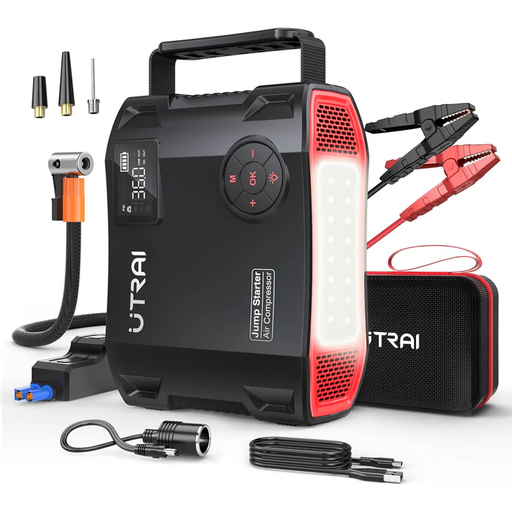
Why this choice suits this profile: This multifunctional model is aimed at SUV, van and motorhome drivers, as well as anyone who wants to power 12 V accessories.
The product details state an advertised airflow rate of 45 L/min, a maximum pressure of 150 PSI, automatic shut-off and pressure display.
Advertised peak current of 6,000 A, 27,000 mAh battery, DC output of up to 160 W, USB-C charging and 1,600-lumen LED light.
We have put together a complete, real-time updated list of products that meet these demanding selection criteria and European safety requirements.
It depends on the model. Some have a ‘Boost’ mode that can force a start when the detected voltage is very low. However, you must follow the instructions and check that the battery is not damaged. If the problem keeps recurring, a booster is no substitute for a mechanic’s diagnosis.
The time depends on the battery capacity, the charger used and the available port. A full initial charge is generally recommended before first use. To keep the device ready for use, follow the interval specified by the manufacturer and check its charge level before a long journey.
No. The compressor is used to reinflate a tyre or inflatable item, while a mains charger gradually recharges the vehicle battery. A booster combines an energy reserve with a temporary jump-start function. These devices therefore serve different purposes, but they can work perfectly well together.