
Livraison le jour même ou le lendemain

Qualité garantie

Débloquez vos offres de bienvenue: Livraison GRATUITE | Jusqu'à -80 % | 30 jours d'essai gratuits à JoyPlus
Téléchargez l'application
A flat battery or an under-inflated tyre can quickly turn an ordinary journey, a holiday departure or a campervan getaway into a real nightmare. A car battery booster with compressor combines several handy functions: jump-starting, tyre inflation, USB charging and emergency lighting.
However, spec sheets don’t always tell the full story. Flattering peak current figures, unrepresentative maximum pressure, advertised battery life without context… Here are the main pitfalls to avoid and the criteria to examine before buying a car battery booster.
A value of 3,000, 5,000 or 7,000 A is bound to catch your eye. Yet peak current alone isn’t enough to determine whether a booster will suit your vehicle. You also need to consider the maximum engine size stated, the fuel type and the circuit voltage.
A 12 V battery jump starter designed for a small petrol car won’t necessarily be up to the job for a diesel van, a large SUV or a campervan. For a diesel engine, carefully check the specific limit stated by the manufacturer.
Maximum pressure is primarily a theoretical value. For a tyre inflator intended for a car, the airflow rate, expressed in L/min, the continuous use time and the auto shut-off matter just as much.
A portable car compressor showing 150 PSI can be perfectly adequate for topping up a tyre. It won’t necessarily replace a workshop compressor for heavy-duty use. A display, a preset pressure and an auto shut-off make inflation easier and reduce the risk of over-inflation, provided you select the pressure recommended by your vehicle’s manufacturer.
A portable battery charger left forgotten in the boot won’t be any use if it doesn’t have enough power on the day you need it. Depending on the model, it’s generally advisable to recharge it every two to six months, even when not in use. The heat that builds up in a car parked in direct sunlight can also accelerate the battery’s ageing.
Before buying, check its capacity, its charging method, whether it has a USB-C cable and the recommended storage conditions. A car backup battery with a charge indicator lets you check its level before a long journey.
Start by identifying your engine’s characteristics:
A diesel jump starter must have sufficiently robust cables and protection against reverse polarity. Smart clamps with an alarm can indicate a poor connection, but they don’t replace the need to read the instruction manual carefully.
For an electric pump intended for tyres, compare at least:
A flow rate between 35 and 45 L/min can noticeably reduce the time needed to bring a tyre back to the correct pressure. However, always respect the usage limits stated by the manufacturer and avoid touching the hose immediately after inflation – it can get very hot.
Choose models that clearly detail their protections against short circuits, overload, overheating, overvoltage and reverse polarity. Also review the contents of the box: jump leads, air hose, adapters for bikes or balls, USB-C cable, carry case and manual in English, where available.
An emergency LED lamp offering a steady light, a flashing mode and an SOS signal can prove invaluable during a night-time breakdown. A 12 V output or a power bank for cars can power certain accessories, but check its maximum power before plugging in a cool box, a vacuum cleaner or a dash cam.
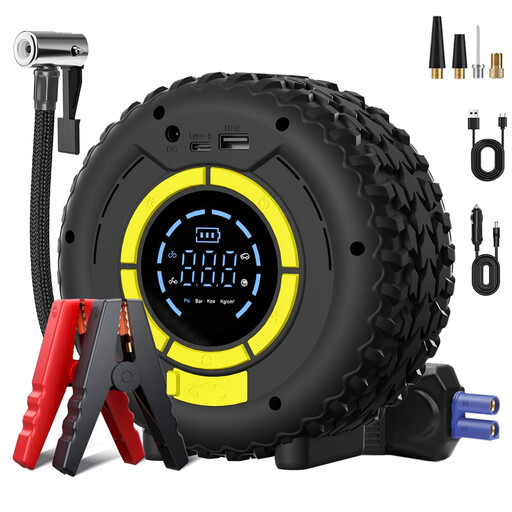
Why this choice suits this profile: With its stated weight of 600 g and essential functions, this model is ideal for motorists looking for a compact solution for everyday journeys.
The screen displays pressure and charge level, while the auto shut-off means you don’t have to watch the inflation constantly.
150 PSI compressor, five modes, four nozzles, LCD screen and USB output.
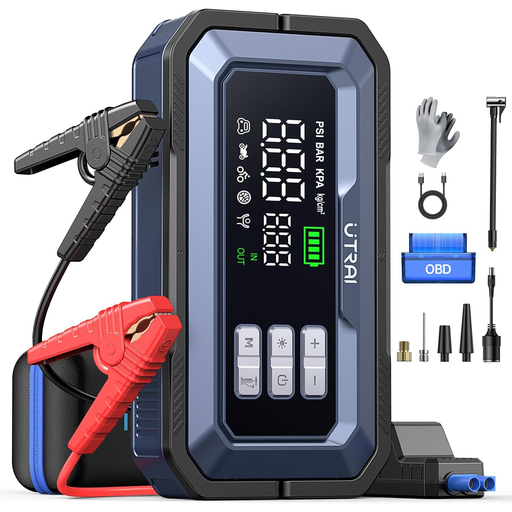
Why this choice suits this profile: This model is aimed at drivers of SUVs, vans and diesel vehicles who want to combine several functions in a single device.
The spec sheet states compatibility up to 14 L for diesel, along with protection against reverse polarity, overheating and overcharging.
Stated peak current of 7,000 A, 150 PSI compressor, 160 W 12 V output and included OBD2 adapter.
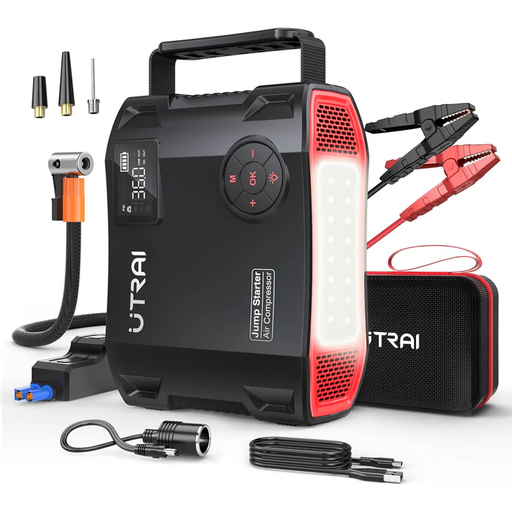
Why this choice suits this profile: Its stated flow rate of 45 L/min, 12 V output and 27,000 mAh capacity make it a great companion for travel, campervan trips and drivers who spend a lot of time on the road.
The screen shows the charge level and pressure in real time, with preset and auto shut-off for the compressor.
Up to 10 L for diesel according to the spec sheet, 45 L/min flow rate, 160 W DC output, 1,600 lumen LED lamp and hard case.
We’ve put together a comprehensive selection, updated in real time, of products that meet these demanding criteria as well as European safety regulations.
Yes, but avoid extreme temperatures, humidity and direct sunlight. Keep it in its case and recharge it regularly. During periods of intense heat, it’s better to store it in a temperate place if the car is parked for a long time.
Compare your engine’s size with the limit stated by the manufacturer for diesel engines. A model designed for 10 L or 14 L offers wider compatibility than a device limited to 3 L or 5 L. However, you must still follow the connection instructions and the minimum required charge level.
The inflation speed depends mainly on the airflow rate, the initial pressure and the tyre volume. So check the L/min value as well as the recommended continuous use time. The auto shut-off at the preset pressure makes the operation more convenient, but the final pressure should always be checked with a reliable gauge.